Digitalowl
- Home
- Why Beginners Should Build Small Projects Before Learning Everything
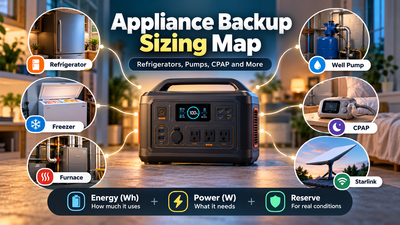
- What to Power First During a 72-Hour Blackout
Recent posts
-
1,000Wh vs 2,000Wh Power Station: What Changes in Real Use?
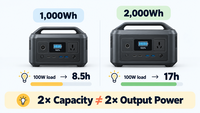
A 2,000Wh portable power station stores approximately twice as much energy as a 1,000Wh model. But twice the battery capacity does not automatically mean twice the output power, faster charging or better performance in every situation. The most significant difference is how long the station can support connected equipment. A larger battery may keep a refrigerator running longer, provide more reser…
- batteries
- electricity
- +4
-
Decision Tools for Energy Storage: Turning Battery Specs Into Better Choices
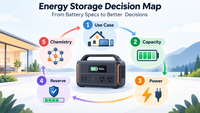
A portable power station may advertise 2,000Wh of battery capacity, 2,400W continuous output, 4,000 charge cycles and multiple charging options. Every specification provides useful information, but none independently tells you whether the system is suitable for a particular application. The real challenge is not finding more battery specifications. It is turning technical measurements into practic…
- battery
- energy
- +5
-
How Much Battery Capacity Does a Well Pump Need?
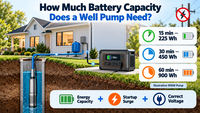
A well pump can provide essential household water during a power outage, but running it from a battery requires more than matching the pump's wattage to a portable power station. Well pumps can demand substantial startup power even when their total daily energy consumption is relatively modest. The battery capacity you need depends on the pump's actual electrical input, operating time, water cons…
- battery
- energy
- +5
-
Does Fast Charging Shorten Battery Life?
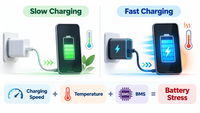
Fast charging is convenient, but does it damage a battery or make it wear out faster? The answer depends on charging power, battery chemistry, temperature, state of charge and how the battery management system controls the process. Faster charging can increase stress inside battery cells, but it does not automatically cause significant damage every time it is used. Modern smartphones, electric veh…
- batteries
- blackout
- +3
-
Battery Capacity Decision Map: Which Specification Should You Check Next?
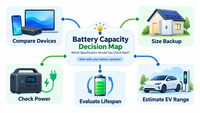
Battery Capacity Decision Map: Which Specification Should You Check Next? Choosing a battery becomes much easier when you know which specification answers your actual question. Battery capacity, usable energy, power output, runtime, cycle life and charging performance are related, but they are not interchangeable. Looking at the wrong number can lead to buying too little capacity, paying for unnec…
- blackout
- electricity
- +3
-
How Much Battery Capacity Does a Home Office Need?
A home office looks simple from a backup-power perspective. A laptop, monitor, router and phone charger seem like small loads compared with appliances such as air conditioners or heaters. But home-office battery sizing still depends on one thing many people underestimate: how long all of those devices need to stay powered together. A 60 W laptop running for one hour is a small energy load. The sam…

- batteries
- electricity
- +4
-
How Much Battery Capacity Does a Refrigerator Need?
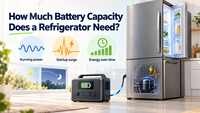
A refrigerator looks like a simple backup load. Check its wattage, multiply by the number of hours you want it to run, and choose a battery. In practice, refrigerators are more complicated because the compressor does not normally run continuously. A refrigerator may consume power for several minutes, stop after reaching the target temperature, and start again later. Each compressor start can also …
- batteries
- electricity
- +4
-
Portable Power Station Capacity Explained
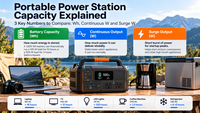
Portable power stations are often compared by one large number on the product page. Sometimes it is 500 Wh, 1,024 Wh or 2,048 Wh. That number matters, but it does not tell you everything the power station can do. To understand whether a portable power station fits a real use case, you need to separate three specifications: Battery capacity in Wh → Continuous output in W → Surge output in W Capacit…
- batteries
- electricity
- +4
-
Battery Charging and Solar Recharging: From Input Watts to Stored Energy
Battery capacity tells you how much energy a battery can store. Charging tells you how quickly — and under what conditions — that stored energy can be replaced. Those two sides of the system are closely connected, but they are not the same thing. A large battery can charge slowly. A smaller battery can charge quickly. A powerful solar array may still be limited by the battery system's input electr…

- batteries
- portable-power-stations
- +2
-
What Are Solar Input Limits?
Adding more solar panels seems like the obvious way to charge a battery faster. Sometimes it works. Sometimes it does almost nothing. The difference often comes down to solar input limits — the electrical boundaries that determine how much solar power a battery system, charge controller or portable power station can actually accept. These limits are usually defined by three numbers: maximum input …

- batteries
- electricity
- +3
-
What Are Peak Sun Hours?
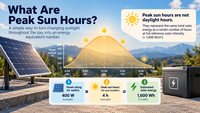
Peak sun hours are a way to convert changing sunlight throughout a day into a simple energy-equivalent number. They do not mean the number of hours between sunrise and sunset. Instead, one peak sun hour represents the same solar energy as receiving approximately full reference solar irradiance for one hour. This makes peak sun hours useful for estimating how much energy a solar panel or solar arra…
- batteries
- blackout
- +3
-
What Is Expandable Battery Capacity?
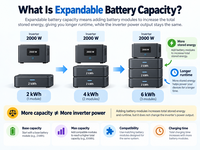
Expandable battery capacity means that an energy-storage system can increase its total stored energy by adding compatible battery modules. A system might begin with one battery and later support one or more expansion batteries. The result is usually more watt-hours or kilowatt-hours of stored energy and therefore potentially longer runtime. But there is an important limitation: Adding battery capa…
- blackout
- electricity
- +2
-
Lithium-Ion vs Lead-Acid Batteries
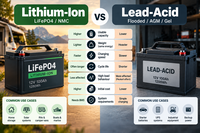
Lithium-ion and lead-acid batteries can both store electrical energy, but the same capacity label does not mean they will behave the same way in real use. The differences become especially important when comparing usable energy, weight, charging behaviour, cycle life and performance under higher loads. There is also an important terminology point: lithium-ion is not one single chemistry. LiFePO4 a…
- batteries
- blackout
- +3
-
LiFePO4 vs NMC
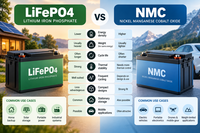
LiFePO4 and NMC are two common lithium-ion battery chemistries, but they are optimized around different priorities. One tends to emphasize long cycle life and thermal stability, while the other can offer higher energy density when size and weight matter. That does not make either chemistry universally better. The useful question is: Which trade-offs matter most for the application? Before comparin…
- batteries
- electricity
- +1
-
Depth of Discharge and Cycle Life
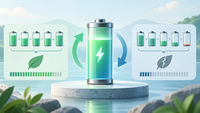
How deeply a battery is discharged can influence how quickly it ages. This relationship is often simplified into advice such as “never discharge a battery below 20%” or “use only 80% of its capacity.” Those rules can sometimes be useful as practical guidelines, but they are not universal laws. Battery chemistry, cell design, temperature, charge rate, discharge rate and the manufacturer’s operating…
- batteries
- electricity
- +4
-
What Is Calendar Aging?
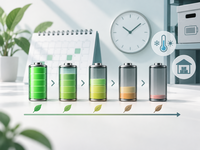
A battery can lose capacity even when it is barely being used. That may sound surprising because battery wear is often associated with charging and discharging. But cycling is only one part of battery degradation. Chemical reactions continue inside many batteries while they sit in storage, remain installed in a device or spend long periods at a particular state of charge. This time-dependent degra…
- batteries
- blackout
- +3
-
What Is C-Rate?
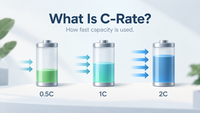
C-rate is a way to describe how quickly a battery is being charged or discharged relative to its rated capacity. It makes current easier to compare across batteries of different sizes because the rate is expressed as a proportion of the battery's own capacity rather than only as amps. A C-rate does not tell you how much energy a battery stores. It tells you how aggressively that stored capacity is…
- blackout
- electricity
- +2