What Is Calendar Aging?
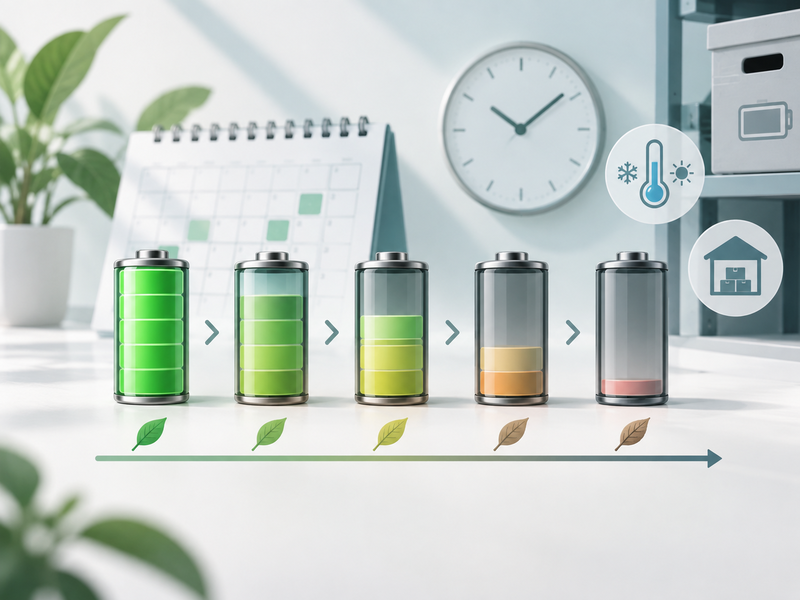
A battery can lose capacity even when it is barely being used.
That may sound surprising because battery wear is often associated with charging and discharging. But cycling is only one part of battery degradation. Chemical reactions continue inside many batteries while they sit in storage, remain installed in a device or spend long periods at a particular state of charge.
This time-dependent degradation is called calendar aging.
Understanding it helps explain why an old battery with a low cycle count may still perform noticeably worse than it did when it was new.
For the broader foundation behind battery capacity, including mAh, Ah and Wh, see:
https://medium.com/@volodymyrzh/battery-capacity-explained-mah-wh-amp-hours-decoded-1dc676be5a38
Calendar Aging Is Aging With Time
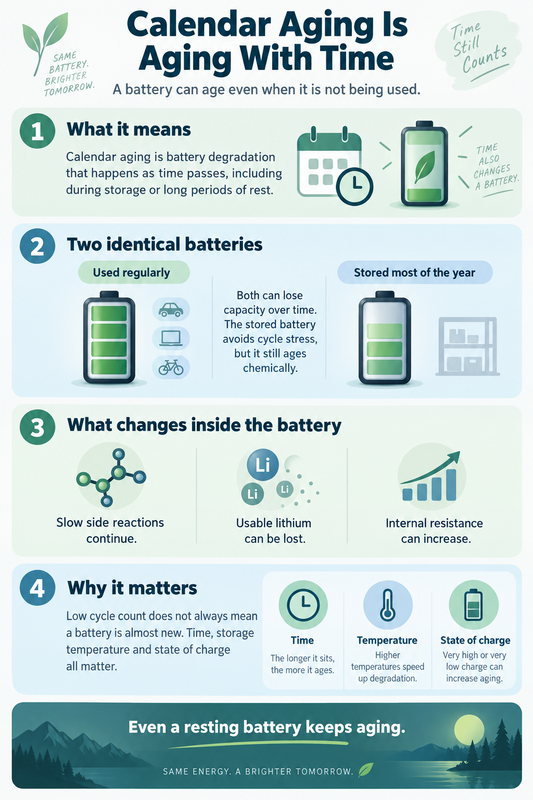
Calendar aging describes battery degradation that occurs as time passes, including during periods when the battery is not actively cycling.
Imagine two identical batteries manufactured on the same day.
One is used regularly. The other spends most of the year sitting in storage.
The stored battery avoids much of the stress associated with repeated charging and discharging, but that does not mean it remains chemically frozen in its original condition.
Slow side reactions can continue inside the cell. Over months and years, they can contribute to loss of usable lithium, changes in electrode interfaces and increased internal resistance.
The result can be lower usable capacity and reduced performance even if the battery has completed relatively few cycles.
Calendar Aging vs Cycle Aging
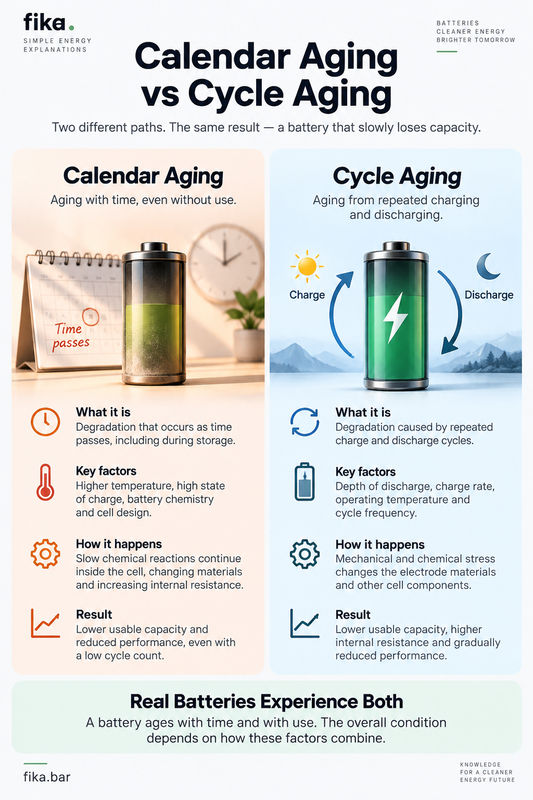
Calendar aging and cycle aging are related, but they describe different parts of battery degradation.
Cycle aging occurs primarily as the battery is repeatedly charged and discharged.
Calendar aging continues with time, including while the battery is resting.
A real battery normally experiences both.
A smartphone battery may complete hundreds of partial charge cycles while also aging every day simply because time is passing. A backup battery may complete very few cycles but spend years sitting at a particular temperature and state of charge.
The overall condition of either battery is therefore the result of multiple degradation processes rather than cycle count alone.
The broader reasons batteries lose capacity over time are explained here:
https://digitalowl.fika.bar/why-batteries-lose-capacity-over-time-01M2Z5S6B6REX9ZM18HDCS7SGV
Temperature Can Strongly Affect Calendar Aging
Storage temperature is one of the most important variables affecting calendar aging.
Higher temperatures generally accelerate chemical reactions. That includes unwanted reactions that contribute to battery degradation.
This means a battery stored for a year in a hot environment may not age in the same way as an otherwise identical battery stored for the same year under moderate conditions.
The exact effect depends on chemistry, cell design and other conditions, so there is no universal rule that can safely be applied to every battery.
Temperature can also affect batteries in two different ways.
Cold temperatures may temporarily reduce available power or capacity during use. Heat, by contrast, can contribute to faster long-term degradation.
That distinction matters because temporary temperature-related performance loss should not automatically be interpreted as permanent capacity loss.
For a deeper explanation of this difference:
https://digitalowl.fika.bar/how-temperature-affects-battery-capacity-01M2TH5RCYRERSTQCFZ39M5J2N
State of Charge During Storage Matters Too
Temperature is not the only important storage condition.
For many lithium-ion batteries, spending long periods at a very high state of charge can increase calendar-aging stress.
A battery sitting close to its upper voltage limit is operating under different electrochemical conditions from one stored at a more moderate state of charge. Over long periods, those conditions can affect the rate of side reactions inside the cell.
This does not mean charging to 100% instantly damages a battery.
It also does not mean that one storage percentage is universally correct for every battery chemistry, device or application.
The important point is that storage state of charge can influence aging rate.
Manufacturer recommendations should take priority when a battery is going to be stored for a long period, especially in specialised equipment, vehicles or large energy-storage systems.
Heat and High State of Charge Can Interact
Battery-aging factors do not always act independently.
For example, high state of charge may create one form of stress, while elevated temperature accelerates the reactions associated with that stress.
A battery stored fully charged in a hot environment can therefore experience a very different aging profile from the same battery stored under moderate temperature and voltage conditions.
This is why battery-life estimates should avoid treating temperature, state of charge and time as completely separate variables.
Real degradation often reflects their interaction.
That also creates an important challenge when using battery-performance data for energy planning. A capacity figure measured under one temperature, storage history or operating condition may not translate perfectly to another environment.
A broader look at building useful temperature-aware battery datasets and energy-planning resources is available here:
Low Cycle Count Does Not Mean a Battery Is New
Cycle count can be useful, but it does not tell the whole story.
Consider a battery that is five years old but has completed only 100 cycles. Compare it with a one-year-old battery that has completed the same 100 cycles.
Their cycle counts are identical.
Their aging histories are not.
The older battery has experienced several additional years of calendar aging. Its storage temperature, average state of charge and chemistry may therefore become important when assessing its remaining capacity or overall state of health.
This is particularly relevant for backup power systems, seasonal equipment, stored electronics and vehicles that spend long periods parked.
Calendar Aging Is Not the Same for Every Battery
There is no single calendar-aging rate that applies to all batteries.
Chemistry matters. Electrode materials matter. Electrolyte formulation, manufacturing quality, storage temperature, state of charge and cell design can all influence the result.
Even two batteries using the same broad chemistry may age differently if their designs or storage histories differ.
For that reason, statements such as “lithium batteries lose X% every year” should be treated as approximations unless the conditions and battery type are clearly defined.
A useful calendar-life claim should ideally tell you what battery was tested, at what temperature, at what state of charge and for how long.
Without those details, a percentage can create more confidence than the evidence actually supports.
Time Is Part of Battery Health
Battery aging is not measured only in cycles.
A battery starts accumulating calendar age from the time chemical degradation processes begin, and those processes continue during storage as well as use.
That is why a realistic view of battery lifespan needs to consider at least three dimensions: time, usage and operating conditions.
Cycle count tells you something about use.
Calendar age tells you something about time.
Temperature, state of charge and other conditions help explain how stressful that time may have been.
Looking at them together gives a much clearer picture of why two batteries of the same age can have very different remaining capacity.
Comments
No comments yet. Be the first to comment!