Why Beginners Should Build Small Projects Before Learning Everything
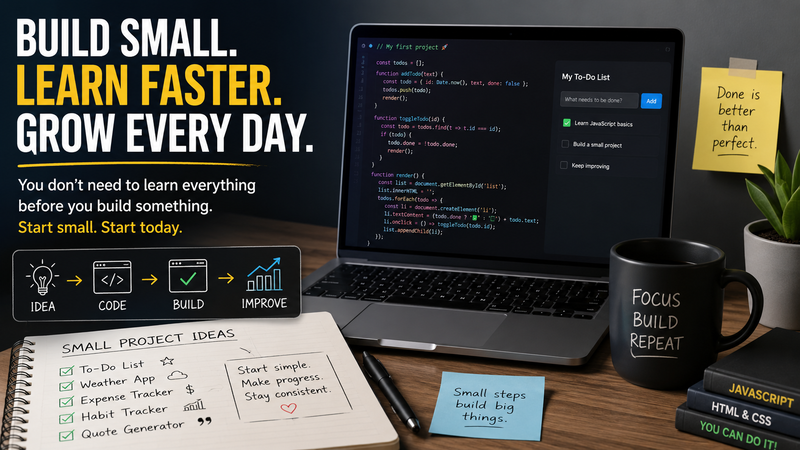
Many beginners think they need to learn a huge amount of theory before they can build anything useful. They wait until they understand every programming concept, every command, every framework, and every best practice. On the surface, this sounds responsible. In reality, it often slows them down.
Programming is not something you fully understand by reading about it. You understand it by using it.
Small projects help beginners move from passive learning to active problem-solving. They turn abstract ideas into something visible, testable, and practical. Instead of asking, “Do I understand programming yet?” a beginner can ask, “Can I make this small thing work?”
That question is much more useful.
Small Projects Make Programming Feel Real
When you are learning to code, tutorials can feel clear while you are watching them. The instructor writes the code, explains each step, and the final result works. But when you open your own editor, the experience is different. You forget syntax. You make mistakes. You do not know where to start.
That is normal.
Small projects are useful because they create real contact with the process. You are no longer just consuming explanations. You are making decisions, testing ideas, fixing errors, and seeing how code behaves.
A small project can be something very simple:
a calculator;
a to-do list;
a personal homepage;
a basic contact form;
a random quote generator;
a simple budget tracker;
a small script that renames files;
a page that changes color when you click a button.
These projects may look basic, but they teach important habits. You learn how to break a problem into parts, how to search for answers, how to debug, and how to improve something step by step.
You Do Not Need to Know Everything to Start
One of the biggest beginner traps is waiting for confidence before building. The problem is that confidence usually comes after building, not before it.
You do not need to understand every advanced concept before creating a small working project. You do not need to master algorithms before making a simple web page. You do not need to know every JavaScript method before building a tiny interactive tool.
You only need enough knowledge to take the next step.
For example, if you want to build a to-do list, you can learn only what you need for that project:
how to create an input field;
how to add a button;
how to store a task in a list;
how to display that list on the page;
how to remove a task;
how to save progress if needed.
This kind of learning is focused. Instead of studying everything in a random order, the project gives your learning a reason.
Small Projects Reveal What You Actually Need to Learn
A common beginner problem is not knowing what matters. Programming has too many topics: variables, functions, loops, arrays, objects, APIs, databases, frameworks, deployment, version control, testing, security, and more.
Trying to learn everything at once can feel overwhelming.
A small project filters the noise. It shows you which concepts matter right now. If your project needs a button, you learn event handling. If it needs saved data, you learn local storage or a simple database. If it needs information from another service, you learn APIs.
This makes learning more natural.
Instead of memorizing concepts with no context, you learn them because your project needs them. That makes the knowledge easier to remember and easier to use later.
Mistakes Become Part of the Learning Process
Many beginners are afraid of errors. They see error messages as proof that they are bad at coding. But errors are not a sign that you are failing. They are part of how programming works.
Small projects give you a safer place to make mistakes.
If you break a small calculator, you can fix it without panic. If your to-do list stops working, you can inspect the problem. If your layout looks wrong, you can adjust it. The project is small enough that the mistakes are manageable.
This is important because debugging is one of the most valuable programming skills. You learn to read error messages, test assumptions, isolate problems, and change one thing at a time.
A beginner who builds small projects learns not only how to write code, but also how to recover when code does not work.
AI Makes Small Projects Even More Useful
Today, beginners have a major advantage: they can use AI tools to move from idea to first prototype much faster. This does not mean AI replaces learning. It means AI can help reduce the blank-page problem.
Instead of staring at an empty file, a beginner can ask for a simple structure, an explanation, a debugging hint, or a step-by-step improvement. This makes it easier to start building before fully understanding everything.
One reason beginners can start building earlier today is that AI-assisted coding changes the learning path. You do not need to understand every concept before creating your first working prototype. This guide explains how vibe coding helps you start writing code faster than you think:
https://medium.com/@volodymyrzh/vibe-coding-how-you-start-writing-code-faster-than-you-think-0f87879ca954
The important thing is to use AI actively, not passively. Do not just copy the answer and move on. Ask why the code works. Change it. Break it. Fix it. Add one feature. Remove another. Compare versions.
That is where learning happens.
A Small Project Gives You Motivation
Learning theory without a visible result can become boring. You may study for days and still feel like you have nothing to show. A small project changes that.
Even a very simple project gives you proof of progress. You can open it, click it, test it, show it to someone, or improve it tomorrow. That visible result matters.
Motivation grows when you see that your effort creates something real.
A beginner who builds a small weather widget, habit tracker, portfolio page, or expense calculator starts to feel ownership. The project may not be perfect, but it is theirs. That feeling is powerful because it turns programming from a subject into a tool.
Small Projects Teach Problem-Solving Better Than Perfect Courses
Courses are useful, but they often create a false sense of progress. You can complete lessons, watch videos, and take notes without actually becoming comfortable solving problems alone.
Projects force you to think differently.
When building something, you have to answer practical questions:
What should happen first?
What data do I need?
What should the user see?
What happens if the user makes a mistake?
How do I know the feature works?
What can I simplify?
What should I build next?
These questions are closer to real programming than memorizing definitions. They help you develop the mindset of a builder.
Start Smaller Than You Think
Many beginners choose projects that are too big. They want to build a full social network, marketplace, game, AI app, or complex dashboard as their first attempt. Ambition is good, but oversized projects can quickly become frustrating.
A better approach is to shrink the idea.
Instead of building a full budgeting app, build a simple expense list.
Instead of building a complete e-commerce site, build one product card with an “add to cart” button.
Instead of building a full blog platform, build one page that displays posts from a small data file.
Instead of building a complex game, build one simple interaction.
Small does not mean useless. Small means finishable.
A finished small project teaches more than an abandoned huge project.
How to Choose Your First Small Project
The best beginner project is simple, practical, and slightly interesting to you. It should be small enough to finish, but not so boring that you lose interest.
A good first project should have:
one clear purpose;
a visible result;
only a few features;
room for improvement;
a problem you can understand;
no complicated setup at the beginning.
For example, a personal reading tracker can start with only three fields: book title, author, and status. Later, you can add filters, ratings, notes, or saved data. The project grows with your skills.
That is the ideal pattern: start simple, then improve.
Build, Then Learn Deeper
Building small projects does not mean ignoring theory. It means changing the order.
Instead of learning everything first and building later, you build something small and then study the concepts behind it. This makes theory easier to understand because you already have practical experience.
For example, after building a simple interactive page, you can go back and learn more about functions, events, arrays, and DOM manipulation. Those concepts will make more sense because you have already seen them in action.
This creates a useful loop:
Build something small.
Notice what you do not understand.
Study that concept.
Improve the project.
Start another small project.
That loop is much stronger than endless preparation.
Conclusion
Beginners should build small projects before learning everything because programming is a practical skill. You learn by doing, testing, failing, fixing, and improving.
Small projects make coding feel real. They reveal what you need to learn. They make mistakes less scary. They give you motivation and visible progress. They also help you use AI tools in a more active and educational way.
You do not need to know everything before you start. You need a small idea, a simple goal, and the willingness to make something imperfect.
That is how beginners become builders.
Comments
No comments yet. Be the first to comment!