How Much Battery Capacity Does a Refrigerator Need?
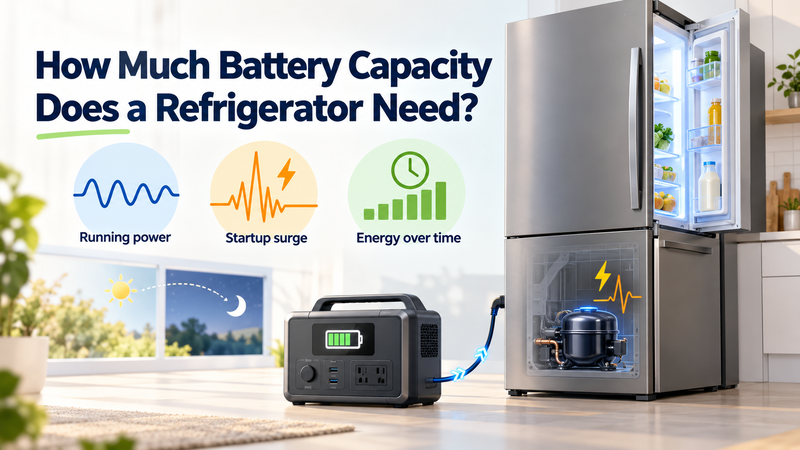
A refrigerator looks like a simple backup load. Check its wattage, multiply by the number of hours you want it to run, and choose a battery.
In practice, refrigerators are more complicated because the compressor does not normally run continuously.
A refrigerator may consume power for several minutes, stop after reaching the target temperature, and start again later. Each compressor start can also create a short power surge that is much higher than normal running consumption.
That means refrigerator backup requires checking three separate things:
running power → startup surge → energy consumed over time
Battery capacity mainly answers the third question. The inverter must also be capable of handling the first two.
For the broader battery-capacity framework:
https://medium.com/@volodymyrzh/battery-capacity-explained-mah-wh-amp-hours-decoded-1dc676be5a38
Start With the Refrigerator, Not a Generic Wattage
There is no single wattage that represents every refrigerator.
A compact efficient refrigerator, an older full-size model, a fridge-freezer and a large multi-door appliance can have very different consumption patterns.
The best starting points are therefore:
the appliance label
the manufacturer's specifications
or, ideally,
a plug-in energy meter measuring the actual refrigerator
This is more reliable than using a generic number found in a sizing chart.
The purpose of an example calculation is to explain the method — not to predict the consumption of every refrigerator.
Running Watts Tell You What Happens When the Compressor Is On
Suppose an example refrigerator draws approximately 100 W while its compressor is running.
That does not mean it consumes:
100 W × 24 h = 2,400 Wh/day
because the compressor may operate only part of the time.
The 100 W figure describes power while the appliance is actively running.
Battery sizing requires energy over time.
That distinction is fundamental:
watts (W) = power
watt-hours (Wh) = energy
The broad battery concepts are covered here:
https://medium.com/@volodymyrzh/battery-capacity-explained-mah-wh-amp-hours-decoded-1dc676be5a38
Duty Cycle Changes the Energy Calculation
The compressor cycles on and off according to temperature, thermostat settings and operating conditions.
The percentage of time it operates is sometimes described as its duty cycle.
Imagine our 100 W refrigerator runs, on average, for 40% of an hour.
Its approximate average power over that period becomes:
100 W × 0.40 = 40 W average
Across 24 hours:
40 W × 24 h = 960 Wh
So a refrigerator rated around 100 W while running could, under those illustrative conditions, consume roughly:
960 Wh per day
But 40% is only an example.
Real duty cycle can change substantially.
What Changes Refrigerator Duty Cycle?
Several factors affect how often the compressor needs to run:
room temperature;
refrigerator temperature setting;
appliance efficiency;
insulation quality;
refrigerator age;
how often the door is opened;
quantity and temperature of food placed inside;
ventilation around the appliance;
freezer compartment behaviour.
A refrigerator in a cool room may need much less compressor runtime than the same appliance in a hot room.
This is why measured daily energy consumption is often more useful for battery sizing than running wattage alone.
Use Measured Wh When Possible
If an energy meter shows that your refrigerator used:
850 Wh over 24 hours
you already have a strong starting point for battery sizing.
For 12 hours of similar operation, an initial estimate might be roughly:
850 Wh ÷ 2 = 425 Wh
For 24 hours:
≈850 Wh
For 48 hours:
≈1,700 Wh
Real consumption may vary between days, so these figures should still include a margin.
The general runtime relationship is explained here:
https://digitalowl.fika.bar/battery-runtime-formula-01M2JVJ0DBC2706XRP728QTZQ3
Battery Capacity Must Be Larger Than Refrigerator Consumption
If the refrigerator is expected to consume 850 Wh, a battery advertised as exactly 850 Wh should not automatically be considered sufficient.
The power path may include:
battery → inverter → refrigerator
Energy is lost during conversion, and the battery system itself may consume some power.
There may also be a difference between nominal battery capacity and the energy actually available at the AC outlet.
A practical planning model is:
refrigerator energy requirement + conversion losses + reserve = target battery capacity
Suppose you expect the refrigerator to use around:
850 Wh
If the complete system requires additional capacity for losses and reserve, the resulting target could move above 1 kWh.
The exact margin should depend on the actual battery, inverter and operating conditions rather than a universal percentage.
Startup Surge Is a Different Problem
A refrigerator compressor can briefly require much more power when starting than it consumes while running.
For example, an appliance might operate at around:
100 W running power
but briefly require several times that amount at compressor startup.
This short peak is not primarily a battery-capacity problem.
It is an inverter output problem.
A battery may contain enough Wh to keep the refrigerator running for an entire day but still fail to start the compressor if the inverter cannot support the startup surge.
The difference between these two specifications is explained here:
https://digitalowl.fika.bar/starting-watts-vs-running-watts-01M2K3FNMK1HM1FQDAYVFRT1PM
Always check the actual appliance and inverter specifications rather than assuming a fixed surge multiplier.
Capacity and Power Must Pass Two Different Tests
A refrigerator backup system should therefore pass two independent checks.
Energy test
Does the battery contain enough usable Wh to run the refrigerator for the required time?
Power test
Can the inverter support both:
normal compressor running power
and:
the short startup surge?
Passing only one test is not enough.
A very large battery with a small inverter can still fail to start the refrigerator.
A powerful inverter connected to a small battery may start it easily but provide very little runtime.
A Simple 24-Hour Example
Consider an illustrative refrigerator that has measured daily consumption of:
900 Wh/day
You want approximately 24 hours of backup.
The starting energy requirement is therefore:
≈900 Wh
Now allow for conversion losses and reserve.
The practical target may move into roughly the 1.1–1.3 kWh range, depending on the battery system and the amount of reserve you want.
At the same time, suppose the refrigerator runs at around 120 W but has a short startup demand considerably above that.
The battery system must therefore satisfy both:
enough usable energy for roughly 900 Wh of refrigerator consumption
and:
enough inverter surge capability to start the compressor
The capacity figure alone cannot answer both questions.
Longer Outages Scale the Energy Requirement
If daily refrigerator consumption is approximately 900 Wh, then a simplified multi-day calculation becomes:
1 day ≈ 0.9 kWh
2 days ≈ 1.8 kWh
3 days ≈ 2.7 kWh
before system losses and reserve.
But this assumes no meaningful recharging.
If solar, generator charging or intermittent grid power replenishes the battery during the outage, the required stored reserve may be lower.
The broader home-backup sizing approach is covered here:
Refrigerator Plus Other Loads Changes the Calculation
A refrigerator is rarely the only device using a home-backup battery.
You may also need:
router
lights
phone charging
laptop
freezer
heating controls
If the refrigerator requires 900 Wh during the planned backup period and the other essential loads require another 1,200 Wh, the system should be sized around the combined energy demand:
900 Wh + 1,200 Wh = 2,100 Wh
before losses and reserve.
You must also consider simultaneous power demand.
The refrigerator compressor might start while another appliance is already operating.
This is why real-world load profiles can change battery-storage sizing even when the total Wh calculation looks straightforward:
Measure First When the Refrigerator Is Important
If refrigerator operation is a critical part of your backup plan, measuring the appliance is usually better than relying on generic assumptions.
A practical process is:
1. Measure energy consumption for at least a representative period.
Preferably capture normal household use rather than an unusually quiet day.
2. Record Wh or kWh consumed.
This gives you the actual energy requirement.
3. Check running power.
This helps determine normal inverter load.
4. Check startup behaviour.
Use appliance specifications or suitable measurement equipment to understand compressor startup demand.
5. Decide required backup duration.
12 hours, 24 hours and several days create very different battery requirements.
6. Add losses and reserve.
Do not assume nominal battery capacity equals energy delivered to the refrigerator.
7. Include other essential loads.
Home backup is normally a system calculation, not a single-appliance calculation.
The Refrigerator Needs Both Energy and Starting Power
The most important distinction is simple:
Battery capacity determines how long the refrigerator can potentially operate.
Inverter output determines whether the refrigerator can operate and start its compressor.
And duty cycle connects the two.
Instead of calculating:
running watts × 24 hours
use actual measured energy whenever possible.
Then verify that the backup system can handle the compressor's startup demand.
That produces a much more realistic refrigerator backup estimate than choosing a battery from a generic wattage table.
Comments
No comments yet. Be the first to comment!