Lithium-Ion vs Lead-Acid Batteries
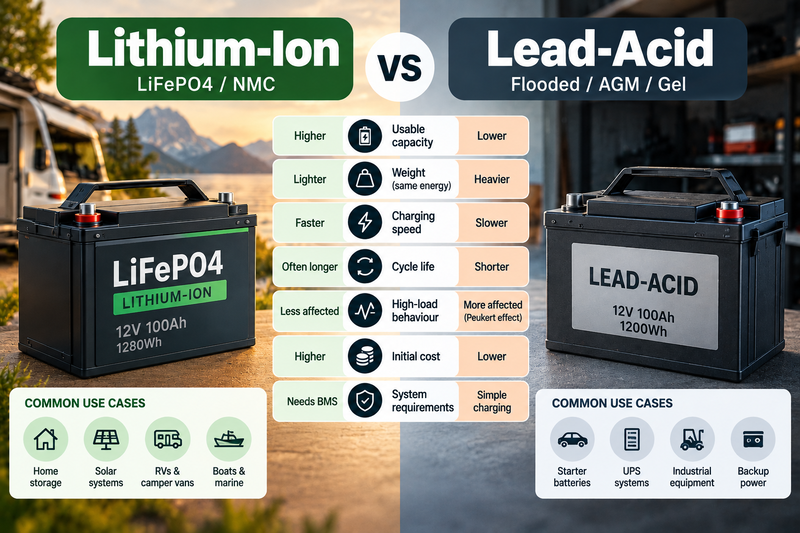
Lithium-ion and lead-acid batteries can both store electrical energy, but the same capacity label does not mean they will behave the same way in real use.
The differences become especially important when comparing usable energy, weight, charging behaviour, cycle life and performance under higher loads.
There is also an important terminology point: lithium-ion is not one single chemistry. LiFePO4 and NMC, for example, are both lithium-ion batteries with different characteristics. A broader explanation of battery capacity, including Ah and Wh, is available here:
https://medium.com/@volodymyrzh/battery-capacity-explained-mah-wh-amp-hours-decoded-1dc676be5a38
Lithium-Ion and Lead-Acid Are Different Battery Families
Lead-acid batteries use lead-based electrodes and a sulfuric-acid electrolyte. The technology has been used for more than a century and remains common in starter batteries, backup systems and applications where low initial cost matters.
Lithium-ion batteries use lithium-based cell chemistries. Two examples already covered in this series are:
LiFePO4: https://digitalowl.fika.bar/what-is-a-lifepo4-battery-01M2ZXCSGCM7R3AZWCTMWBDNGP
NMC: https://digitalowl.fika.bar/what-is-an-nmc-battery-01M30ZRDJ2SAT2PSPFN5WHV631
Because lithium-ion includes several chemistries, exact voltage, cycle life, energy density and operating limits vary. The comparison below therefore describes broad system-level tendencies rather than treating every lithium battery as identical.
The Same Rated Capacity Can Produce Different Usable Energy
Suppose two batteries are each rated at 12 V and 100 Ah.
Ignoring voltage-profile differences for a simple comparison:
12 V × 100 Ah = 1,200 Wh
So both appear to store about 1.2 kWh of nominal energy.
But nominal capacity is not automatically the same as practical usable capacity.
A battery system may limit how deeply the battery is discharged to protect lifespan, maintain voltage or satisfy manufacturer operating limits. Many lithium systems allow a larger proportion of rated capacity to be used regularly than traditional lead-acid systems.
This is why comparing batteries only by 100 Ah vs 100 Ah can be misleading.
The better comparison is:
rated energy → allowed depth of discharge → load conditions → practical usable energy
There is no universal percentage that applies to every lead-acid or lithium battery. Manufacturer specifications and the intended cycle-life target matter.
Weight Is One of the Largest Practical Differences
Lithium-ion batteries generally offer higher energy density than lead-acid batteries.
That means a lithium system can usually store the same amount of energy with substantially less mass. The advantage becomes increasingly important as the required capacity grows.
Weight matters particularly in:
camper and RV systems;
boats;
portable power systems;
mobile equipment;
applications where payload is limited.
In a stationary backup installation, additional battery weight may be much less important. In that case, price, expected cycling frequency and available installation space can have greater influence on the choice.
Charging Behaviour Is Different Too
Lead-acid and lithium batteries require different charging strategies.
Lead-acid charging typically progresses through multiple stages, and the final part of the charge can take considerably longer as current tapers. Correct charging voltage also depends on battery type and temperature.
Lithium-ion systems can often accept relatively high charging power through a larger portion of the charging process, although charge limits still depend on chemistry, temperature, cell design and the battery-management system.
This can make lithium particularly useful when the battery must be recharged quickly between repeated uses.
But faster charging should never be assumed from the chemistry name alone.
The battery, BMS and charger must all support the intended charge rate.
Cycle Life Can Change the Cost Comparison
Lead-acid batteries can work well in applications with relatively infrequent cycling. Their low initial price is one reason they remain widely used.
When a battery is expected to charge and discharge frequently, cycle life becomes more important.
Many modern lithium systems—especially LiFePO4 designs intended for energy storage—can provide substantially more cycles than conventional deep-cycle lead-acid batteries under their respective specified conditions.
However, cycle counts should never be compared without context. Important variables include:
depth of discharge;
temperature;
charge rate;
discharge rate;
end-of-life capacity threshold;
manufacturer test methodology.
A battery advertised for thousands of cycles is not promising identical capacity forever. The cycle figure normally refers to a defined remaining-capacity threshold under stated conditions.
High Loads Affect Lead-Acid Capacity More Strongly
Another major difference appears when discharge current increases.
Lead-acid batteries are strongly affected by the Peukert effect: as discharge rate rises, the amount of usable capacity available from the battery can decrease.
A deeper explanation is available here:
https://app.fika.bar/blog/post/what-is-the-peukert-effect-01M2R90J0CQTA65NA7WY5XASTA
Imagine a battery that performs well when supplying a modest load over many hours. If the same lead-acid battery is asked to deliver much higher current, its effective usable energy may be noticeably lower.
Lithium batteries are not completely unaffected by high discharge rates—voltage drop, heat and internal resistance still matter—but their capacity is generally less dominated by the classical Peukert behaviour associated with lead-acid batteries.
This makes load level an important part of any fair comparison.
Lithium-Ion vs Lead-Acid: Key Trade-Offs
The main differences can be summarised without declaring a universal winner:
Usable capacity: lithium systems often allow a larger share of rated energy to be used regularly; actual limits depend on the battery.
Weight: lithium generally stores more energy per kilogram.
Charging: lithium can often recharge faster, subject to BMS, cell and charger limits.
Cycle life: many lithium designs are better suited to frequent cycling.
High-load behaviour: lead-acid capacity is more sensitive to discharge rate and the Peukert effect.
Initial cost: lead-acid can offer a lower upfront purchase price.
System complexity: lithium batteries rely heavily on suitable battery-management and protection systems.
Which Battery Type Fits the Application?
Lead-acid may remain practical when initial cost matters, weight is not a major problem and the battery will not be deeply cycled every day.
Lithium-ion becomes particularly attractive when the priorities include:
lower weight;
more usable energy from a similar nominal rating;
frequent cycling;
faster recharge;
mobile applications;
repeated high-demand use.
The better decision is therefore not simply:
Lithium or lead-acid?
It is:
How much usable energy is required, how heavy can the system be, how often will it cycle, how quickly must it recharge, and what loads will it support?
Comparing those requirements first makes the chemistry comparison much more meaningful.
Comments
No comments yet. Be the first to comment!