Battery Capacity Decision Map: Which Specification Should You Check Next?
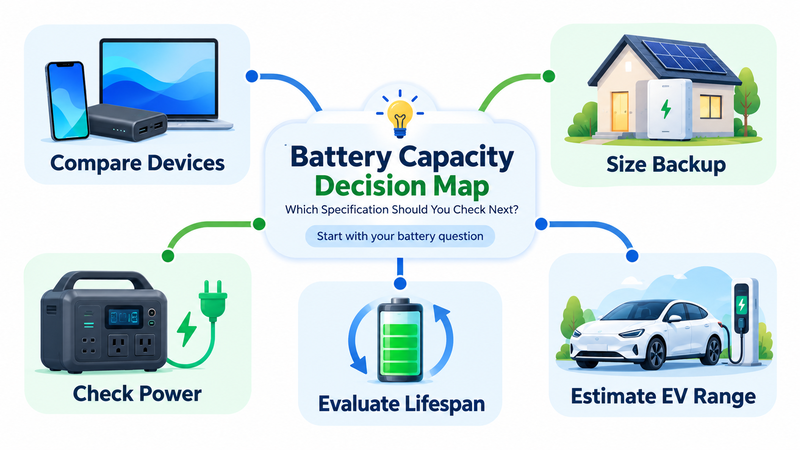
Battery Capacity Decision Map: Which Specification Should You Check Next?
Choosing a battery becomes much easier when you know which specification answers your actual question. Battery capacity, usable energy, power output, runtime, cycle life and charging performance are related, but they are not interchangeable. Looking at the wrong number can lead to buying too little capacity, paying for unnecessary storage or misunderstanding how a battery will perform.
This battery capacity decision map provides a practical route through the most important specifications. Instead of comparing every number at once, start with your intended use and follow the relevant measurement.
Step 1: Understand What Battery Capacity Actually Measures
Battery capacity describes how much electrical charge or energy a battery can store under specified conditions. Common units include milliamp-hours (mAh), amp-hours (Ah) and watt-hours (Wh).
For comparing stored energy across different systems, Wh and kWh are generally the most useful starting points because they account for energy rather than electrical charge alone.
Two batteries with identical mAh ratings may store different amounts of energy if their nominal voltages differ.
Before making comparisons, establish what each specification measures. The essential definitions and conversions are explained in:
Battery Capacity Explained: mAh, Wh & Amp Hours Decoded
https://medium.com/@volodymyrzh/battery-capacity-explained-mah-wh-amp-hours-decoded-1dc676be5a38
Decision: If you are confused by mAh, Ah, Wh or kWh, resolve the measurement first. Every later calculation depends on this foundation.
Step 2: Are You Comparing Different Devices?
Battery labels become especially misleading when comparing products designed for different applications.
A smartphone may advertise 5,000 mAh, while a laptop displays 60 Wh. These figures cannot be compared directly without accounting for voltage.
The same issue appears when comparing power banks with laptop batteries. A power bank's advertised mAh rating commonly refers to its internal cells, not necessarily the capacity available at the USB output voltage.
For portable charging comparisons, follow:
Power Bank Capacity Explained: mAh, Wh and Real Usable Energy
For direct comparisons between phones and laptops, use:
Phone vs Laptop Battery Capacity: Why mAh Alone Is Not Enough
Decision: When devices use different voltages or rating conventions, compare energy in Wh rather than raw mAh figures.
Step 3: Do You Need to Carry the Battery on a Flight?
Air travel introduces a different decision: compliance with airline and aviation battery rules.
Watt-hours are particularly important because many lithium battery restrictions use Wh thresholds. However, the permitted configuration depends on factors such as battery type, installed versus spare status, airline requirements and applicable aviation regulations.
Do not assume that a battery permitted in everyday use will automatically be accepted in checked or carry-on baggage.
The practical checks are covered in:
Airline Battery Limits in Watt-Hours: How to Check Before You Fly
Decision: If travel is involved, verify the battery's Wh rating and the current airline requirements before considering convenience or capacity.
Step 4: Are You Choosing a Portable Power Station?
Portable power stations require more than a capacity comparison. A unit may store sufficient energy but still be unable to power a particular appliance.
Three measurements are especially important:
Battery capacity (Wh): how much energy the system stores.
Continuous output (W): how much power it can deliver during normal operation.
Surge capability (W): whether it can handle permitted short-duration starting loads.
Usable energy, inverter efficiency, output connections, charging options and expected operating conditions also matter.
For a structured comparison, read:
How to Compare Portable Power Stations Without Focusing on the Wrong Numbers
Decision: First confirm that the station can power your appliances. Then calculate whether its usable energy can support them for the required duration.
Step 5: How Much Reserve Capacity Should You Add?
A battery sized only for expected energy consumption may leave insufficient room for changing conditions.
For example, a system with a calculated requirement of 1,000 Wh might need additional capacity because of conversion losses, incomplete discharge availability, uncertain appliance consumption or the need for emergency flexibility.
Reserve margin should be based on realistic requirements rather than an arbitrary universal percentage.
The calculation process is explained in:
How Much Battery Reserve Margin Do You Need?
https://digitalowl.fika.bar/how-much-battery-reserve-margin-do-you-need-01M4DEWDQ2JQXNVN5HGTCQKQDK
Decision: After calculating the required usable energy, evaluate uncertainty and add an appropriate reserve before choosing nominal battery capacity.
Step 6: Will Several Devices Run Together?
Sizing a battery for one appliance is relatively straightforward. Multiple devices introduce simultaneous power demand and different operating durations.
Consider an illustrative backup setup:
Router: 15 W for 8 hours = 120 Wh.
Laptop: 60 W for 3 hours = 180 Wh.
Lighting: 25 W for 6 hours = 150 Wh.
The combined appliance energy requirement is 450 Wh, before accounting for conversion losses and reserve capacity.
You must also calculate peak simultaneous power. Total energy consumption and simultaneous power demand are different measurements.
For the complete method, see:
How to Size Battery Capacity for Multiple Devices
Decision: Create a load list, calculate each device's energy requirement, check simultaneous demand and add the results before selecting equipment.
Step 7: Are You Comparing Cells, Modules or Complete Packs?
Battery capacity becomes more complicated when individual cells are combined into modules and complete battery packs.
Series connections increase nominal voltage, while parallel connections increase amp-hour capacity, assuming appropriately matched cells and configurations.
A battery pack's overall performance also depends on cell specifications, configuration, thermal management and battery management system limits.
A simple cell-capacity figure cannot describe every characteristic of the assembled battery.
Read:
Battery Modules and Packs Explained: From Cells to Complete Systems
Decision: When comparing battery architecture, distinguish cell-level specifications from module and pack-level ratings. Verify both voltage and total stored energy.
Step 8: Are You Comparing Capacity With Battery Lifespan?
A battery's initial energy capacity does not tell you how long it will remain useful.
Capacity describes stored energy at a particular time. Lifespan describes long-term durability under ageing and repeated use.
Cycle life, state of health and capacity retention help explain how performance changes.
A battery that retains 80% of its original capacity may still function, but its suitability depends on the required runtime and application.
For the detailed distinction, see:
Battery Capacity vs Battery Lifespan: What's the Difference?
Decision: Evaluate present usable energy separately from expected battery durability and capacity retention.
Step 9: Do You Need a Final Battery Sizing Checklist?
Once the main specifications are understood, the remaining task is to translate them into a practical purchase or system-design decision.
A useful final checklist should establish:
Which devices or appliances require electricity.
How much power they draw.
How many hours they must operate.
Whether they run simultaneously.
What conversion losses apply.
How much usable energy the battery provides.
Whether additional reserve is necessary.
Whether charging and output capabilities match the application.
A complete step-by-step workflow is available in:
Battery Capacity Sizing Checklist: From Loads to Final Reserve
Decision: If your goal is to select an actual battery system, complete the checklist before comparing product prices.
Step 10: Are You Evaluating an Electric Vehicle Battery?
Electric vehicles use battery capacity on a much larger scale, typically expressed in kilowatt-hours.
However, kWh alone cannot predict driving range. Vehicle efficiency, operating conditions and usable battery capacity also affect the result.
A simplified calculation is:
Estimated range = Usable capacity (kWh) ÷ Energy consumption (kWh/100 km) × 100
For example, a vehicle with 60 kWh of usable capacity consuming 20 kWh/100 km has a theoretical range of 300 km under that assumed consumption.
For practical interpretation, see:
EV Battery Capacity in kWh: What It Means for Energy and Driving Range
Decision: Compare usable kWh and realistic energy consumption together, rather than treating battery size as a direct range guarantee.
Step 11: Do You Need a Broader Home Backup Sizing Guide?
Battery selection is sometimes part of a larger energy resilience decision.
Home backup systems may involve different priorities from phones, power banks or electric vehicles. The required capacity depends on essential loads, outage duration, charging availability and whether alternative generation is available.
If you are planning household backup rather than comparing a single device, start with the broader decision framework:
Battery Backup Sizing Map: Find the Right Guide for Your Scenario
This helps separate basic capacity questions from more complex backup-system planning.
How to Avoid Comparing the Wrong Battery Specifications
One common mistake is treating all published battery numbers as directly comparable.
A 2,000 Wh power station, a 2,000 W inverter and a battery rated for 2,000 cycles describe entirely different properties.
Wh: stored energy.
W: electrical power.
Cycles: repeated-use durability.
kWh/100 km: vehicle energy consumption.
SoH: estimated battery condition.
Reliable comparisons require consistent units, clearly defined measurement conditions and attention to the intended application.
For a broader comparison methodology, read:
How to Compare Battery Specifications Without Comparing the Wrong Numbers
The central principle is simple: compare numbers only when they measure the same property under reasonably comparable conditions.
Final Battery Capacity Decision Map
Before selecting a battery, identify the question that matters most:
Understanding electrical units? Start with mAh, Ah, Wh and kWh.
Comparing devices? Convert ratings into comparable energy measurements.
Travelling with batteries? Check Wh ratings and applicable restrictions.
Buying a power station? Evaluate energy capacity and output power separately.
Planning backup energy? Calculate loads, runtime and reserve.
Building a battery system? Understand cell, module and pack architecture.
Evaluating longevity? Examine cycle life and capacity retention.
Choosing an EV? Compare usable kWh with realistic consumption.
The best battery decision is not based on the largest advertised number. It starts with choosing the right measurement, estimating real energy requirements and matching the complete system to the intended use.
Comments
No comments yet. Be the first to comment!