Decision Tools for Energy Storage: Turning Battery Specs Into Better Choices
A portable power station may advertise 2,000Wh of battery capacity, 2,400W continuous output, 4,000 charge cycles and multiple charging options. Every specification provides useful information, but none independently tells you whether the system is suitable for a particular application.
The real challenge is not finding more battery specifications. It is turning technical measurements into practical decisions.
For someone preparing for power outages, usable energy and essential appliance loads may matter most. A camper van owner might prioritise weight, charging flexibility and daily consumption. An electric vehicle buyer needs to understand the relationship between battery capacity and driving efficiency.
Decision trees, calculators, sizing checklists and comparison frameworks help connect these different requirements. The most useful tools do not simply rank batteries. They explain which specifications matter, how calculations work and where uncertainty remains.
Why Battery Specifications Need a Decision Framework
Battery specifications describe different technical properties.
For example:
Battery capacity (Wh or kWh): how much electrical energy is stored.
Continuous output (W): how much power the system can supply during normal operation.
Surge output (W): its supported short-duration output capability.
Cycle life: durability under repeated charging and discharging, measured against specified conditions.
Charging power (W): the rate at which the system can accept or deliver charging energy.
Usable capacity: energy available within the system's operating limits.
A system can offer substantial energy capacity but insufficient output power to start a motor. Another system may deliver high power but operate only briefly because its battery stores relatively little energy.
A comparison that treats these specifications as interchangeable is fundamentally misleading.
The first requirement of a useful decision tool is therefore measurement consistency.
For a practical methodology, see How to Compare Battery Specifications Without Comparing the Wrong Numbers:
This distinction should determine how a comparison tool groups, explains and evaluates its inputs.
Step 1: Start With the Intended Use
A buyer should not begin by asking which battery has the highest capacity or longest advertised lifespan.
The more useful first question is: What must this energy-storage system actually do?
Consider four scenarios.
Home backup: power essential equipment during a defined outage period.
Portable power: supply energy for camping, outdoor work or temporary locations.
Daily renewable storage: retain generated energy for use when production is unavailable.
Electric vehicles: provide enough usable energy for realistic travel requirements.
Each scenario creates different priorities.
A portable camping system may benefit from lower weight and flexible recharging. A home backup system may place greater emphasis on simultaneous appliance demand and reserve capacity.
A renewable energy system also requires an understanding of generation variability and charging constraints.
This use-case-first approach is closely related to the editorial methodology behind Comparison Tools and Decision Trees:
https://seolabsdp.blogspot.com/2026/09/comparison-tools-and-decision-trees.html
A good decision tree narrows the problem before introducing more technical information.
Step 2: Calculate Energy Demand in Watt-Hours
Once the use case is defined, the next task is to calculate energy requirements.
The fundamental relationship is:
Energy (Wh) = Power (W) × Operating Time (hours)
Imagine a simplified eight-hour backup scenario:
Router: 15W × 8h = 120Wh.
Laptop: 60W × 3h = 180Wh.
Lighting: 20W × 6h = 120Wh.
Fan: 40W × 5h = 200Wh.
Total appliance energy demand:
120 + 180 + 120 + 200 = 620Wh.
This establishes the baseline energy requirement.
However, a 620Wh battery is not automatically sufficient. Actual battery systems may have conversion losses, internal power consumption, operating limits and reserve requirements.
For calculations involving several devices, use How to Size Battery Capacity for Multiple Devices:
A decision tool should calculate each load separately and then combine their energy requirements.
It should also allow users to change operating hours and assumptions instead of forcing one fixed scenario.
Step 3: Check Continuous and Starting Power
Energy capacity determines how long a battery may support equipment. Output power determines which appliances it can operate.
These are independent constraints.
For example, a 2,000Wh power station with 1,000W continuous output cannot necessarily operate a 1,500W appliance, regardless of its remaining charge.
Motor-driven equipment introduces another requirement: startup power.
Refrigerators, water pumps and other motor-driven loads may briefly demand substantially more electrical power during startup than during normal operation.
A decision tool should therefore distinguish:
Total stored energy.
Maximum expected simultaneous running demand.
Starting or surge requirements.
Inverter voltage and frequency compatibility.
Product-specific output limitations.
This prevents a common purchasing mistake: selecting sufficient battery capacity without checking whether the connected equipment can operate.
The same principle applies to portable energy systems. The buyer-neutral framework in How to Compare Portable Power Stations Without Focusing on the Wrong Numbers addresses capacity, output, charging, durability and practical constraints separately:
A useful comparison should reject an electrically incompatible option before ranking its secondary features.
Step 4: Include Losses and Reserve Capacity
Battery calculations become less reliable when they assume that nominal stored energy is fully available at the appliance.
Inverters, battery management electronics, converters and operating conditions influence delivered energy.
Suppose the earlier backup scenario requires 620Wh.
Assume an illustrative battery-to-load energy delivery factor of 85%.
The nominal capacity needed before an additional planning margin is:
620Wh ÷ 0.85 ≈ 729Wh.
Now apply a 20% illustrative planning margin:
729Wh × 1.20 ≈ 875Wh.
Under these assumptions, the nominal planning target is approximately 875Wh.
The assumptions are not universal. Actual efficiency, reserve requirements and usable energy must be evaluated for the specific system.
A transparent sizing tool should expose these values as adjustable inputs.
The practical reasoning behind reserve requirements is explained in How Much Battery Reserve Margin Do You Need?:
https://digitalowl.fika.bar/how-much-battery-reserve-margin-do-you-need-01M4DEWDQ2JQXNVN5HGTCQKQDK
The strongest calculators show users how changing efficiency, operating duration or reserve assumptions affects the result.
Step 5: Turn the Calculation Into a Buying Checklist
A numerical result is only one part of a reliable battery decision.
Before purchasing, users should verify whether the proposed system satisfies the full set of requirements.
A useful checklist should include:
Which devices must be powered?
How much energy does each device consume?
What is the longest required operating period?
Which loads operate simultaneously?
Are there motor starting requirements?
What battery energy is actually usable?
What conversion losses are expected?
How much reserve is appropriate?
How quickly can the system recharge?
Are voltage, connections and operating conditions compatible?
This structure transforms a calculation into a repeatable decision process.
It also exposes missing information. If a user knows the required energy but not the pump's startup characteristics, the tool should identify that uncertainty rather than return an unjustifiably confident recommendation.
The complete process appears in Battery Capacity Sizing Checklist: From Loads to Final Reserve:
The goal is to produce a justified requirement, not merely a battery-size number.
Step 6: Account for Different Battery Applications
Not every energy-storage decision can be handled with the same final calculation.
For home backup, the primary output might be the minimum nominal capacity, continuous power and required surge capability.
For portable power, weight, charging options, transportability and compatibility become additional factors.
For electric vehicles, battery capacity must be evaluated alongside energy consumption per distance.
Consider a hypothetical EV with 60kWh of usable capacity and consumption of 18kWh per 100km.
Estimated range:
60 ÷ 18 × 100 ≈ 333km.
The result changes when consumption changes, even if battery capacity remains constant.
That means a larger EV battery does not automatically guarantee longer driving range than a smaller battery in a more efficient vehicle.
The relationship is explored in EV Battery Capacity in kWh: What It Means for Energy and Driving Range:
A decision tool should adapt its final outputs to the application's actual objective.
Step 7: Compare Long-Term Suitability
Initial performance is not the only consideration.
Battery chemistry, cycle life, calendar ageing, operating temperature, charging limits and warranty conditions influence long-term suitability.
For example, a frequently cycled energy-storage system may prioritise durability differently from a power station stored mainly for emergencies.
A useful comparison should consider whether a battery's performance remains acceptable after ageing.
However, cycle-life specifications must be interpreted carefully. A claim of several thousand cycles is meaningful only alongside its test conditions and capacity-retention threshold.
Long-term suitability also depends on storage conditions and actual usage.
These factors should remain separate from the initial energy and output-power checks, rather than being combined into an unexplained product score.
Step 8: Use Visualisation to Explain the Result
The presentation of technical information strongly affects its practical usefulness.
Different questions benefit from different visual formats.
Decision trees: select the relevant criteria based on use case.
Bar charts: compare energy capacity or runtime across options.
Line charts: show charging behaviour, capacity retention or sensitivity to changing loads.
Calculators: quantify requirements from editable inputs.
Checklists: verify that essential conditions have been considered.
Visualisation is particularly useful when several variables interact.
For example, a runtime chart can show how operating time changes as appliance demand increases while battery capacity remains constant.
A comparison graphic can separate continuous output from stored energy, reducing confusion between W and Wh.
The broader content methodology is discussed in Data Visualisation as a Linkable Asset:
https://seolabsdp.blogspot.com/2026/09/data-visualisation-as-linkable-asset.html
A visualisation becomes genuinely useful when it clarifies a decision, not when it merely makes technical information look attractive.
What Makes a Battery Decision Tool Trustworthy?
A decision-support resource should be transparent about both its calculations and limitations.
Several principles are particularly important.
Clear definitions: users should know exactly what each input represents.
Visible assumptions: efficiency, reserve margin and operating conditions should not remain hidden.
Comparable measurements: energy, power, durability and charging speed should be evaluated separately.
Realistic uncertainty: calculated runtime should be presented as an estimate unless supported by direct measurements.
Product neutrality: recommendations should reflect the stated requirements rather than steering every result toward one preferred product.
Maintainability: data, methodology and specifications should be updated when relevant information changes.
These features also contribute to the editorial value of technical resources.
A tool with transparent methodology, useful calculations and clearly documented assumptions can become a reference for educators, technical writers and other publishers.
That does not guarantee backlinks or citations. However, it gives potential readers and publishers a concrete reason to reference the resource.
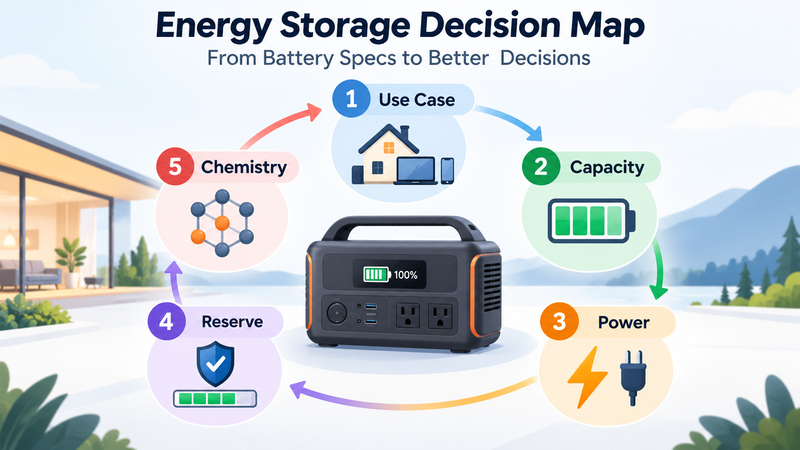
A Five-Stage Energy Storage Decision Map
The entire process can be summarised in five stages.
1. Use Case
Define the application, expected operating conditions and essential requirements.
2. Capacity
Calculate energy demand in Wh or kWh using realistic consumption and operating time.
3. Power
Verify continuous output, startup requirements and electrical compatibility.
4. Reserve
Include usable-energy limitations, conversion losses, uncertainty and recharge availability.
5. Chemistry and Specifications
Evaluate durability, temperature limits, charging characteristics, portability and long-term suitability.
If a candidate system fails an essential requirement, return to the relevant stage and revise the selection.
A broader route through specialised battery calculations is available in Battery Capacity Decision Map: Which Specification Should You Check Next?:
This approach allows users to move from general specifications toward increasingly specific decisions without confusing independent technical measurements.
Final Takeaway
Better energy-storage decisions depend on asking the right questions in the right order.
Battery capacity, output power, starting requirements, reserve margin, charging characteristics and lifespan each describe different aspects of performance.
Calculators translate energy requirements into numbers. Checklists reveal missing information. Decision trees identify the next relevant question. Visualisations make the trade-offs easier to understand.
For content publishers, these resources can also transform isolated technical explanations into more useful, transparent and referenceable information.
The most valuable energy storage decision tool is not the one displaying the most specifications. It is the one that helps readers turn their actual requirements into a clear, justified and realistic choice.
Comments
No comments yet. Be the first to comment!