1,000Wh vs 2,000Wh Power Station: What Changes in Real Use?
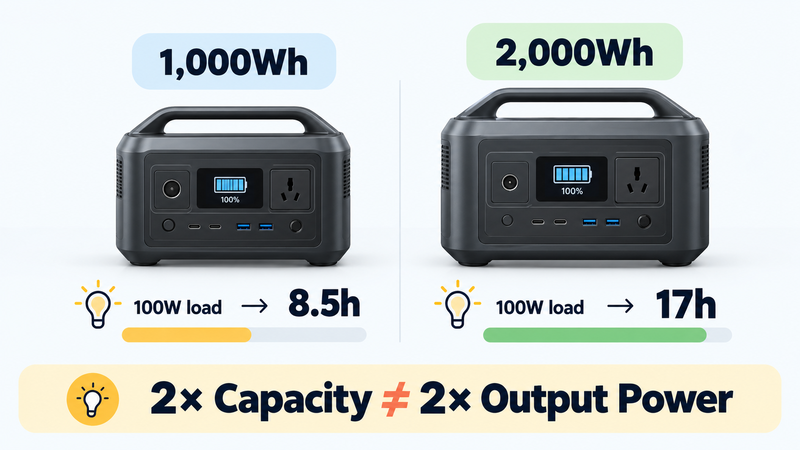
A 2,000Wh portable power station stores approximately twice as much energy as a 1,000Wh model. But twice the battery capacity does not automatically mean twice the output power, faster charging or better performance in every situation.
The most significant difference is how long the station can support connected equipment. A larger battery may keep a refrigerator running longer, provide more reserve during an outage or support additional days of camping. However, the additional capacity usually comes with higher weight, greater size and increased cost.
The right choice depends on your actual energy consumption, operating duration, portability requirements and recharging opportunities.
What Is the Difference Between 1,000Wh and 2,000Wh?
Battery capacity describes the amount of energy a system can store.
1,000Wh = 1kWh of nominal stored energy.
2,000Wh = 2kWh of nominal stored energy.
The second system stores approximately 1,000Wh more energy.
However, nominal capacity should not be confused with usable energy delivered to appliances. AC inverter losses, internal electronics, battery operating limits and temperature can affect how much energy reaches connected equipment.
For example, assume both stations deliver an illustrative 85% of nominal battery energy under comparable conditions.
1,000Wh station:
1,000Wh × 0.85 = 850Wh delivered energy.
2,000Wh station:
2,000Wh × 0.85 = 1,700Wh delivered energy.
The second station provides twice as much energy under these assumptions.
Real products may have different conversion efficiency, standby consumption and operating characteristics.
For the basic concepts, see Portable Power Station Capacity Explained:
https://digitalowl.fika.bar/portable-power-station-capacity-explained-01M418WTCRZQBSBGP2JVK082W9
How Much Longer Will a 2,000Wh Station Run?
A simplified battery runtime formula is:
Runtime (hours) = Usable Energy (Wh) ÷ Average Power Demand (W)
Using the illustrative delivered-energy figures of 850Wh and 1,700Wh, we can compare several constant-load scenarios.
50W Load — Router and Small Electronics
1,000Wh station: 850 ÷ 50 = 17 hours.
2,000Wh station: 1,700 ÷ 50 = 34 hours.
100W Load — Moderate Essential Equipment
1,000Wh station: 8.5 hours.
2,000Wh station: 17 hours.
200W Load — Multiple Small Appliances
1,000Wh station: 4.25 hours.
2,000Wh station: 8.5 hours.
500W Load — More Demanding Equipment
1,000Wh station: 1.7 hours.
2,000Wh station: 3.4 hours.
These are mathematical examples, not guaranteed runtimes.
At low loads, standby consumption can become significant. At higher loads, conversion efficiency, discharge characteristics and thermal limits may change.
The calculation process is explained in Battery Runtime Formula:
https://digitalowl.fika.bar/battery-runtime-formula-01M2JVJ0DBC2706XRP728QTZQ3
The practical distinction: a larger battery generally provides more operating time, but real runtime should be estimated from usable energy and total system consumption.
Does a 2,000Wh Power Station Deliver More Watts?
Not necessarily.
Battery capacity and inverter output power are separate specifications.
Capacity is measured in Wh. Output power is measured in W.
A 1,000Wh station might have a 1,800W continuous inverter, while another station with approximately 2,000Wh of capacity might have a different output rating.
Some larger products provide more inverter power, but that depends on product design rather than battery capacity alone.
For example, manufacturer specifications for different EcoFlow DELTA models show that capacity, rated AC output, charging input and weight vary independently across the range.
A 1,024Wh model and a 2,048Wh model should therefore be compared by their complete technical specifications rather than assuming every performance figure doubles.
Manufacturer comparison:
https://www.ecoflow.com/au/blog/ecoflow-delta-3-series
Before choosing a power station, check:
Continuous AC output rating.
Supported surge output.
Maximum combined output.
Individual AC and DC port limits.
Required voltage and frequency.
Compatibility with motor-driven appliances.
A larger battery does not make an electrically incompatible appliance compatible.
What Changes for Refrigerator Backup?
Refrigerator backup is one of the most practical reasons to consider a 2,000Wh station.
A refrigerator normally cycles its compressor rather than consuming its running wattage continuously.
Suppose a refrigerator uses 1,000Wh over a representative 24-hour period.
Using the earlier delivered-energy assumptions:
1,000Wh power station
850Wh available ÷ 1,000Wh/day × 24 ≈ 20.4 hours.
2,000Wh power station
1,700Wh available ÷ 1,000Wh/day × 24 ≈ 40.8 hours.
The 2,000Wh system provides additional time and flexibility before recharging.
However, refrigerator energy consumption changes with ambient temperature, door openings, compressor design and other conditions.
The power station must also support the refrigerator's starting power.
For longer outages, the decision may depend on how reliably the battery can be recharged rather than on capacity alone.
What Changes for Home Backup?
A 1,000Wh station can be useful for maintaining a limited set of essential devices.
Potential applications include communication equipment, LED lighting, laptop charging and other relatively low-energy loads.
A 2,000Wh station can extend the operating period or support a larger combined energy budget.
Consider a simplified outage scenario:
Router: 15W for 10 hours = 150Wh.
Laptop: 60W for 4 hours = 240Wh.
Lighting: 20W for 6 hours = 120Wh.
Fan: 40W for 5 hours = 200Wh.
Total appliance energy demand:
710Wh.
Using the illustrative 85% battery-to-load delivery factor:
1,000Wh station: approximately 850Wh available.
2,000Wh station: approximately 1,700Wh available.
Both could theoretically cover the 710Wh requirement, assuming adequate output compatibility and the stated losses.
But the smaller system would have approximately 140Wh remaining under the modelled conditions, compared with 990Wh for the larger station.
That difference matters when outages last longer than expected or equipment consumes more energy than planned.
The value of 2,000Wh is not simply the ability to connect more devices. It is the additional energy available when circumstances change.
Which Size Is Better for Camping and RV Use?
Portability can make a smaller power station preferable even when a larger model offers more energy.
A 1,000Wh-class system may be easier to transport, move between locations and store in a vehicle.
A 2,000Wh system can be attractive for longer off-grid stays, especially when refrigeration, lighting, communications and other devices must operate without frequent recharging.
However, additional capacity can substantially increase weight.
For example, EcoFlow's DELTA 3 comparison describes a 1,024Wh-class product weighing approximately 12kg and a 2,048Wh-class product weighing approximately 22kg, depending on the exact model.
These are examples from one manufacturer, not universal weight specifications for all power stations.
Before buying, consider:
How often the station must be carried.
Whether one person can move it comfortably.
Available storage space.
Daily energy consumption.
Expected time between recharging opportunities.
Whether the station will be moved frequently or kept in one location.
For regular transport and relatively modest energy requirements, 1,000Wh may be more practical.
For longer stationary use, the additional capacity of a 2,000Wh system may justify the extra weight.
Does a 2,000Wh Station Charge Twice as Slowly?
Not automatically.
Charging time depends on battery capacity and accepted charging power.
A simplified charging-time relationship is:
Charging Time ≈ Energy to Replenish ÷ Average Charging Power
Suppose two hypothetical batteries both support an average charging input of 500W.
Ignoring losses and charging taper:
1,000Wh ÷ 500W = 2 hours.
2,000Wh ÷ 500W = 4 hours.
Under those assumptions, the larger battery takes twice as long to recharge.
But now suppose the 2,000Wh system supports 1,000W average charging input.
2,000Wh ÷ 1,000W = 2 hours.
The larger system can theoretically recharge in a similar period when the supported charging rate is higher.
Actual charging time also depends on efficiency, battery temperature, charging stages and manufacturer limits.
When comparing products, check maximum AC charging input, solar input limits and realistic charging curves rather than relying only on battery capacity.
What About Solar Recharging?
Solar input can change the value of additional battery capacity.
If you regularly have access to adequate solar generation, a smaller station may be replenished during the day.
During cloudy weather, winter conditions or extended outages, a larger battery can provide more reserve when generation is limited.
Consider an illustrative solar system delivering 600Wh of energy to the battery during one day.
A household uses 800Wh daily.
The approximate daily energy deficit is:
800Wh − 600Wh = 200Wh.
A larger battery can absorb that deficit for longer, but it does not solve a persistent shortage of incoming energy.
Eventually, both batteries need sufficient recharging.
Therefore, a 2,000Wh system is not automatically better for solar use unless its additional storage capacity matches the expected generation and consumption pattern.
When Does a 1,000Wh Power Station Make More Sense?
A 1,000Wh-class station may be the more appropriate choice when:
Daily energy consumption is relatively low.
Backup duration is limited.
Portability matters.
Recharging is available frequently.
Storage space is restricted.
The planned energy budget already includes sufficient reserve.
The larger battery would add little practical benefit.
For example, if your equipment consumes only 200Wh during a short outing, both capacity classes may cover the requirement comfortably.
The 2,000Wh system would provide additional unused energy, but that extra capacity may not justify its higher weight or cost.
A larger specification is not automatically a better match.
When Is 2,000Wh Worth the Upgrade?
A 2,000Wh-class station may be worth considering when:
Overnight loads approach the usable capacity of a smaller station.
Refrigeration or communication equipment must operate for extended periods.
Recharging opportunities are limited or uncertain.
Several essential devices share one battery.
You need more operating reserve for unexpected outages.
You plan longer camping or off-grid stays.
The additional weight and cost are acceptable.
The upgrade becomes more valuable when the extra stored energy addresses a real limitation.
For example, moving from approximately 850Wh to 1,700Wh of assumed delivered energy could make a significant difference to an overnight load requiring 1,100Wh.
But a system consuming only 250Wh per day may have little immediate need for such a large reserve.
Compare the Complete Power Station, Not Just Capacity
A useful purchasing comparison should include more than the headline watt-hour rating.
Evaluate each station against the same use case.
Energy: How many usable Wh does it provide?
Power: Can it run all required devices, including starting surges?
Charging: How quickly can it recharge using available sources?
Portability: Is its weight and size suitable for the intended location?
Durability: What are the battery chemistry, cycle-life conditions and warranty terms?
Expandability: Can capacity be increased later if the model supports compatible batteries?
Cost: How much are you paying for usable energy and capabilities you will actually need?
These questions are explored in How to Compare Portable Power Stations Without Focusing on the Wrong Numbers:
For a structured decision process that connects use case, capacity, power, reserve and chemistry, see Decision Tools for Energy Storage: Turning Battery Specs Into Better Choices:
The goal is to select a system whose complete specification matches the intended application.
Final 1,000Wh vs 2,000Wh Decision Checklist
Before choosing between the two capacity classes, answer these questions:
Energy demand: how many Wh will connected devices consume?
Runtime: how long must the battery operate without recharging?
Reserve: how much extra energy is needed for uncertainty?
Output: does the inverter support continuous and starting-power requirements?
Charging: how much energy can realistically be replenished each day?
Portability: how important are weight and size?
Future expansion: are additional devices or longer outages likely?
Value: does the larger system solve a real problem, or simply provide unused capacity?
A helpful comparison begins with these requirements rather than with the assumption that 2,000Wh must always be the better option.
Final Takeaway
A 2,000Wh portable power station offers approximately twice the nominal stored energy of a 1,000Wh model, but not necessarily twice the output power, charging speed or overall usefulness.
For a fixed load and comparable efficiency, the larger battery can provide approximately twice the runtime.
The trade-offs are typically greater weight, size and cost.
A 1,000Wh station may be the better choice for portable, short-duration and relatively low-energy applications. A 2,000Wh system becomes more valuable when backup duration, refrigeration, multi-device use or limited recharging opportunities justify the additional reserve.
The practical rule is simple: calculate your energy needs first, verify output-power compatibility and buy the additional capacity only when it serves a realistic operating requirement.
All runtime calculations are approximate and depend on the actual devices, usable capacity, conversion losses and operating conditions.
Comments
No comments yet. Be the first to comment!