Battery Charging and Solar Recharging: From Input Watts to Stored Energy
Battery capacity tells you how much energy a battery can store. Charging tells you how quickly — and under what conditions — that stored energy can be replaced.
Those two sides of the system are closely connected, but they are not the same thing.
A large battery can charge slowly. A smaller battery can charge quickly. A powerful solar array may still be limited by the battery system's input electronics. And the amount of solar energy available during a day depends on much more than the wattage printed on the panel.
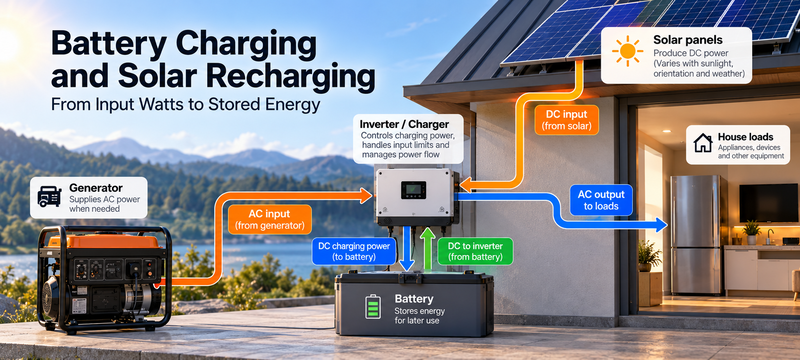
The most useful way to understand charging is therefore as an energy flow:
energy source → charging system → battery → loads
Once that flow is clear, charger watts, charging efficiency, solar production, peak sun hours, input limits and pass-through operation become parts of the same model rather than isolated specifications.
For the underlying capacity concepts, start here:
https://medium.com/@volodymyrzh/battery-capacity-explained-mah-wh-amp-hours-decoded-1dc676be5a38
Start With Energy That Must Be Replaced
Imagine a battery has delivered 1,500 Wh since its last full charge.
At a basic level, the charging problem is simple: approximately that amount of stored energy must be replenished.
But battery capacity is measured as energy, while chargers are normally described by power.
That distinction is fundamental.
A 1,000 W charger does not contain 1,000 Wh of energy. It describes the rate at which power can potentially be supplied.
More on this relationship:
https://digitalowl.fika.bar/charging-power-vs-battery-capacity-01M3F78YY9ZSWJQV8EX0ZGEMP1
The basic charging-time relationship is:
Energy to replace (Wh) ÷ charging power (W) = theoretical charging time (hours)
For example:
1,500 Wh ÷ 750 W = 2 hours
But two hours is an idealised starting point, not necessarily the real charging time.
Real Charging Takes Longer Than the Simplest Formula
Actual charging systems introduce losses and operating limits.
Some energy is lost in electronics, cables, conversion stages and the battery itself. Charging power may also change as the battery approaches a high state of charge.
That means energy drawn from the source is normally greater than the increase in stored battery energy.
The basic charging-time calculation is explained here:
https://digitalowl.fika.bar/battery-charge-time-formula-01M3F98QE99JV0CY8AEYC2PWAV
Charging efficiency is covered here:
https://digitalowl.fika.bar/what-is-charging-efficiency-01M3FBWVAFHWYBA8TBT7J8FCD5
A more realistic mental model is:
Source energy → conversion losses → stored battery energy
There is no single charging-efficiency percentage that applies to every battery and charger combination. Hardware, temperature, charge level and operating conditions can all affect the result.
Temperature Can Change the Charging Rules
Charging is not only a question of watts.
Battery chemistry and temperature can determine whether charging should happen at all, or whether the battery-management system must limit it.
This is particularly important in cold conditions.
More detail:
https://zhvv1989.blogspot.com/2026/09/charging-lithium-batteries-in-cold.html
The practical lesson is important: a theoretical charge-time calculation cannot override the operating limits of the battery.
The allowable charging conditions always come first.
Solar Adds a Variable Energy Source
Grid charging is relatively easy to conceptualise because the source can often deliver fairly stable power.
Solar is different.
A panel's watt rating represents power under specified test conditions. It does not tell you directly how many watt-hours the panel will produce during an actual day.
This difference is explained here:
https://digitalowl.fika.bar/solar-panel-watts-vs-solar-energy-01M3KRYFWQ65C0E305C4EV3RMQ
A 400 W panel, for example, does not simply produce 400 Wh every hour from sunrise to sunset.
Solar output changes with sunlight intensity, panel orientation, temperature, shading, weather and system losses.
For energy planning, the question is therefore not only:
How many watts of solar do I have?
It is also:
How much solar energy can I realistically collect during the available charging period?
Peak Sun Hours Connect Solar Watts to Daily Energy
One useful planning concept is peak sun hours.
Peak sun hours do not mean the number of hours when the sun is visible. They represent the day's solar energy expressed as an equivalent number of hours at a reference irradiance.
For example, a simplified estimate might look like:
400 W × 4 peak sun hours = 1,600 Wh
before accounting for system losses and other real-world factors.
A detailed explanation:
https://digitalowl.fika.bar/what-are-peak-sun-hours-01M3KVQA7E6RMVJD737AM7AD7Q
This turns the solar side of the system into the same language as the battery side: watt-hours.
Recharging Changes How Much Battery Capacity You Need
Without recharging, a battery is essentially a fixed energy budget.
If you have 2,000 Wh of usable stored energy, loads gradually consume that budget.
Solar changes the model because energy can be added while the system is operating.
Instead of:
stored energy → loads → empty battery
you may have:
stored energy + daytime solar replenishment → loads
That can reduce the amount of stored capacity required for some scenarios.
But it does not mean you can simply subtract expected solar production from battery size. Solar availability varies, loads may occur at different times, and poor weather can reduce replenishment.
More on this relationship:
More Solar Panels Do Not Always Mean More Charging Power
Another important limit sits between the panels and the battery.
A power station or solar charge controller may have limits for accepted voltage, current and total input power.
Once one of those limits is reached, adding more theoretical panel output may not increase the charging rate.
That is why the panel array and the charging system must be considered together.
More detail:
https://app.fika.bar/blog/post/what-are-solar-input-limits-01M3PJ8JW30QZQVW81SJQAM0J0
The key distinction is:
available solar power ≠ automatically accepted charging power
The battery system decides how much of the available input it can actually use.
Loads Can Compete With Charging
Charging calculations become more interesting when devices are operating at the same time.
Some systems support simultaneous charging and output, commonly described as pass-through charging.
More on that here:
https://digitalowl.fika.bar/what-is-pass-through-charging-01M3PM70SHY2CKT6F32ZCJF03P
Suppose 700 W is entering a system while connected devices are consuming 300 W.
The battery may not receive the full 700 W.
Depending on system architecture, part of the incoming power may support the loads while the remainder contributes to charging.
This means gross input power and net battery charging power can be very different numbers.
It also explains why recharge-time estimates made while the battery is idle may not match charging performance while the system is actively powering equipment.
A Generator Can Become Another Recharging Source
The same energy-flow model also applies when solar is unavailable or insufficient.
A generator can provide AC power to an inverter/charger, which then replenishes the battery. Some systems can simultaneously use generator power for active loads.
That creates a hybrid flow such as:
Generator → loads
and
Generator → charger → battery
The generator therefore does not necessarily need to act as the sole continuous source.
More on generator-battery hybrid charging:
https://digitalowl.fika.bar/generator-and-battery-hybrid-charging-01M3XWJMZ4DFGQT9EQHCZ5NP4Q
Charging Is a System, Not a Single Specification
The complete charging picture can now be represented as a chain:
Source power → input limits → charging power → efficiency → stored Wh → loads
For solar, add:
panel watts → peak sun hours → expected solar Wh
For simultaneous use, add:
incoming power → active loads → remaining charging power
And for real batteries, always include environmental and hardware constraints.
This is why no single specification tells you how quickly or reliably a battery can be replenished.
The broader battery design also matters — chemistry, voltage, cells and pack architecture all influence how capacity is built and managed.
That foundation is covered here:
The most useful approach is to treat charging as an energy-management workflow rather than a race for the largest watt number.
Start with the energy that must be replaced. Then check how much charging power the system can accept, account for losses and operating conditions, estimate how much energy the source can realistically provide, and finally consider what loads may consume energy during the process.
Once those pieces are connected, battery charging, solar recharging and hybrid backup systems become much easier to compare and plan.
Comments
No comments yet. Be the first to comment!