What Is Expandable Battery Capacity?
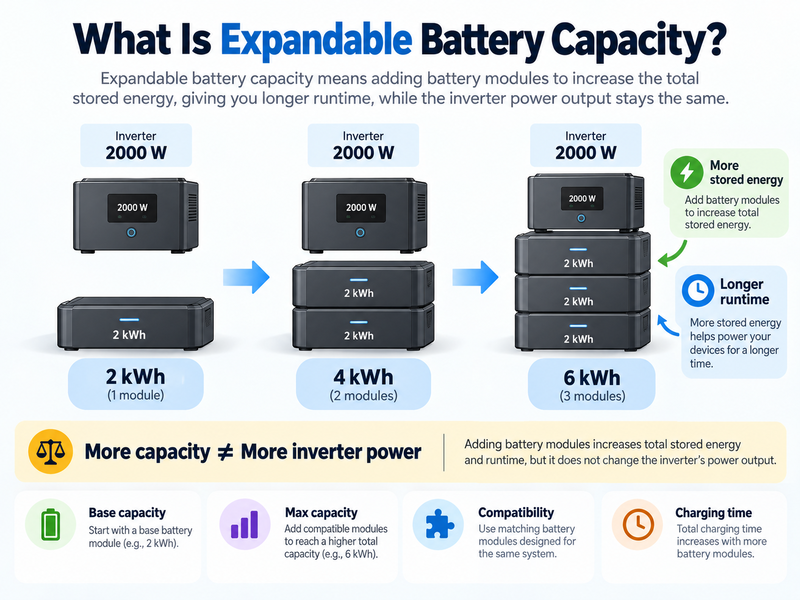
Expandable battery capacity means that an energy-storage system can increase its total stored energy by adding compatible battery modules.
A system might begin with one battery and later support one or more expansion batteries. The result is usually more watt-hours or kilowatt-hours of stored energy and therefore potentially longer runtime.
But there is an important limitation:
Adding battery capacity does not automatically increase the system's power output.
A larger battery bank may run loads for longer while the inverter's watt rating remains exactly the same.
Capacity Expansion Means Adding Stored Energy
Battery capacity describes how much energy a battery can store.
For example, imagine a system with a 2,000 Wh base battery.
If the manufacturer allows a compatible 2,000 Wh expansion battery to be connected, the combined nominal capacity may become approximately:
2,000 Wh + 2,000 Wh = 4,000 Wh
Adding another identical expansion module could theoretically increase it to:
6,000 Wh
The exact usable capacity depends on the battery system, operating limits and manufacturer specifications, but the general principle is simple:
more compatible battery modules → more stored energy
A broader explanation of how battery capacity differs from runtime is available here:
Expandable Capacity Usually Means Modular Design
Expandable systems are designed around modules.
A typical architecture may contain:
a main power unit;
one or more battery modules;
battery-management electronics;
communication between modules;
defined expansion limits.
This modular approach allows users to start with a smaller capacity and increase it later if their energy requirements grow.
That can be useful when the original requirement is uncertain.
For example, someone may initially need enough storage for several essential devices during a short outage. Later, they may want longer backup duration or additional loads.
Instead of replacing the entire system, a compatible expansion module may increase stored energy.
Adding Capacity Does Not Automatically Add Power
This is one of the most important distinctions in expandable battery systems.
Suppose a portable power system has:
2,000 Wh battery capacity
2,000 W inverter output
An expansion battery increases total capacity to:
4,000 Wh
The inverter may still be rated at:
2,000 W
The system can now potentially operate a given load for longer, but it cannot necessarily run a larger load.
Capacity answers:
How much energy is stored?
Power answers:
How quickly can that energy be delivered?
So an expandable battery system can increase runtime without changing maximum AC output.
This is why Wh and W should never be treated as interchangeable specifications.
Expansion Batteries Must Be Compatible
Expandable capacity does not mean arbitrary batteries can be connected together.
A modular battery system may depend on specific:
battery chemistry;
voltage range;
communication protocol;
BMS design;
connector system;
firmware;
module generation;
maximum supported number of batteries.
Even products from the same manufacturer may not always be mutually compatible.
The system may need to recognise each battery module and coordinate charging, discharging and protection across the complete battery bank.
For that reason, expansion capability should be verified using the manufacturer's specifications rather than assumed from voltage or connector appearance alone.
Series and Parallel Architecture Still Matters
Expanding a battery bank changes the electrical architecture behind the system.
Depending on the product design, additional cells or modules can contribute to capacity through series, parallel or more complex arrangements.
The basic electrical principle is covered here:
https://digitalowl.fika.bar/batteries-in-series-vs-parallel-01M3ADSFCS839DE87JYK879SPD
In simple terms:
series connections increase voltage;
parallel connections increase Ah capacity at the same voltage.
Commercial expandable systems handle these relationships through a predefined architecture.
Users normally see the result as additional Wh or kWh rather than needing to manage individual cell arrangements themselves.
Cell Balancing Becomes Part of the Larger System
Once multiple cells and modules operate as one battery system, differences between them need to be managed.
Cells can vary slightly in:
state of charge;
capacity;
internal resistance;
temperature;
aging.
Battery-management systems monitor these differences and may use balancing to keep cells operating within defined limits.
A deeper explanation is available here:
https://digitalowl.fika.bar/what-is-battery-cell-balancing-01M3AKY2YBAZ6ZEMBB2YVF33S1
This becomes especially relevant in larger modular systems because adding capacity also adds more cells that must operate together as part of the same energy-storage system.
More Capacity Usually Means Longer Runtime
Suppose a load requires an average of 500 W.
Ignoring losses for a simplified comparison:
A 2,000 Wh battery would theoretically provide:
2,000 Wh ÷ 500 W = 4 hours
A 4,000 Wh expanded system would theoretically provide:
4,000 Wh ÷ 500 W = 8 hours
A 6,000 Wh system would theoretically provide:
6,000 Wh ÷ 500 W = 12 hours
Real runtime will usually be lower because of inverter losses, standby consumption, usable-capacity limits and varying load.
But the relationship is still useful:
adding battery capacity primarily increases energy duration.
It does not necessarily change what appliances the inverter can support at the same moment.
Expansion Limits Matter
Expandable systems normally have a maximum supported capacity.
A manufacturer may limit:
the number of expansion batteries;
total Wh or kWh;
supported battery combinations;
allowable module generations;
charge and discharge current.
This means “expandable” should not be interpreted as unlimited.
A useful specification is therefore not simply:
Expandable battery: Yes
It is:
Expandable from what starting capacity to what maximum capacity?
For example:
2 kWh base → up to 10 kWh total
provides much more useful information than the word “expandable” by itself.
Expansion Can Also Change Charging Time
More capacity means more energy must eventually be replaced.
If charging power remains unchanged, a larger battery bank can require longer to recharge.
For example, doubling stored capacity while keeping approximately the same charging input can roughly double the theoretical energy-replacement time.
Actual charging behaviour is more complicated because charging power can vary during the process.
Still, the general relationship matters:
more Wh + same charging W = longer recharge requirement
So expansion should be evaluated not only through runtime but also through how the larger battery bank will be replenished.
What to Check Before Comparing Expandable Systems
When comparing expandable battery products, look beyond maximum kWh.
Check:
Base capacity: how much energy the starting system stores.
Maximum capacity: how far the system can expand.
Expansion increments: capacity added by each module.
Maximum number of modules: the architecture limit.
Inverter power: whether output power changes with expansion.
Compatibility: which batteries or generations can be combined.
Charging capability: whether charging power scales with the larger bank.
Usable capacity: how much of nominal capacity is practically available.
These specifications describe different parts of the system.
The Key Difference
Expandable battery capacity is fundamentally about adding stored energy.
A system may grow from:
2 kWh → 4 kWh → 6 kWh
while its inverter remains:
2,000 W → 2,000 W → 2,000 W
The larger battery can support the same load for longer, but it does not automatically support a more powerful load.
The useful way to evaluate expansion is therefore:
Base Wh → expansion Wh → maximum Wh → inverter W → compatibility → charging capability
This keeps capacity, runtime and power separate.
For the broader relationship between voltage, amp-hours and watt-hours:
https://medium.com/@volodymyrzh/battery-capacity-explained-mah-wh-amp-hours-decoded-1dc676be5a38
Expandable capacity is valuable because it lets an energy-storage system grow with future needs — but only within the electrical, battery-management and compatibility limits built into that system.
Comments
No comments yet. Be the first to comment!