Depth of Discharge and Cycle Life
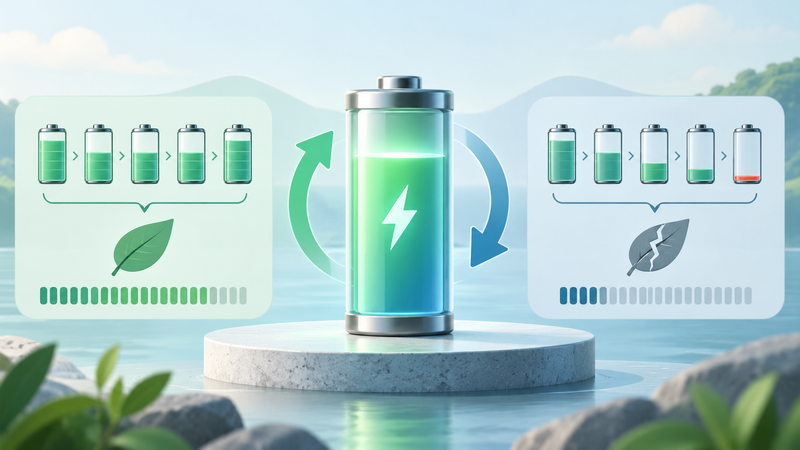
How deeply a battery is discharged can influence how quickly it ages.
This relationship is often simplified into advice such as “never discharge a battery below 20%” or “use only 80% of its capacity.” Those rules can sometimes be useful as practical guidelines, but they are not universal laws.
Battery chemistry, cell design, temperature, charge rate, discharge rate and the manufacturer’s operating limits all affect the result.
To understand the relationship properly, it helps to separate two concepts: depth of discharge and cycle life.
For the broader framework behind battery capacity, mAh, Ah and Wh, see:
https://medium.com/@volodymyrzh/battery-capacity-explained-mah-wh-amp-hours-decoded-1dc676be5a38
What Is Depth of Discharge?
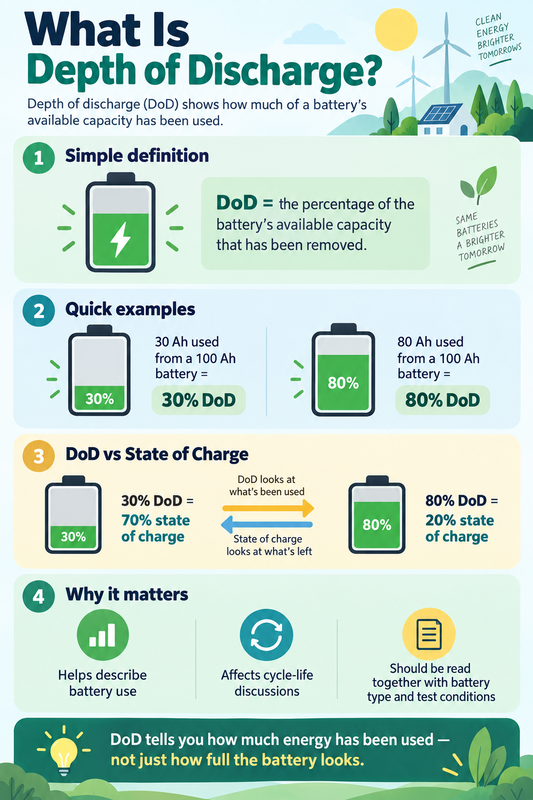
Depth of discharge, usually abbreviated as DoD, describes how much of a battery’s available capacity has been removed.
If a fully charged battery has 100 Ah available and 30 Ah is used, its depth of discharge is approximately 30%.
If 80 Ah is used, the DoD is approximately 80%.
This is closely related to state of charge, but the two measurements look at the battery from opposite directions.
A battery at roughly 70% state of charge has used about 30% of its available capacity, so its depth of discharge is approximately 30%.
A more detailed explanation is available here:
What Is Cycle Life?
Cycle life describes how many charge-discharge cycles a battery can complete before reaching a defined performance threshold.
That threshold matters.
A manufacturer might define end of cycle life as the point when measured capacity falls to 80% of its original value. Another test may use a different threshold.
Cycle-life figures therefore should not be interpreted without knowing the test conditions.
A battery rated for 3,000 cycles has not necessarily “failed” immediately after cycle 3,000. The rating usually means that under a specified test method, the battery is expected to retain a stated amount of capacity after approximately that number of cycles.
For more detail:
https://digitalowl.fika.bar/what-is-battery-cycle-life-01M2YNVWHAW1CQ4D7CFQ9DSEHH
Deeper Cycles Can Create More Stress
For many rechargeable battery systems, deeper discharge cycles can contribute to faster degradation than shallower cycles.
Imagine repeatedly using almost the entire available capacity of a battery before charging it again.
The electrodes experience a wider range of chemical and physical change during each cycle than they would during smaller charge-discharge swings.
Over many repetitions, that can contribute to greater material stress and faster loss of usable capacity.
This is why manufacturers often report different cycle-life figures at different depths of discharge.
A battery may achieve more cycles when tested at 50% DoD than when repeatedly cycled at 100% DoD.
But this does not mean that reducing DoD automatically increases total lifetime energy by exactly the same proportion.
More Cycles Does Not Automatically Mean More Lifetime Energy
Cycle count alone can be misleading.
Consider a simplified example.
Battery A completes:
2,000 cycles × 100% DoD
Battery B completes:
3,000 cycles × 50% DoD
Battery B has a higher cycle count, but each cycle moves only half as much energy.
To compare the two fairly, you would also need to consider how much total energy each battery delivered across its lifetime.
This is one reason cycle-life specifications should not be compared using the cycle number alone.
The DoD used during testing matters.
So do battery capacity, degradation threshold, temperature and charge-discharge conditions.
Partial Cycles Still Add Up
A battery does not need to move from 100% charge to nearly empty for a cycle to count.
Battery usage can also be described using equivalent full cycles.
For example, two separate discharges of approximately 50% of usable capacity represent roughly the same total energy throughput as one full 100% discharge.
Similarly, four 25% discharges add up to approximately one equivalent full cycle.
This does not mean that four shallow cycles create exactly the same degradation as one deep cycle. The electrochemical stress can differ.
Equivalent full cycles are mainly a useful way to describe total energy throughput.
They help prevent the mistaken idea that only complete 100-to-0% discharges count as battery usage.
Why the 80% DoD Rule Is Not Universal
You may often see recommendations to limit a battery to around 80% depth of discharge.
In some systems, this can provide a useful compromise between available energy and battery longevity.
But 80% is not a universal boundary between “safe” and “damaging.”
Different chemistries behave differently.
Lithium iron phosphate, other lithium-ion chemistries, lead-acid batteries and newer storage technologies can have very different preferred operating ranges.
Battery packs also contain management systems that may reserve some capacity beyond what the user sees.
A device displaying 0% state of charge may therefore not necessarily have driven the individual cells to their absolute electrochemical minimum.
The correct operating range should come from the battery or equipment manufacturer rather than from a single percentage applied to every battery.
Temperature Changes the Relationship
Depth of discharge does not act alone.
A battery repeatedly cycled deeply at moderate temperature may age differently from an identical battery performing the same cycles under high-temperature conditions.
Heat can accelerate many degradation reactions.
High current can create additional internal heating.
Fast charging, deep discharge and elevated temperature can therefore combine to create more stress than any single factor considered separately.
This is one reason real battery lifespan cannot be predicted accurately from DoD alone.
The Best DoD Depends on the Application
Different applications need different trade-offs.
A backup power system may spend most of its life almost fully charged and only discharge deeply during outages.
An electric vehicle may complete partial cycles almost every day.
A portable power station might alternate between long storage periods and occasional deep discharge.
A solar-storage system may cycle every day depending on generation and household demand.
The most useful depth of discharge is therefore not necessarily the shallowest possible cycle.
Restricting a battery to a very narrow operating range may extend cycle life, but it also reduces the amount of usable energy available from the installed battery capacity.
The practical goal is usually to balance usable energy, required lifespan, cost and operating conditions.
Read Cycle-Life Claims Together With DoD
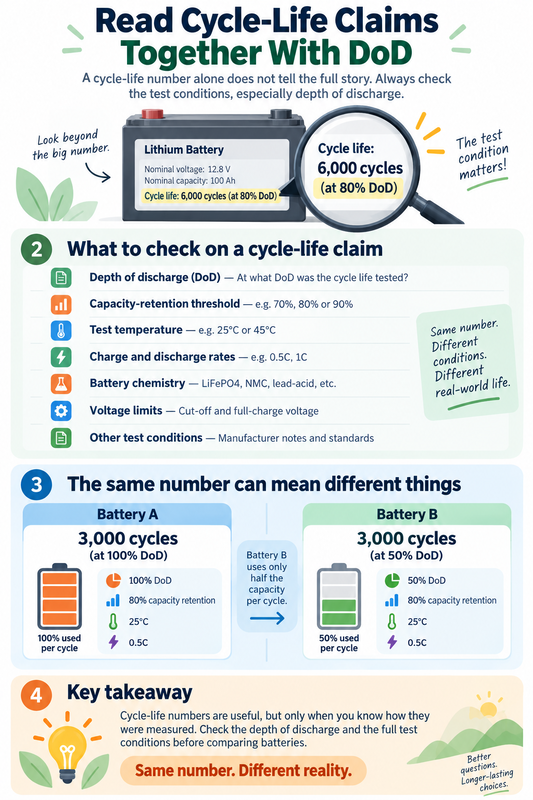
When a battery specification says:
“6,000 cycles”
the next question should be:
At what depth of discharge?
Then check:
the capacity-retention threshold;
test temperature;
charge and discharge rates;
battery chemistry;
voltage limits;
other stated test conditions.
Two batteries advertised with the same cycle count may have been tested under substantially different conditions.
Likewise, a battery with a lower advertised cycle count is not automatically inferior if its rating was measured using a more demanding test.
Depth of Discharge Is One Part of Battery Lifespan
Depth of discharge can influence battery aging, but it is only one variable.
Repeated deep cycling can increase degradation stress for many battery types, while shallower cycling can often increase the number of cycles available.
But there is no single DoD percentage that guarantees a particular lifespan.
Battery chemistry, temperature, current, voltage limits, calendar aging and battery-management strategy all matter too.
So instead of asking:
“What is the perfect depth of discharge?”
a better question is:
“What operating range was this battery designed and tested for?”
That keeps the focus on the actual battery rather than on a rule that may have been taken from a completely different chemistry or application.
Comments
No comments yet. Be the first to comment!