LiFePO4 vs NMC
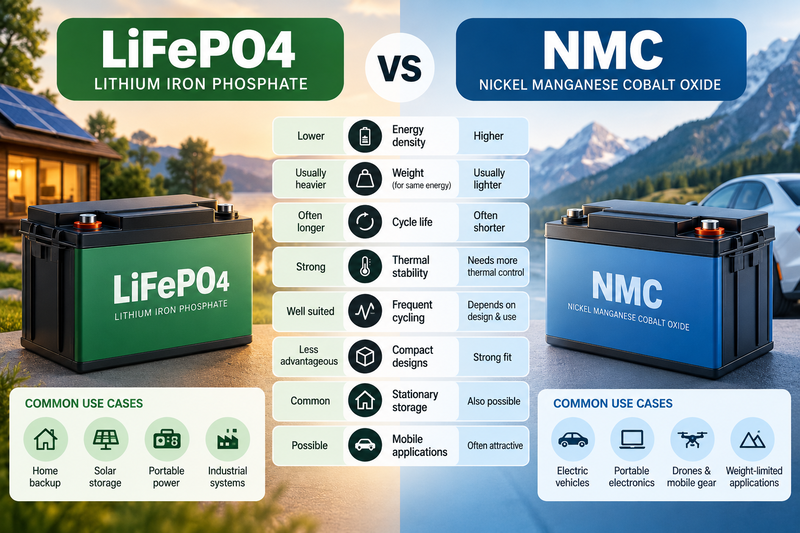
LiFePO4 and NMC are two common lithium-ion battery chemistries, but they are optimized around different priorities. One tends to emphasize long cycle life and thermal stability, while the other can offer higher energy density when size and weight matter.
That does not make either chemistry universally better.
The useful question is:
Which trade-offs matter most for the application?
Before comparing chemistry, it also helps to separate battery chemistry from battery capacity. Capacity tells you how much charge or energy a battery can store; chemistry influences characteristics such as weight, cycle life, voltage behaviour and operating limits. A broader explanation of battery capacity, including mAh, Ah and Wh, is available here:
https://medium.com/@volodymyrzh/battery-capacity-explained-mah-wh-amp-hours-decoded-1dc676be5a38
What Is LiFePO4?
LiFePO4, or lithium iron phosphate, is a lithium-ion chemistry that uses lithium iron phosphate as the cathode material.
It has become common in applications where durability, frequent cycling and long service life matter. Examples include portable power stations, solar storage systems, home backup batteries and some industrial energy-storage applications.
A more detailed introduction to this chemistry is available here:
https://digitalowl.fika.bar/what-is-a-lifepo4-battery-01M2ZXCSGCM7R3AZWCTMWBDNGP
LiFePO4 is generally associated with:
long cycle life;
strong thermal stability;
good durability under repeated cycling;
relatively stable operating behaviour;
lower energy density than some other lithium-ion chemistries.
That final point creates one of the main trade-offs in a LiFePO4 vs NMC comparison.
What Is NMC?
NMC stands for lithium nickel manganese cobalt oxide. Its cathode combines nickel, manganese and cobalt in proportions that can vary between battery designs.
NMC is widely used where manufacturers need to store substantial energy while keeping battery size and weight relatively low. That makes it particularly relevant to electric vehicles, portable electronics and other applications where energy density matters.
A dedicated explanation of NMC chemistry is available here:
https://digitalowl.fika.bar/what-is-an-nmc-battery-01M30ZRDJ2SAT2PSPFN5WHV631
Typical NMC advantages include:
higher energy density;
lower weight for a given amount of stored energy;
compact battery-pack design;
strong suitability for mobile applications.
Its trade-offs can include shorter cycle life than long-life LiFePO4 designs and a greater need for careful thermal and battery-management controls.
LiFePO4 vs NMC: The Main Differences
The easiest way to compare the two chemistries is to look at the design priorities they tend to support:
Energy density: LiFePO4 is generally lower; NMC is generally higher.
Weight for the same stored energy: LiFePO4 packs are usually heavier; NMC can often achieve lower weight.
Cycle life: LiFePO4 often offers longer cycle life; NMC cycle life depends more heavily on cell design and operating conditions.
Thermal stability: LiFePO4 is known for strong thermal stability; NMC typically requires more careful thermal management.
Frequent cycling: LiFePO4 is often well suited to repeated daily cycling.
Compact designs: NMC has an advantage where size and weight are major constraints.
Stationary storage: LiFePO4 is common, although NMC can also be used.
Mobile applications: NMC is often attractive because of its higher energy density.
These are general chemistry-level tendencies. Actual battery performance still depends on cell design, battery management, temperature, depth of discharge, charge rate and other operating conditions.
A chemistry label alone does not tell you everything about a finished battery pack.
Cycle Life: Why LiFePO4 Is Often Used for Repeated Cycling
Cycle life describes how many charge-discharge cycles a battery can complete before its usable capacity declines to a defined threshold.
LiFePO4 is often selected for systems expected to cycle frequently. A home battery, solar storage system or portable power station may be charged and discharged repeatedly for years, making cycle durability an important design priority.
NMC batteries can also provide substantial cycle life, but their major advantage is often elsewhere: storing more energy in less mass and volume.
This means a buyer should not compare chemistry using cycle count alone. A claimed number of cycles should always be interpreted together with:
depth of discharge;
temperature;
charge and discharge rates;
end-of-life capacity threshold;
manufacturer test conditions.
Energy Density and Weight
Energy density describes how much energy can be stored relative to battery mass or volume.
This is one of NMC's major strengths. If two battery packs store similar amounts of energy, an NMC design can often be made smaller or lighter than an equivalent LiFePO4 design.
That matters particularly in:
electric vehicles;
portable electronics;
compact mobile equipment;
applications with strict weight limits.
LiFePO4 can be less attractive when minimum weight and maximum compactness are the main priorities. For stationary storage, however, the additional weight may matter much less.
Temperature and Thermal Behaviour
Battery temperature affects performance, charging and degradation regardless of chemistry.
LiFePO4 is generally valued for strong thermal stability, which is one reason it is widely used in stationary and backup applications. NMC systems can also operate safely when correctly designed, but thermal management and battery-management protections are especially important.
Low temperatures create another consideration. Neither chemistry should be treated as unaffected by cold. Available power, charging behaviour and usable capacity can all change with temperature, and the exact limits depend on the individual cell and battery-management system.
For real products, manufacturer operating-temperature specifications matter more than assuming behaviour from the chemistry name alone.
Which Chemistry Fits Which Use Case?
Instead of asking which battery chemistry is better overall, match the chemistry to the design priorities.
LiFePO4 may make more sense when:
the battery will be cycled frequently;
long service life is a major priority;
additional weight is acceptable;
the system is stationary or semi-portable;
thermal stability is especially valuable.
NMC may make more sense when:
energy density is critical;
weight needs to be minimized;
the battery must fit into limited space;
mobility is a major design requirement;
more stored energy per kilogram is valuable.
This is why the same chemistry does not dominate every battery category.
A home backup battery and an electric vehicle may both require large amounts of stored energy, but their design constraints are very different.
Chemistry Is Only One Part of the Battery Decision
LiFePO4 vs NMC is useful as a comparison, but chemistry should not replace system-level evaluation.
A suitable battery also needs the right:
energy capacity;
continuous power capability;
surge capability;
charging rate;
voltage;
battery-management system;
temperature range;
physical size and weight.
A high-energy-density battery is not useful if it cannot support the required load. A long-cycle-life battery may still be oversized for the application. A lighter chemistry may offer little practical advantage in a permanently installed system.
The better decision process is:
Define the application → determine energy and power requirements → identify physical and lifetime constraints → compare chemistry.
LiFePO4 and NMC solve different engineering problems well. The right choice depends less on finding a universal winner and more on understanding which compromises the application can accept.
Comments
No comments yet. Be the first to comment!