What Are Solar Input Limits?
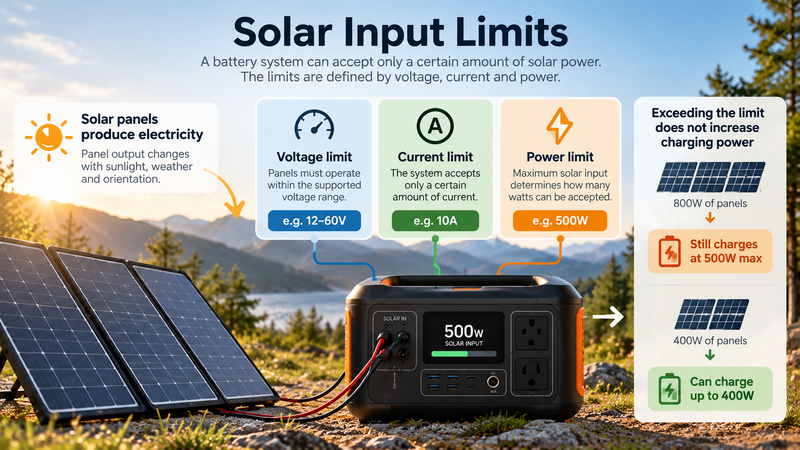
Adding more solar panels seems like the obvious way to charge a battery faster. Sometimes it works. Sometimes it does almost nothing.
The difference often comes down to solar input limits — the electrical boundaries that determine how much solar power a battery system, charge controller or portable power station can actually accept.
These limits are usually defined by three numbers:
maximum input voltage
maximum input current
maximum input power
Understanding them is important because solar panels and batteries cannot simply be matched by comparing watt ratings.
Solar Input Is Not Unlimited
A portable power station might advertise:
Solar input: 500W max
That means the charging system is designed to accept up to roughly 500W under appropriate conditions. Connecting 800W of panels does not automatically mean the station will charge at 800W.
The charging electronics may simply cap the accepted power near their rated maximum. In some systems, oversizing the solar array can still be useful because panels rarely operate at their full nameplate rating all day.
But there is an important difference between having more panel capacity available and having more charging power accepted.
For the broader battery-capacity framework, see:
https://medium.com/@volodymyrzh/battery-capacity-explained-mah-wh-amp-hours-decoded-1dc676be5a38
Maximum Solar Input Power
The simplest limit to understand is wattage.
Suppose a power station has:
Maximum solar input: 400W
A 200W panel may supply up to around 200W under good conditions. Two 200W panels could theoretically provide around 400W.
Four 200W panels have 800W of nameplate capacity, but the power station may still accept only around 400W. The remaining potential output cannot simply be forced into the battery.
This is why charging power and battery capacity should be treated as separate specifications.
A deeper explanation of that distinction is available here:
https://digitalowl.fika.bar/charging-power-vs-battery-capacity-01M3F78YY9ZSWJQV8EX0ZGEMP1
Battery capacity tells you how much energy can be stored. Solar input power tells you how quickly solar energy can potentially enter the system.
Voltage Limits Matter Too
Wattage is only one part of the specification. Solar charging inputs normally operate within a voltage range.
A simplified specification might look like:
Solar input: 12–60V
That means the connected solar array must produce voltage within the range supported by the charger. Too little voltage may prevent charging from starting efficiently. Too much voltage can exceed the input rating of the system.
This is particularly important when panels are connected in series.
Series Connections Increase Voltage
Imagine two solar panels, each with an operating voltage of roughly 20V.
Connected in series:
20V + 20V = 40V
If the solar input supports up to 60V, that configuration may fall within the operating range.
Add a third identical panel:
20V + 20V + 20V = 60V
Now the system is much closer to its upper voltage limit.
And the calculation should not rely only on the panel's typical operating voltage. Solar-panel specifications also include open-circuit voltage, often written as Voc.
This value can be higher than normal operating voltage, and cold conditions can raise panel voltage further. For that reason, a solar array should not be designed to sit exactly at the charger's maximum voltage under idealised assumptions.
Current Limits Work Differently
Solar charging inputs also have a maximum current.
Suppose the specification says:
Maximum solar input current: 10A
If the connected array can theoretically deliver 15A, the charging system may still accept only up to its current limit.
Current becomes especially important when panels are connected in parallel. While series connections increase voltage, parallel connections primarily increase available current.
That means changing the panel wiring arrangement can move the system closer to either its voltage or current boundary.
Watts Are the Result of Voltage and Current
Electrical power follows the basic relationship:
Power = Voltage × Current
or:
W = V × A
For example:
50V × 10A = 500W
but:
25V × 10A = 250W
Even though the current limit is the same, the possible input power is different.
This is one reason why solar-input specifications often list voltage, amperage and wattage separately. You need all three to understand the practical limits.
Why More Panels Can Still Help
If a charger accepts only 500W, why would anyone connect more than 500W of panels?
Because solar panels rarely produce their nameplate output continuously.
A nominal 500W array might produce:
420W in good sun
280W with imperfect orientation
180W under light cloud
much less in the morning or evening
A somewhat larger array can keep the charger closer to its maximum input for more of the day.
For example, an 800W array connected to a 500W solar input may reach the 500W charging ceiling earlier in the morning and remain near it longer in the afternoon.
The charger still cannot accept more than its limit, but the total energy collected across the day may increase.
This Is Sometimes Called Overpaneling
Designing a solar array with a higher theoretical watt rating than the charger's maximum accepted power is sometimes called overpaneling.
It can be useful when done within the electrical limits of the system. But wattage alone does not determine whether the configuration is safe.
You still need to respect:
maximum input voltage
maximum input current
supported operating-voltage range
connector specifications
manufacturer requirements
An array can be oversized in watts while remaining within acceptable voltage and current limits. A different configuration with the same total wattage could exceed one of those limits.
Solar Input Limits Affect Battery Sizing Too
Solar input limits also influence how much battery capacity is useful in a system.
Suppose you have a large battery that consumes 3,000Wh overnight. If the solar input can accept only 300W, replenishing that energy may take a long time even if a much larger solar array is available.
In simplified terms:
3,000Wh ÷ 300W = 10 hours
Real charging would usually take longer because solar output varies and charging is not perfectly efficient.
This creates an important design relationship:
Battery capacity must be considered together with realistic recharge capability.
The previous article in this series explains how solar replenishment changes battery-capacity requirements:
A large battery can provide long runtime, but it is less useful if the charging system cannot replenish it within the available solar window.
A Bigger Array Does Not Always Mean Faster Charging
Consider a power station with:
2,000Wh battery capacity
500W maximum solar input
You connect 500W of panels. Under strong conditions, the system may approach its maximum charging rate.
Now you increase the array to 1,000W. The battery does not suddenly receive 1,000W.
The charging system still limits incoming power to approximately 500W. The larger array may improve charging during weaker sunlight, but peak charging speed remains limited by the input hardware.
That distinction matters when deciding whether to spend money on more panels or on a system with a higher solar-input rating.
Panel Configuration Can Matter More Than Total Wattage
Two arrays can have the same total panel wattage and behave differently.
Imagine four 100W panels.
Total array size:
400W
One wiring configuration might produce higher voltage and lower current. Another might produce lower voltage and higher current.
Both are still technically 400W arrays, but only one configuration may fit comfortably inside the voltage and current limits of a particular charger.
That is why the phrase “supports 400W of solar” is not enough information by itself. You also need the electrical input range.
MPPT Controllers Operate Within a Window
Many modern power stations and battery systems use an MPPT — Maximum Power Point Tracking — charge controller.
Its job is to operate the solar array near a point where useful power extraction is maximised. But an MPPT controller still has operating boundaries.
A typical specification may include something like:
MPPT input: 11–60V, 15A, 500W max
Each part matters. The system must operate within those limits for the controller to work as intended.
Check Limits Before Adding Panels
Before changing a solar array, check the specifications for both the panels and the receiving device.
For the charger or power station, identify:
maximum solar input wattage
acceptable voltage range
maximum voltage
maximum current
connector requirements
For the panels, check:
rated power
operating voltage
open-circuit voltage
operating current
short-circuit current
Then consider how those values change when panels are connected in series or parallel.
The Key Idea
Solar input limits define how much electrical power a battery system can accept from solar panels and under what electrical conditions.
The three main constraints are:
Voltage — how much electrical potential the input can tolerate
Current — how much amperage the input can accept
Power — how many watts the charging system can process
Adding more panel wattage can increase the amount of energy available during weak or variable sunlight, but it does not automatically increase maximum charging power.
Once the charging system reaches its input ceiling, the bottleneck is no longer the solar array.
It is the charger itself.
Comments
No comments yet. Be the first to comment!