Appliance Backup Sizing Index: Refrigerators, Pumps, CPAP and More
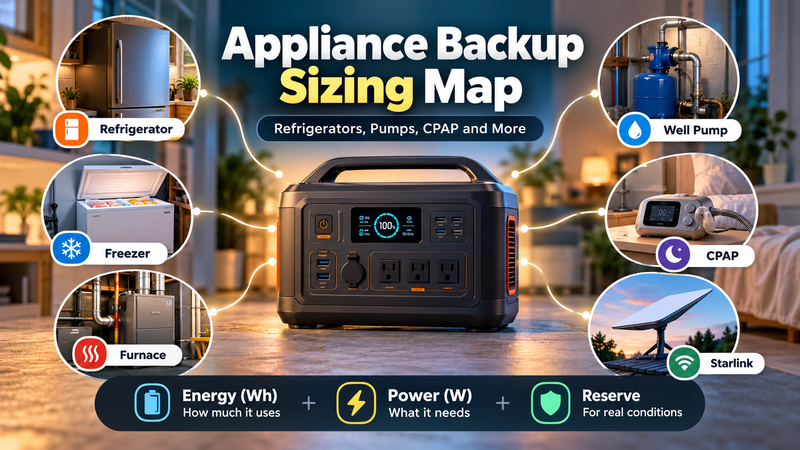
A battery backup system that can run a refrigerator overnight may not be suitable for a well pump. A power station that supports a CPAP machine for twelve hours might provide much shorter runtime for a furnace blower. And a battery with enough stored energy may still lack the electrical output needed to start a motor.
Backup battery sizing begins with the appliance, not the battery specification. Each device has its own energy consumption, operating pattern, starting requirements and power compatibility constraints.
This appliance backup sizing index helps you select the appropriate calculation method for refrigerators, freezers, heating equipment, water pumps, CPAP machines, Starlink systems and portable power stations.
Start With Four Battery Backup Questions
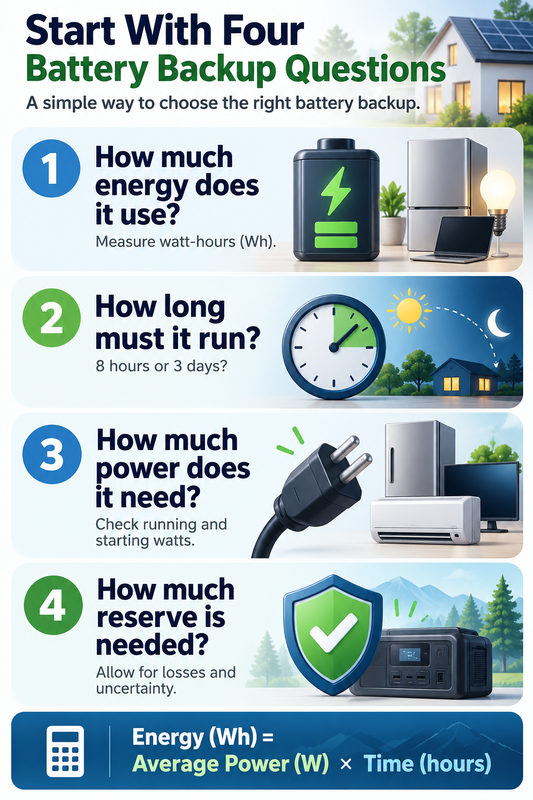
Before choosing a battery, establish four requirements.
1. How much electrical energy does the appliance consume? Measure or estimate watt-hours (Wh) over a representative period.
2. How long must it operate? An eight-hour outage and a three-day outage create very different energy requirements.
3. How much power does it need? Continuous running watts and short-duration starting requirements determine whether the inverter can support the appliance.
4. How much reserve is necessary? Conversion losses, variable consumption and uncertainty can reduce actual runtime.
The basic relationship is:
Energy (Wh) = Average Power (W) × Operating Time (hours)
For example, a constant 50W load requires 400Wh over eight hours.
However, a refrigerator compressor or well pump may operate intermittently, making average energy consumption more useful than rated running watts alone.
For the broader sizing workflow across household loads and outage durations, see Battery Backup Sizing Map: Find the Right Guide for Your Scenario:
Refrigerator Backup: Start With Daily Watt-Hours
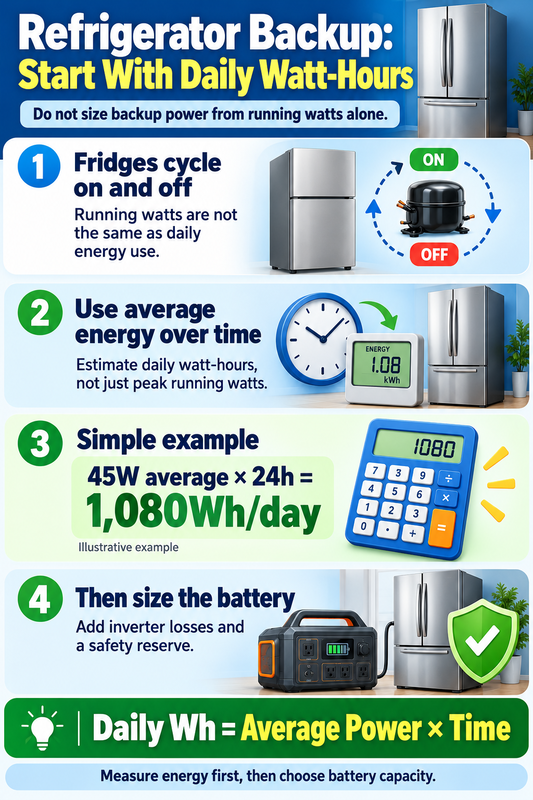
Refrigerators usually cycle their compressors rather than drawing full running power continuously.
A refrigerator consuming 120W while its compressor is active does not necessarily consume 2,880Wh every day.
Its actual daily energy use depends on compressor operating time, ambient temperature, door openings and appliance design.
For example, a refrigerator averaging 45W requires:
8 hours: 360Wh.
12 hours: 540Wh.
24 hours: 1,080Wh.
These are illustrative appliance-level figures, before battery-system losses.
To understand why running watts can exaggerate daily energy requirements, read Why Refrigerator Running Watts Can Overestimate Daily Energy Use:
If you are specifically evaluating a small portable power station, continue with Can a 1,000Wh Power Station Run a Refrigerator Overnight?
Remember to check the compressor's starting power separately from its average energy consumption.
Freezer Backup: Capacity vs Cold Retention
A freezer presents a different decision because its contents may remain safely frozen for some time after grid electricity fails.
The first question is whether immediate backup power is necessary or whether keeping the freezer closed is sufficient during a short outage.
For longer interruptions, energy consumption becomes important.
Suppose a freezer averages 50W while operating under representative conditions:
8 hours: 400Wh.
12 hours: 600Wh.
24 hours: 1,200Wh.
The required battery capacity will be higher after accounting for conversion losses and reserve.
For the complete sizing method, see How Much Battery Capacity Does a Freezer Need During an Outage?
Freezer food safety should be assessed separately from battery runtime, using reliable temperature information and food-safety guidance.
Furnace Blower Backup: Know What Produces the Heat
A gas furnace and an electric resistance furnace have fundamentally different electrical demands.
A gas furnace may use electricity primarily for the blower, ignition, inducer motor and controls. Electric resistance heating uses electricity directly to generate heat and can require many kilowatts.
Consider a hypothetical gas furnace averaging 220W electrically.
Its energy consumption would be:
8 hours: 1,760Wh.
12 hours: 2,640Wh.
24 hours: 5,280Wh.
Actual consumption depends on heating duty cycle and operating conditions.
For the calculations and connection requirements, use How Much Battery Capacity Does a Furnace Blower Need?
A hardwired furnace may require professionally installed transfer equipment. Sufficient battery capacity alone does not establish safe compatibility.
Well Pump Backup: Starting Surge Comes First
Well pumps introduce another important consideration: motor startup.
A battery can contain enough energy for several pumping cycles yet be unable to start the motor.
Suppose a hypothetical well pump consumes 900W while running.
Its operating energy would be:
15 minutes: 225Wh.
30 minutes: 450Wh.
60 minutes: 900Wh.
These figures exclude conversion losses, reserve and supporting electrical equipment.
Because pumps often run intermittently, the total pumping time can be much shorter than the outage duration.
However, the inverter must provide the correct voltage, frequency, phase arrangement and motor-starting capability.
For the complete workflow, read How Much Battery Capacity Does a Well Pump Need?
Hardwired pump connections should be designed and verified by qualified professionals.
CPAP Backup: Reliability Matters More Than the Headline Capacity
A CPAP machine may have comparatively modest energy consumption, but its backup requirements should be approached carefully because continuity of therapy can be important.
Power consumption varies with machine configuration, pressure settings, heated humidification and heated tubing.
A hypothetical CPAP configuration averaging 45W requires:
8 hours: 360Wh.
10 hours: 450Wh.
12 hours: 540Wh.
The battery must also provide manufacturer-compatible power and remain operational throughout the required period.
Automatic low-load shutdown, incompatible DC adapters or interruptions when switching power sources may make an otherwise adequate power station unsuitable.
For detailed calculations, see How to Size Backup Battery Capacity for a CPAP Overnight:
Use approved power accessories and confirm the backup arrangement with the equipment provider or appropriate healthcare professional when continuous treatment is essential.
Starlink Backup: Calculate the Complete Connectivity Load
Starlink terminals require electricity even when conventional network infrastructure is unavailable.
Different hardware generations have different consumption ranges, so using one universal wattage can produce inaccurate estimates.
For example, under illustrative average loads:
Starlink Mini — 35W
8 hours: 280Wh.
12 hours: 420Wh.
Starlink Standard — 85W
8 hours: 680Wh.
12 hours: 1,020Wh.
Any separate network switches, access points or additional routers should be included in the energy budget without double-counting equipment already covered by the manufacturer's system power specification.
For model-specific sizing, read How Much Battery Capacity Does Starlink Need During an Outage?
Remember that battery runtime and uninterrupted connectivity are separate requirements. A power-source change may still cause network equipment to restart.
Choosing a Power Station: 1,000Wh or 2,000Wh?
After calculating appliance requirements, the next decision is how much stored energy the power station should provide.
A 2,000Wh battery stores approximately twice the nominal energy of a 1,000Wh battery.
For illustration, assume both deliver 85% of their nominal capacity to a compatible load:
1,000Wh station: approximately 850Wh delivered.
2,000Wh station: approximately 1,700Wh delivered.
At a constant 100W load, simplified runtime estimates become 8.5 and 17 hours respectively.
The larger station offers more reserve but may also be heavier, larger and more expensive.
For the complete comparison, see 1,000Wh vs 2,000Wh Power Station: What Changes in Real Use?
The better choice is the one that satisfies the required energy budget without introducing unnecessary compromises.
Do Not Confuse Watts and Watt-Hours
A power station offering 2,000W continuous output does not necessarily contain a 2,000Wh battery.
These specifications answer different questions.
Watts (W) describe the rate at which the system can deliver electrical power.
Watt-hours (Wh) describe stored or consumed energy.
For example, a hypothetical 2,000Wh battery supplying a constant 1,000W load would last two hours in a perfectly efficient system, assuming it can deliver that output.
Real runtime would generally be shorter because of conversion losses and operating constraints.
For a practical explanation, see 2,000W vs 2,000Wh: Why These Specs Mean Different Things:
This distinction matters especially when selecting backup power for motors, heating equipment or several appliances simultaneously.
A Practical Five-Step Battery Sizing Workflow
The calculations for all these appliances follow a common structure.
Step 1 — Define the essential load. List the exact equipment that must remain operational.
Step 2 — Measure or estimate energy consumption. Use representative Wh measurements wherever possible, especially for devices with variable duty cycles.
Step 3 — Establish the backup duration. Calculate energy for the actual required period, not simply the total duration of the outage if equipment operates intermittently.
Step 4 — Verify power compatibility. Check continuous load, startup requirements, voltage, frequency and approved connection methods.
Step 5 — Add losses and reserve. Use documented usable-energy information, conversion efficiency and an appropriate uncertainty margin.
For example, if essential appliances require 1,200Wh, an illustrative 85% delivery factor and 20% planning margin produce:
1,200 ÷ 0.85 × 1.20 ≈ 1,694Wh nominal battery capacity.
This is a planning result, not a product recommendation or guaranteed runtime.
The wider decision framework is explained in From Energy Loads to Backup Capacity: A Practical Sizing Framework:
It connects appliance requirements, outage duration and recharging availability to a systematic sizing process.
When Battery Runtime Is Different From Expected
Even a carefully calculated system can deliver less runtime than expected.
Potential causes include inaccurate appliance consumption assumptions, changing temperature, inverter standby consumption, reduced battery health or an incorrect interpretation of usable capacity.
Before assuming the battery has failed, identify which measurement is responsible for the difference.
The broader diagnostic guide is Battery Health & Runtime Troubleshooting Index:
https://digitalowl.fika.bar/battery-health-runtime-troubleshooting-index-01M57ZRECZN3GJMQ3JFHJK5XNS
This helps distinguish energy-consumption problems from battery ageing and equipment configuration issues.
Final Appliance Backup Decision Checklist
Before selecting a backup battery, confirm:
Appliance: what exact model and electrical configuration will be powered?
Consumption: how many Wh does it use over a representative period?
Runtime: how long must it operate without recharging?
Starting power: is motor surge capability required?
Usable capacity: how much energy reaches the appliance?
Reserve: have losses and uncertain conditions been considered?
Connections: are voltage, frequency and power-transfer arrangements compatible?
Additional loads: will other equipment operate simultaneously?
Recharging: can the battery recover enough energy during an extended outage?
Safety: are all operating and installation requirements satisfied?
The most important lesson is that appliances with similar wattage ratings can have very different backup requirements. Some operate continuously, others cycle, some require high startup current, and others need uninterrupted compatible power.
Final Takeaway
Reliable appliance backup sizing requires both an energy calculation and an electrical compatibility check.
Refrigerators and freezers need realistic average consumption estimates. Furnace blowers and well pumps require careful motor and connection assessment. CPAP backup prioritises compatible, reliable operation. Starlink requires model-specific energy calculations and consideration of network continuity.
Portable power station capacity determines how much energy is stored, while inverter output determines which devices can operate.
The practical rule is simple: identify the appliance, calculate its real energy requirement, verify its power needs and choose a battery with sufficient usable capacity and reserve.
All calculations are illustrative. Actual runtime, conversion losses and power demand vary with the equipment and operating conditions.
Comments
No comments yet. Be the first to comment!