Does Fast Charging Shorten Battery Life?
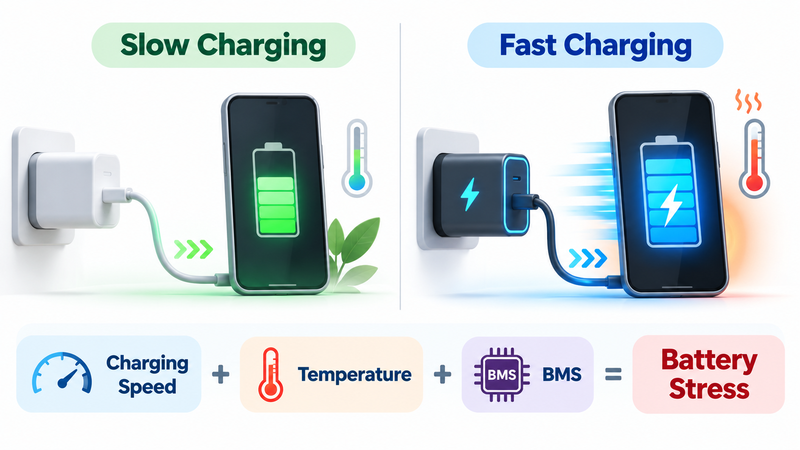
Fast charging is convenient, but does it damage a battery or make it wear out faster? The answer depends on charging power, battery chemistry, temperature, state of charge and how the battery management system controls the process. Faster charging can increase stress inside battery cells, but it does not automatically cause significant damage every time it is used.
Modern smartphones, electric vehicles and portable power stations often support charging rates much higher than older battery systems. Many are specifically designed to manage those rates within defined operating limits.
The important distinction is between fast charging that remains within a battery's engineered limits and charging conditions that create excessive thermal or electrochemical stress.
Why Can Fast Charging Affect Battery Lifespan?
Charging moves lithium ions between the electrodes of a lithium-ion battery. When charging current increases, the battery must accommodate this movement more quickly.
Higher charging rates can contribute to greater internal heating, polarisation and other electrochemical effects.
Under unfavourable conditions, particularly low temperatures or high states of charge, aggressive charging may increase the risk of lithium plating on the negative electrode. This can contribute to irreversible capacity loss and, in some circumstances, safety concerns.
However, charging-related degradation is influenced by the combination of conditions rather than charging speed alone.
Important variables include:
Charging current relative to battery capacity.
Cell chemistry and design.
Battery temperature.
State of charge during charging.
Charging duration and frequency.
Battery management and thermal control.
A battery designed for high charging rates may handle charging conditions that would be unsuitable for another battery.
For the broader relationship between charging current and longevity, see Charge Rate and Battery Lifespan:
https://digitalowl.fika.bar/charge-rate-and-battery-lifespan-01M2ZHDG7NFH4EGQ5JDD590TEG
The practical conclusion: fast charging can increase battery stress, but its actual effect depends on the charging conditions and system design.
Fast Charging vs Slow Charging: What Changes?
Slow charging generally applies a lower current over a longer period. Fast charging transfers energy more quickly, often requiring a higher current during part of the charging session.
Consider a hypothetical battery with a nominal capacity of 100 Ah.
At a charging current of 20 A, the nominal rate is 0.2C.
At 50 A, the nominal rate is 0.5C.
At 100 A, the nominal rate is 1C.
The C-rate expresses current relative to battery capacity. In this example, 1C corresponds to 100 A.
These values do not mean that the battery will always charge completely in exactly five hours, two hours or one hour. Actual charging behaviour depends on voltage limits, charging stages, efficiency and battery management restrictions.
A higher C-rate does not automatically indicate unsafe charging. The key question is whether the battery is designed and approved to accept that rate under the current conditions.
Why Battery Temperature Matters So Much
Temperature is one of the most important factors connecting charging speed and battery degradation.
When a battery charges, some electrical energy becomes heat because of internal resistance and other losses.
Higher charging current can increase heat generation, although the amount varies with battery design, temperature and state of charge.
Excessive heat may accelerate unwanted chemical reactions inside the cells. Over time, this can contribute to capacity loss and increased internal resistance.
Low temperatures create a different challenge. Charging a lithium-ion battery too quickly when it is cold can increase lithium-plating risk because the electrode processes may not accommodate the incoming lithium ions sufficiently quickly.
This is why some battery systems reduce charging current when their cells are too cold or too warm.
A detailed explanation of temperature-dependent battery performance is available in How Temperature Affects Battery Capacity:
https://digitalowl.fika.bar/how-temperature-affects-battery-capacity-01M2TH5RCYRERSTQCFZ39M5J2N
Fast charging at a controlled, suitable temperature is not equivalent to fast charging under extreme thermal conditions.
Does Fast Charging Always Produce More Battery Degradation?
Not necessarily.
A laboratory comparison between two charging profiles may reveal different rates of degradation, but those results cannot automatically be generalised to every battery.
For example, a high-power charging session that rapidly increases battery temperature could accelerate certain ageing mechanisms.
Another battery may have effective thermal management, suitable cell chemistry and a charging profile designed to limit stress.
The second system could perform substantially better under its supported charging conditions.
Battery ageing is also affected by calendar time, depth of discharge, storage conditions and operating patterns.
Therefore, it is misleading to claim that fast charging universally reduces battery lifespan by a fixed percentage.
Reliable comparisons require controlled tests that account for the battery chemistry, operating temperature, charge limits and cycling methodology.
How Does Fast Charging Affect Battery Cycle Life?
Cycle life describes how a battery's performance changes under repeated charging and discharging.
Manufacturers commonly express cycle life as the number of cycles completed before capacity falls to a specified retention threshold, such as 80% under defined test conditions.
Charging rate can influence the degradation observed during those cycles.
However, a battery rated for several thousand cycles under one charging protocol may not achieve the same result under a substantially different protocol.
The relationship also depends on discharge rate, depth of discharge and temperature.
For example, two batteries completing the same number of equivalent full cycles may experience different degradation if one operates at high temperatures and aggressive charging rates while the other follows a less stressful profile.
Learn more about cycle-count interpretation in What Is Battery Cycle Life?
https://digitalowl.fika.bar/what-is-battery-cycle-life-01M2YNVWHAW1CQ4D7CFQ9DSEHH
Cycle count alone does not describe battery ageing. The conditions under which those cycles occur matter.
Why Fast Charging Often Slows Down Near Full Capacity
Many lithium-ion charging systems do not maintain their highest charging power from empty to full.
Charging power may be relatively high during part of the session and then decrease as the battery approaches its upper voltage or state-of-charge limits.
This behaviour helps the system remain within its electrical, thermal and electrochemical operating boundaries.
In electric vehicles, the pattern is often represented by a charging curve showing delivered power against state of charge.
A vehicle might accept a high charging rate when the battery is suitably warm and at a relatively low SoC, then reduce charging power later.
The exact curve depends on vehicle design, battery condition, temperature and charger capability.
Portable power stations and smaller consumer devices also use charging-control strategies, although their implementations differ.
The important point is that the charger's advertised maximum power is not necessarily the power the battery receives throughout the entire session.
What Does a Battery Management System Do?
The battery management system (BMS) monitors and manages important operating conditions.
Depending on the system, its functions may include monitoring cell voltages, current, temperature and estimated state of charge, as well as controlling or requesting limits on charging and discharging.
During fast charging, these controls help prevent operation beyond the battery's permitted boundaries.
Some systems also include active thermal management, such as liquid cooling or controlled heating, to keep cells within suitable temperature ranges.
However, a BMS cannot eliminate all battery ageing.
Protective controls reduce certain risks and manage operating limits, but the cells still undergo time-dependent and usage-related degradation.
A good charging system therefore balances speed, performance, temperature and durability rather than trying to maximise charging current continuously.
Fast Charging in Electric Vehicles vs Portable Power Stations
The effects of fast charging are not identical across battery applications.
Electric Vehicles
EV batteries may support high-power DC charging, but the accepted charging power varies with temperature, state of charge, battery condition and vehicle design.
Thermal management and charging software are important parts of the system.
Repeated high-power charging under demanding conditions can contribute to battery wear, but actual degradation varies considerably between vehicles and usage profiles.
Portable Power Stations
Portable power stations may support rapid AC charging, solar input or combinations of charging sources.
Their charging behaviour depends on battery chemistry, battery capacity, power electronics and manufacturer limits.
Some models allow users to select slower or faster charging modes, which can be useful when charging time is not critical.
Smartphones and Laptops
Smaller devices have different thermal constraints. Fast charging may be limited by battery temperature, charging state and device-specific charging algorithms.
Heat generated elsewhere in the device can also affect the battery's operating environment.
Across these categories, a higher advertised charging wattage does not automatically indicate poorer battery longevity.
Why Battery Temperature Data Matters Beyond Charging
Temperature affects much more than the speed at which a battery can recharge.
It also influences available capacity, power delivery, charging restrictions and ageing behaviour.
This creates opportunities to study battery performance using datasets that connect charging conditions, temperature and energy availability.
For example, a useful technical comparison might examine charging curves at different temperatures alongside capacity-retention results under documented test conditions.
Such evidence can help readers distinguish real performance differences from simplified product claims.
The relationship between battery performance data and useful energy-planning resources is explored in the LinkedIn article Battery Temperature and Performance Data: Building Better Energy Planning Resources:
Transparent temperature and charging data are particularly valuable because real-world battery behaviour cannot always be described adequately by a single charging-speed figure.
Should You Avoid Fast Charging to Extend Battery Life?
There is no need to assume that every fast-charging session is harmful.
If the manufacturer supports fast charging under the relevant conditions, using that function as intended is generally different from forcing the battery beyond its approved limits.
However, when charging speed is not essential, a slower supported charging mode may reduce current-related stress or heat generation in some systems.
Practical considerations include:
Follow manufacturer limits. Use compatible chargers and approved charging methods.
Pay attention to temperature. Avoid exposing batteries to unnecessary heat during charging.
Respect cold-weather restrictions. Do not bypass charging protections or attempt to charge outside the permitted temperature range.
Use slower charging when practical. This may be beneficial for some batteries, but the magnitude of any lifespan improvement is not universal.
Avoid unnecessary extremes. Follow battery-specific recommendations about charging limits and prolonged high states of charge.
Monitor actual performance. Changes in runtime, battery health and charging behaviour are more informative than assumptions based solely on charger wattage.
The objective is not to eliminate fast charging. It is to use the available charging methods appropriately.
Final Takeaway
Fast charging can contribute to faster battery degradation under certain conditions, but it does not automatically shorten every battery's life by a predictable amount.
Charging current, temperature, chemistry, state of charge, cell design and battery management all influence the outcome.
Modern battery systems can regulate charging power to manage heat and electrochemical stress, although those protections do not completely prevent ageing.
Slow charging can be a sensible option when time is not critical, while fast charging remains valuable when rapid energy replenishment is needed.
The best practical rule is to charge within the battery's approved limits, manage temperature and avoid treating maximum charging speed as either universally harmful or universally harmless.
Comments
No comments yet. Be the first to comment!