Portable Power Station Capacity Explained
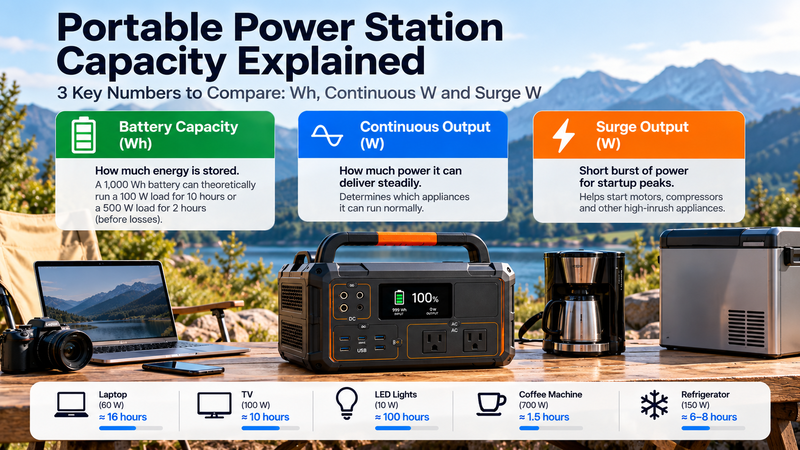
Portable power stations are often compared by one large number on the product page. Sometimes it is 500 Wh, 1,024 Wh or 2,048 Wh. That number matters, but it does not tell you everything the power station can do.
To understand whether a portable power station fits a real use case, you need to separate three specifications:
Battery capacity in Wh → Continuous output in W → Surge output in W
Capacity tells you how much energy is stored. Continuous output tells you how much power the unit can deliver steadily. Surge output describes the short burst of power it may provide when certain appliances start.
Those three numbers answer different questions, and none of them can replace the others.
For the broader battery-capacity framework, see:
https://medium.com/@volodymyrzh/battery-capacity-explained-mah-wh-amp-hours-decoded-1dc676be5a38
Start With Watt-Hours
Portable power station capacity is usually expressed in watt-hours (Wh).
A 1,000 Wh battery theoretically contains about 1,000 watt-hours of stored energy. At a simplified level, that could mean:
100 W load × 10 hours = 1,000 Wh
or:
500 W load × 2 hours = 1,000 Wh
That does not mean either runtime will be exact in real use. Conversion losses, standby consumption and usable-capacity limits reduce the amount of energy eventually delivered to your devices.
The important point is that Wh describes energy, not instantaneous power.
A useful comparison between stored capacity and actual runtime is explained here:
Capacity Does Not Tell You What the Power Station Can Run
Imagine two power stations both have a capacity of 1,000 Wh.
The first has a continuous AC output of 600 W.
The second has a continuous output of 1,800 W.
Their stored energy may be similar, but their ability to operate high-power appliances is very different.
A 1,200 W appliance may be within the output capability of the second unit but above the continuous rating of the first.
This is why comparing portable power stations only by battery capacity can be misleading.
You need to ask two separate questions:
How much energy does the power station store?
and:
How much power can it deliver at once?
The distinction between watts and watt-hours is explained here:
https://digitalowl.fika.bar/watts-vs-watt-hours-what-s-the-difference-01M2GNJJ68FM3605JW1JW54A99
Continuous Watts Tell You About Ongoing Load
The continuous output rating tells you approximately how much electrical load the power station is designed to support steadily.
Suppose a unit is rated for:
1,000 Wh capacity
and:
1,200 W continuous output
These numbers are not competing specifications.
The 1,000 Wh figure tells you how much stored energy is available.
The 1,200 W figure tells you the approximate maximum ongoing load the inverter can support within its design limits.
A 100 W television might run for many hours.
A 1,000 W appliance may run for much less time because it consumes the stored energy far more quickly.
Both devices can be within the inverter's continuous output limit, but their runtimes will be very different.
Surge Watts Handle Short Starting Peaks
Some appliances briefly require more power when starting than they consume during normal operation.
Motors, compressors and pumps are common examples.
A refrigerator might operate at a relatively modest power level once running but briefly require a much larger starting surge when its compressor switches on.
Portable power stations therefore often list a second output specification:
Surge power
or:
Peak power
This rating represents a temporary power capability rather than normal continuous output.
For example, a power station might be specified as:
1,500 W continuous
3,000 W surge
That does not mean it can continuously power a 3,000 W load.
It means the system may support a short peak up to its stated surge capability under the manufacturer's specified conditions.
The exact surge duration and behaviour vary by product, so the manufacturer's specifications still matter.
Wh and W Answer Different Buying Questions
A practical comparison becomes much easier when you assign one question to each specification.
Wh — How long can the stored energy potentially last?
Continuous W — Can the power station operate this load normally?
Surge W — Can it handle a short startup peak?
This creates a useful three-part check before comparing brands or additional features.
A power station with very high capacity but insufficient continuous output may store plenty of energy yet still be unsuitable for a high-power appliance.
A unit with high output but modest capacity may operate the appliance successfully but only for a relatively short period.
That is why battery capacity and inverter output should always be considered together.
Rated Capacity Is Not the Same as Energy Delivered to Your Appliance
If a power station is advertised as 1,024 Wh, you should not automatically expect exactly 1,024 Wh to appear at its AC sockets.
Some energy is consumed inside the system.
Possible losses include:
inverter conversion;
internal electronics;
battery-management systems;
standby consumption;
cable and conversion losses.
Manufacturers may also reserve part of the battery's theoretical capacity to protect the cells.
The difference between rated capacity and practically usable capacity is covered here:
For runtime planning, usable delivered energy is more important than the headline Wh number alone.
A Simple Portable Power Station Example
Consider a portable power station with these specifications:
Capacity: 1,024 Wh
Continuous output: 1,800 W
Surge output: 2,700 W
Now consider three loads.
A 60 W laptop
The continuous output limit is not a concern. The main question is how much energy the laptop consumes over the desired runtime.
At 60 W for five hours:
60 W × 5 h = 300 Wh
That is comfortably below the nominal 1,024 Wh capacity before accounting for losses.
A 700 W coffee machine
The power station can support the load because 700 W is below the 1,800 W continuous rating.
But the appliance consumes energy quickly.
If it operates for only ten minutes, however, the total energy requirement is much smaller than 700 Wh because it does not run for an entire hour.
A compressor-based appliance
Its normal running power may be below 1,800 W, but startup could briefly be much higher.
Now surge capability becomes relevant.
This illustrates why the same battery specification must be interpreted differently depending on the appliance.
Bigger Capacity Can Also Mean More Weight and Volume
More stored energy usually requires more battery material, although chemistry and pack design can change the relationship between capacity, weight and physical size.
This introduces another important distinction:
battery capacity describes total stored energy;
energy density describes how much energy can be stored relative to mass or volume.
Two batteries can contain similar amounts of energy while differing in size or weight because their chemistry and architecture are different.
For a deeper comparison of energy density and total battery capacity, see:
For portable power stations, this matters because capacity is only one part of portability.
A larger battery may provide longer runtime but also make the unit heavier and harder to move.
Do Not Start With Brand or Model
It is tempting to begin by comparing product names, feature lists and promotional claims.
A better process is to define the electrical requirements first.
Start with three numbers:
1. Required energy in Wh
Estimate how much energy your devices need for the desired operating period.
2. Maximum continuous load in W
Add the devices that may operate simultaneously and check whether the power station can support that ongoing demand.
3. Expected startup surge
Identify appliances with motors, compressors or other loads that may briefly require significantly more power when starting.
Once those requirements are known, product comparison becomes much easier.
You can then evaluate charging speed, solar input, ports, battery chemistry, cycle life, weight, expandability and other secondary specifications.
Capacity, Output and Surge Form One Specification Triangle
Portable power station sizing becomes clearer when you stop looking for one specification that determines everything.
Think of the product as a triangle:
Capacity in Wh → runtime potential
Continuous output in W → normal appliance compatibility
Surge output in W → short startup capability
A good match requires all three sides to fit the use case.
A large Wh number cannot compensate for an inverter that cannot run the appliance.
A high continuous watt rating cannot create additional stored energy.
A high surge rating does not mean the unit can sustain that load continuously.
Understanding those distinctions makes portable power station specifications much easier to read and compare.
Before looking at brands, start with the energy your devices need, the highest load they will draw and any startup peaks they may create.
Those three numbers tell you far more than battery capacity alone.
Comments
No comments yet. Be the first to comment!