What Are Peak Sun Hours?
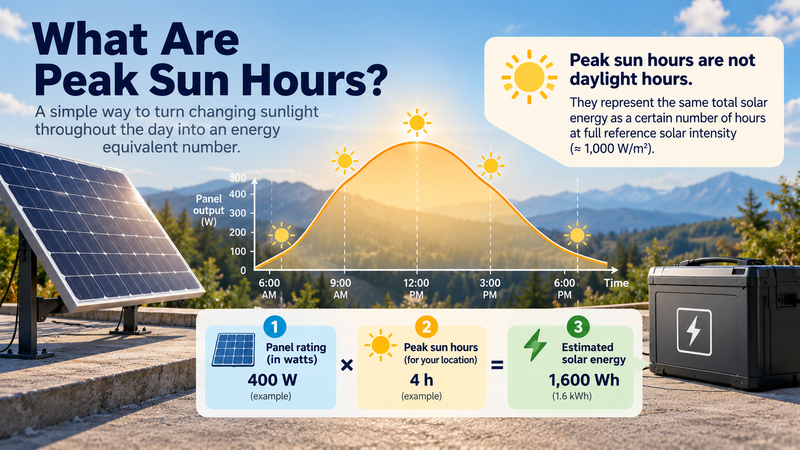
Peak sun hours are a way to convert changing sunlight throughout a day into a simple energy-equivalent number.
They do not mean the number of hours between sunrise and sunset. Instead, one peak sun hour represents the same solar energy as receiving approximately full reference solar irradiance for one hour.
This makes peak sun hours useful for estimating how much energy a solar panel or solar array may produce during a day.
The basic idea is:
Solar array watts × peak sun hours ≈ theoretical daily solar energy
Peak Sun Hours Are Not Daylight Hours
A location might have 10, 12 or 14 hours of daylight.
That does not mean a solar panel operates at its rated output for 10, 12 or 14 hours.
Sunlight changes throughout the day:
weak in the early morning;
stronger as the sun rises;
highest around the strongest part of the day;
weaker again toward evening.
Peak sun hours compress this changing solar resource into an equivalent number of hours at reference-level solar intensity.
So a day with 12 daylight hours might provide the equivalent of only several peak sun hours.
Think of Peak Sun Hours as an Energy Equivalent
Imagine sunlight building gradually during the morning, reaching a high level around midday and then falling again.
The actual solar curve might contain hundreds of different power levels.
Instead of calculating each moment separately, peak sun hours ask:
How many hours at full reference solar intensity would contain the same total solar energy?
For example, if the total sunlight received during a day is equivalent to four hours at approximately 1,000 W/m², the day can be described as providing roughly:
4 peak sun hours
This does not mean the sun was shining for only four hours.
It means the total solar energy is equivalent to four idealised full-power hours.
Why Peak Sun Hours Help Estimate Solar Energy
Suppose you have a 500 W solar array and estimate 4 peak sun hours for the relevant day.
The simplified calculation is:
500 W × 4 h = 2,000 Wh
or:
2 kWh
That gives a theoretical energy estimate before system losses and real-world conditions are considered.
This connects directly with the distinction between solar panel watts and solar energy:
https://digitalowl.fika.bar/solar-panel-watts-vs-solar-energy-01M3KRYFWQ65C0E305C4EV3RMQ
Panel watts describe power.
Peak sun hours help translate that power rating into an approximate daily energy value.
A 400 W Panel Example
Consider a 400 W panel.
With 3 peak sun hours:
400 W × 3 h = 1,200 Wh
With 5 peak sun hours:
400 W × 5 h = 2,000 Wh
With 6 peak sun hours:
400 W × 6 h = 2,400 Wh
The panel itself has not changed.
What changed is the available solar resource.
This is why the same solar array can produce very different amounts of energy in different locations, seasons or weather conditions.
Peak Sun Hours Change by Location
Solar resources vary geographically.
A sunny location may receive substantially more usable solar energy over the year than a cloudy or high-latitude location.
Peak sun hours can therefore differ because of:
latitude;
season;
local climate;
cloud patterns;
atmospheric conditions.
The relevant value for a solar calculation should ideally represent the location and time period being evaluated.
Using an annual average can be useful for a broad estimate, but it may hide important seasonal differences.
Peak Sun Hours Also Change by Season
A system that works comfortably in summer may behave very differently in winter.
For example, suppose a 1,000 W array receives:
5 peak sun hours in one season
That gives:
1,000 W × 5 h = 5,000 Wh theoretical
If another season provides only:
2 peak sun hours
the same array gives:
1,000 W × 2 h = 2,000 Wh theoretical
The solar array has the same rated power, but the available daily energy has fallen dramatically.
This matters when solar is expected to recharge batteries reliably throughout the year.
Peak Sun Hours Are Still an Estimate
The simple calculation:
Panel watts × peak sun hours
is useful, but it should not be interpreted as a guaranteed amount of battery energy.
Several factors can reduce actual production:
panel orientation;
tilt;
shading;
clouds;
temperature;
dirt or snow;
wiring losses;
solar-controller efficiency;
battery charging losses.
So:
500 W × 4 peak sun hours = 2,000 Wh
is best understood as a simplified solar-resource calculation.
The actual usable energy may be lower.
Peak Sun Hours and Battery Capacity
Peak sun hours become especially useful when solar is connected to a battery.
Suppose a battery needs 1,800 Wh to return to the desired state of charge.
You have:
500 W solar array
and:
4 peak sun hours
The theoretical solar energy is:
500 W × 4 h = 2,000 Wh
At first glance, that appears sufficient.
But some energy can be lost between the panels and battery, so the full 2,000 Wh may not become stored battery energy.
The useful comparison is therefore:
solar energy produced → system losses → battery energy stored
rather than simply comparing panel watts with battery watt-hours.
For the broader relationship between battery Wh and energy requirements:
https://medium.com/@volodymyrzh/battery-capacity-explained-mah-wh-amp-hours-decoded-1dc676be5a38
Do Not Size Solar From the Best Day of the Year
Another common mistake is to use an optimistic peak-sun-hours figure from ideal conditions.
If a battery system needs dependable solar replenishment, the relevant period may be the difficult one rather than the best one.
For example, a system designed around excellent summer conditions might have plenty of surplus energy in July but struggle to restore the battery during shorter or cloudier winter days.
A better calculation asks:
What solar resource is available when the system actually needs to work?
That may mean using monthly values, seasonal values or a conservative planning figure rather than one annual maximum.
Peak Sun Hours Do Not Describe Panel Efficiency
Peak sun hours describe the available solar resource.
They do not tell you how efficient a particular solar panel is.
Two different panels exposed to the same location and day can experience the same peak sun hours while producing different amounts of energy because their rated power, orientation or system design differs.
Keep the concepts separate:
Peak sun hours: available solar energy over time.
Panel watts: rated panel power.
Solar Wh/kWh: energy actually or theoretically produced.
Battery Wh: energy storage requirement.
Together, these values form the basis of practical solar-to-battery calculations.
A Simple Solar Energy Workflow
For a first estimate:
Find the solar array rating in watts.
Find an appropriate peak-sun-hours estimate for the location and period.
Multiply watts by peak sun hours.
Convert the result to Wh or kWh.
Account for system losses.
Compare the remaining energy with the battery energy requirement.
For example:
800 W array × 4 peak sun hours = 3,200 Wh theoretical solar energy
If conditions or system losses reduce the usable result, the energy reaching the battery will be lower.
That distinction becomes important when estimating how solar recharging can change the amount of battery capacity a system needs.
The Key Idea
Peak sun hours are not the number of sunny or daylight hours.
They are an energy-equivalent way of representing the total solar resource available over a period.
The core relationship is:
Solar array W × peak sun hours ≈ theoretical solar Wh
So:
500 W × 4 peak sun hours ≈ 2,000 Wh
This gives a practical bridge between a solar panel's power rating and the energy needed to charge a battery.
Peak sun hours therefore help answer the question that panel wattage alone cannot:
How much solar energy might this array actually have available during the day?
Comments
No comments yet. Be the first to comment!