What Is C-Rate?
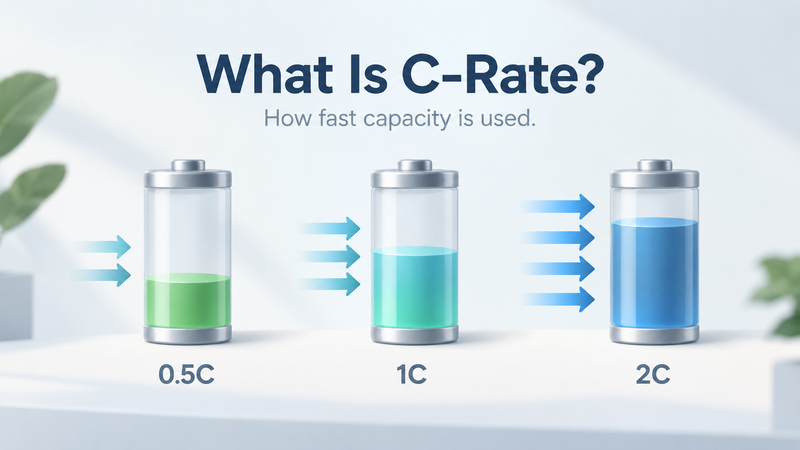
C-rate is a way to describe how quickly a battery is being charged or discharged relative to its rated capacity. It makes current easier to compare across batteries of different sizes because the rate is expressed as a proportion of the battery's own capacity rather than only as amps.
A C-rate does not tell you how much energy a battery stores. It tells you how aggressively that stored capacity is being used or replenished.
For the broader relationship between mAh, Ah, Wh and usable battery capacity, see:
https://medium.com/@volodymyrzh/battery-capacity-explained-mah-wh-amp-hours-decoded-1dc676be5a38
The Basic C-Rate Idea
For a battery rated at 100 Ah:
1C = 100 A
0.5C = 50 A
0.2C = 20 A
2C = 200 A
The basic relationship is:
Current = C-rate × battery capacity in Ah
So if a 60 Ah battery is discharged at 0.5C:
0.5 × 60 Ah = 30 A
At 1C, the same battery would be discharged at 60 A.
At 2C, it would be 120 A.
This makes C-rate useful because saying “100 amps” means very different things for a 20 Ah battery and a 200 Ah battery.
What Does 1C Mean in Time?
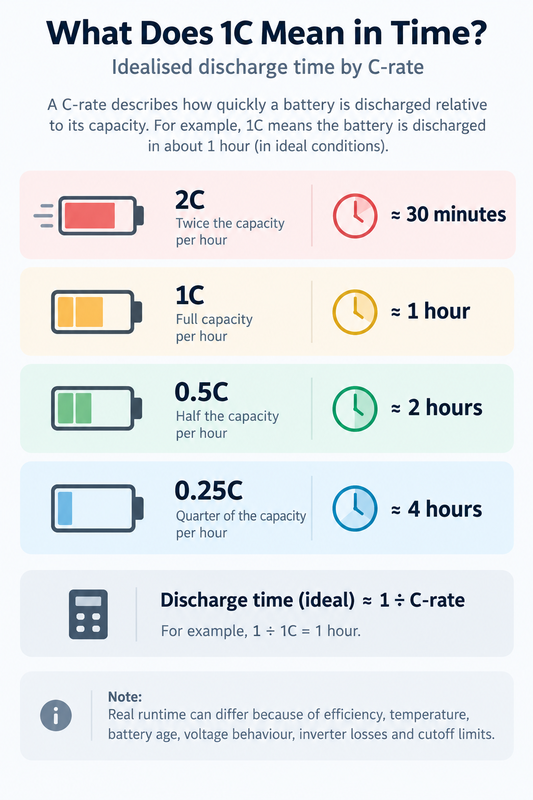
In an idealised example, a battery discharged at 1C would deliver its rated capacity in about one hour.
At 0.5C, the theoretical duration would be about two hours.
At 0.25C, about four hours.
At 2C, about 30 minutes.
This is a useful mental model, but it should not be treated as an exact runtime calculator.
Real battery runtime also depends on factors such as efficiency, temperature, battery chemistry, voltage behaviour, state of charge, age, inverter losses and the manufacturer's discharge limits.
Battery capacity and runtime are related but are not the same specification. That distinction is explained here:
C-Rate Makes Battery Sizes Easier to Compare
Consider two batteries:
Battery A: 20 Ah
Battery B: 100 Ah
A 20 A load represents:
1C for Battery A
0.2C for Battery B
The electrical current is identical, but the smaller battery is being worked much harder relative to its capacity.
That difference can affect heat generation, voltage sag and how closely real-world performance matches the battery's rated capacity.
This is why current alone does not always tell you how demanding a load is.
C-rate gives the current context.
Higher C-Rates Usually Mean More Stress
As discharge current rises, internal electrical losses become more important.
A battery has internal resistance. When current passes through that resistance, some energy is converted into heat rather than reaching the load.
A simplified relationship is:
Power lost as heat ∝ current² × resistance
That means increasing current can increase internal heating much faster than a simple one-to-one relationship might suggest.
Higher discharge rates may therefore lead to:
more heat;
greater voltage sag;
lower conversion efficiency;
earlier low-voltage cutoff under heavy load;
and potentially faster degradation if high-rate operation exceeds the conditions the battery was designed for.
However, there is no single C-rate that is automatically “too high” for every battery.
A high-power lithium cell may be designed for discharge rates that would be unsuitable for a different lithium cell or a lead-acid battery.
Always use the manufacturer's specifications for the actual battery.
C-Rate and Usable Capacity
A battery rated at a certain number of amp-hours does not necessarily deliver exactly the same usable energy at every discharge rate.
At higher loads, some batteries may provide less effective usable capacity than they do under gentler discharge conditions.
This effect can be especially noticeable in some lead-acid batteries. Lithium batteries can behave differently and often maintain capacity better at moderate-to-high loads, but their performance still depends on chemistry, cell design, temperature and protection limits.
So a battery labelled 100 Ah should not automatically be interpreted as:
100 Ah available under every possible load.
The discharge rate matters.
This relationship becomes especially important when sizing batteries for inverters, motors, heaters, power tools or other high-power loads.
C-Rate Is Not the Same as Power Output
C-rate describes current relative to battery capacity.
Power output is normally expressed in watts.
They are connected through voltage:
Power ≈ Voltage × Current
For example, a nominal 12 V, 100 Ah battery discharged at approximately 1C would be delivering about 100 A.
A simple nominal calculation gives:
12 V × 100 A = 1,200 W
But that does not automatically mean the battery system can continuously supply a 1,200 W appliance.
The battery management system, wiring, inverter, connectors, temperature limits and the battery manufacturer's continuous-current rating all matter.
For more on continuous output as a separate specification:
https://digitalowl.fika.bar/what-is-continuous-power-output-01M2JYJBJJHR19Q9ZVAPNTN5GX
Charging Also Has a C-Rate
C-rate can describe charging as well as discharging.
For a 100 Ah battery:
charging at 0.1C means about 10 A;
0.5C means about 50 A;
1C means about 100 A.
But again, a battery should not automatically be charged at any mathematically possible C-rate.
The permitted charge rate depends on chemistry, cell design, temperature, battery management and the manufacturer's specifications.
A battery capable of a high discharge rate may have a much lower recommended charging rate.
Charge C-rate and discharge C-rate should therefore be treated as separate limits.
How to Read C-Rate in a Specification
When comparing batteries, look for wording such as:
maximum continuous discharge current;
recommended discharge rate;
peak discharge current;
maximum charge current;
standard charge rate;
or a stated C-rate.
If a manufacturer gives both a C-rate and an amp rating, you can check whether they are consistent with the battery's rated Ah capacity.
For a 50 Ah battery, for example:
1C = 50 A
2C = 100 A
0.5C = 25 A
This makes unfamiliar specifications easier to interpret.
The Practical Meaning of C-Rate
C-rate answers a simple but important question:
How hard is this battery being asked to work relative to its size?
A 50 A load might be gentle for one battery and extremely demanding for another.
That is why C-rate is useful when comparing battery performance, estimating the impact of high loads, interpreting charge and discharge specifications, and understanding why two batteries with the same nominal capacity may behave differently under the same appliance load.
Battery capacity tells you how much energy is available.
Continuous power tells you what the system can sustain.
C-rate helps connect the two by showing how quickly the battery's capacity is being used.
Comments
No comments yet. Be the first to comment!