How Much Battery Capacity Does a Well Pump Need?
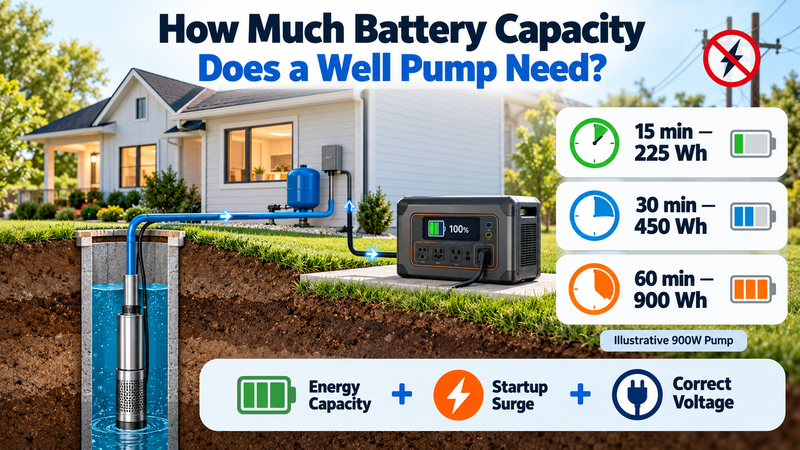
A well pump can provide essential household water during a power outage, but running it from a battery requires more than matching the pump's wattage to a portable power station. Well pumps can demand substantial startup power even when their total daily energy consumption is relatively modest.
The battery capacity you need depends on the pump's actual electrical input, operating time, water consumption, pressure tank behaviour and desired backup duration. Voltage compatibility and a safe electrical connection are equally important.
The most useful approach is to separate three questions: Can the backup system start the pump? How much energy will pumping consume? How long must the battery support it?
Why Well Pump Backup Is Different From Ordinary Appliance Backup
A well pump typically runs intermittently, supplying water and pressurising a tank rather than operating continuously throughout the day.
This creates two distinct electrical demands:
Running power (W): electricity required while the pump operates.
Starting demand: the higher short-duration electrical demand that some motors require when starting.
Battery capacity, measured in Wh or kWh, determines how much energy is stored. Inverter output capability determines whether that energy can be delivered at the required power level.
A 1,000Wh battery may theoretically contain enough energy for several pumping cycles but still fail to start a motor if the inverter cannot supply its starting demand.
The underlying distinction is explained in Starting Watts vs Running Watts:
https://digitalowl.fika.bar/starting-watts-vs-running-watts-01M2K3FNMK1HM1FQDAYVFRT1PM
Practical rule: verify voltage and motor-starting requirements before calculating battery runtime.
Step 1: Identify the Pump's Electrical Specifications
Well pumps vary considerably in design. Common categories include submersible pumps installed inside the well and above-ground jet pumps.
Their electrical requirements depend on motor design, pump size, pressure requirements and installation conditions.
Before selecting a battery system, identify:
Rated supply voltage and frequency.
Motor horsepower (HP), where specified.
Electrical input power or measured running watts.
Running current and starting-current characteristics.
Required phase configuration.
Control-box and pressure-switch requirements.
Horsepower is not the same as electrical input power.
One mechanical horsepower equals approximately 746 W of mechanical power, but a motor's electrical input will be higher because conversion is not perfectly efficient. Motor rating conventions and operating conditions also matter.
Do not simply convert the horsepower label into running watts and assume the result is exact.
In North America, some residential pumps require 120 V while many others use 240 V split-phase power. Elsewhere, pumps may use 230 V single-phase or three-phase configurations.
The backup system must match the actual motor and installation.
Step 2: Check the Pump's Starting Surge
Motor startup is often the most demanding part of well pump backup planning.
An induction motor can draw considerably more current during startup than during normal operation. The magnitude and duration depend on the motor design, pump conditions and starting method.
Consider a hypothetical well pump:
Running electrical power: 900 W.
Illustrative starting demand: 2,700 W.
Supply voltage: determined by the installed pump.
A portable power station offering 1,200 W continuous output may appear sufficient for the 900 W running load.
However, if its supported surge performance is inadequate for the motor's starting behaviour, the pump may fail to start.
A second complication is that motor starting involves current, power factor and sometimes apparent power in VA. An advertised peak-watt figure alone does not guarantee compatibility.
Check the inverter manufacturer's motor-starting specifications rather than assuming every surge rating can start every pump.
A suitable backup system must also deliver the correct voltage, frequency and phase arrangement.
Step 3: Estimate How Long the Well Pump Runs
A well pump does not necessarily need electricity for every minute of an outage.
Its operating time depends on water usage and the well system's design.
A pressure tank can supply some water while the pump is inactive. When pressure falls to the switch's cut-in level, the pump starts and replenishes the tank until the cut-out pressure is reached.
For a simplified illustration, imagine a 900 W pump operating for a total of 20 minutes during one day.
Convert operating time to hours:
20 ÷ 60 = 0.333 hours.
Estimated pump energy:
900 W × 0.333 h ≈ 300 Wh.
If the pump operates for 40 minutes:
900 W × 0.667 h ≈ 600 Wh.
If it operates for one full hour:
900 W × 1 h = 900 Wh.
These are illustrative values, not universal daily consumption estimates.
Actual operating time depends on household water demand, pump delivery rate, pressure settings, tank characteristics and other factors.
Step 4: Calculate Battery Capacity for Different Pumping Needs
Suppose a hypothetical well pump draws 900 W while operating.
Its energy requirements might look like this:
Light water use — 15 minutes of total pumping
Pump running power: 900 W.
Total active time: 0.25 hours.
Energy demand: 225 Wh.
Moderate water use — 30 minutes of total pumping
Pump running power: 900 W.
Total active time: 0.5 hours.
Energy demand: 450 Wh.
Higher water use — 60 minutes of total pumping
Pump running power: 900 W.
Total active time: 1 hour.
Energy demand: 900 Wh.
These figures represent pump energy consumption alone.
They do not include inverter conversion losses, battery control electronics, continuously powered controllers or a reserve margin.
Importantly, a battery with sufficient energy capacity still needs an inverter capable of starting and running the pump safely.
Step 5: Include Battery-System Losses and Reserve
A portable power station stores energy in its battery but may need to convert DC electricity into AC electricity for the pump.
This process introduces losses.
A simplified planning formula is:
Required Nominal Battery Capacity (Wh) = Pump Energy Demand (Wh) ÷ Delivery Factor × Reserve Factor
Consider the moderate-use example:
Pump energy requirement: 450 Wh.
Illustrative battery-to-load delivery factor: 85%.
Illustrative reserve factor: 1.20.
The calculation is:
450 ÷ 0.85 × 1.20 ≈ 635 Wh.
Under these assumptions, approximately 635 Wh of nominal battery capacity meets the calculated energy target.
Using the same assumptions:
225 Wh demand: approximately 318 Wh nominal.
450 Wh demand: approximately 635 Wh nominal.
900 Wh demand: approximately 1,271 Wh nominal.
These are mathematical planning examples, not recommendations for particular pumps. The delivery factor and reserve should be adapted to the selected battery system and actual usage.
They also assume that additional idle consumption is either negligible or accounted for separately.
For a broader household approach, see How Much Battery Capacity Do You Need for Home Backup?
Step 6: Why a Pressure Tank Changes the Calculation
A pressure tank stores pressurised water, which allows the household to draw some water without starting the pump immediately.
The tank's usable drawdown depends on its size, pre-charge and operating pressure settings.
A larger effective drawdown can reduce the frequency of pump starts, although it does not necessarily reduce the total hydraulic energy required to move the same quantity of water.
This distinction matters because frequent motor starts may place different demands on electrical equipment than longer, less frequent pumping cycles.
A pump running for a combined thirty minutes across several cycles may consume a similar amount of running energy to one operating for thirty continuous minutes, but starting losses and inverter demands can differ.
For battery planning, measure or estimate the actual pumping time rather than assuming the motor operates continuously whenever water is needed.
Step 7: What Changes During a Longer Outage?
Outage duration and pumping duration are different measurements.
A household may experience a 24-hour power outage without running its well pump for 24 hours.
Instead, the pump may operate periodically as water is used.
Imagine the earlier 900 W pump operating for a total of 30 minutes each day.
For a simplified three-day outage:
450 Wh/day × 3 days = 1,350 Wh.
Using the illustrative 85% delivery factor and 20% planning margin:
1,350 ÷ 0.85 × 1.20 ≈ 1,906 Wh.
This suggests a nominal planning target of approximately 1.9 kWh for the pump's energy consumption under those assumptions.
However, a power station left active for three days may also consume electricity internally.
If its inverter must remain enabled continuously, standby consumption could be significant.
For example, an additional hypothetical 5 W of continuous system demand over 72 hours would consume:
5 W × 72 h = 360 Wh.
That consumption must be incorporated without double-counting losses already included in the delivery factor.
Step 8: What if the Pump Shares a Battery With Other Appliances?
A home backup system may need to power the well pump alongside other essential equipment.
Consider a hypothetical daily energy budget:
Well pump: 450 Wh.
Refrigerator: 900 Wh.
Router: 15 W × 12 hours = 180 Wh.
Lighting: 20 W × 5 hours = 100 Wh.
Total appliance energy demand:
450 + 900 + 180 + 100 = 1,630 Wh.
Applying the same illustrative 85% delivery factor and 20% reserve factor:
1,630 ÷ 0.85 × 1.20 ≈ 2,301 Wh.
The nominal planning target is approximately 2.3 kWh under those assumptions.
But energy is only half the problem.
If the well pump and refrigerator start at the same time, the inverter may encounter a much higher combined demand.
The complete method is explained in How to Size Battery Capacity for Multiple Devices:
The correct system must satisfy both cumulative energy consumption and maximum simultaneous electrical demand.
Can a Portable Power Station Run a Well Pump?
Potentially, but not every portable power station is suitable.
A compact unit may have enough stored watt-hours while lacking the correct voltage, continuous output or starting capability.
Many well pumps are hardwired into the household electrical system rather than connected through an ordinary wall plug.
A backup source therefore may require professionally installed transfer equipment or another approved electrical arrangement.
Do not attempt to backfeed a home circuit through an ordinary receptacle or construct improvised cables for a hardwired pump.
A qualified electrician should verify electrical compatibility, isolation from the utility supply, protective equipment and applicable installation requirements.
The backup system must also meet the pump manufacturer's instructions.
A battery that looks sufficient on paper is not a suitable well-pump backup unless the power electronics and electrical connection are compatible.
How to Measure Your Well Pump's Actual Consumption
Accurate measurements are preferable to assumptions based solely on horsepower.
A practical assessment should establish:
The pump's rated voltage and electrical configuration.
Running power under normal pumping conditions.
Starting-current and inverter requirements.
Total pumping time under representative water usage.
Additional energy consumed by controls and standby equipment.
Whether other loads will share the same backup source.
Because many pumps are hardwired and operate at substantial voltages, electrical measurements should be performed using suitable equipment by a qualified professional.
Well installation records, the control-box label and manufacturer documentation may provide useful starting information.
If measured energy consumption is available in Wh or kWh, use it directly for capacity sizing rather than reconstructing consumption from rough assumptions.
Common Well Pump Battery-Sizing Mistakes
Mistake 1: Sizing Only From Running Watts
The inverter may fail to start the motor even when its continuous rating exceeds normal running power.
Mistake 2: Assuming Horsepower Equals Electrical Watts
Mechanical horsepower and electrical input power are different measurements. The actual motor specifications matter.
Mistake 3: Treating Outage Duration as Pump Runtime
A pump usually operates intermittently. Use realistic pumping time rather than multiplying running watts by every hour of an outage.
Mistake 4: Ignoring Voltage Compatibility
An inverter with sufficient wattage may still provide the wrong voltage or phase arrangement for the pump.
Mistake 5: Forgetting Idle Consumption and Other Loads
A multi-day outage can introduce meaningful inverter standby losses, while simultaneous appliances may exceed available output power.
Final Well Pump Battery Backup Checklist
Before selecting a power station or battery system, confirm:
Pump voltage: does the backup output match the motor?
Running power: what is the actual electrical demand?
Starting requirement: can the inverter reliably start the motor?
Duty cycle: how long does the pump operate under realistic water usage?
Energy demand: how many Wh are required?
Backup duration: how many hours or days must the system support water access?
Other appliances: will loads operate simultaneously?
Reserve: have conversion losses and uncertainty been considered?
Connection safety: is the backup arrangement professionally designed and approved?
Final Takeaway
Well pump battery capacity should be calculated from actual pumping energy, while inverter suitability must be checked against voltage and motor-starting requirements.
A hypothetical 900 W pump running for thirty minutes consumes approximately 450 Wh before battery-system losses. Under illustrative assumptions of 85% energy delivery and a 20% planning margin, the nominal capacity target is approximately 635 Wh.
That does not mean a 635Wh portable power station can necessarily start or safely supply the pump.
A suitable system must also provide the correct electrical output, sufficient surge capability and an approved connection.
The practical rule is simple: calculate the watt-hours needed to move the water, but verify the electrical requirements before choosing the battery.
Comments
No comments yet. Be the first to comment!