Digitalowl
- Home
- Why Beginners Should Build Small Projects Before Learning Everything
- What to Power First During a 72-Hour Blackout
Recent posts
-
What Is Battery Cycle Life?
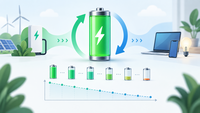
Battery cycle life tells you roughly how many charge-and-discharge cycles a battery can complete before its ability to store energy falls to a specified level. It is one of the most useful battery longevity specifications, but it is also easy to misunderstand. A battery rated for 2,000 cycles does not normally work perfectly for cycle 1,999 and suddenly fail at cycle 2,000. Capacity usually declin…
- batteries
- electricity
- +2
-
What Does a Battery Management System Do?
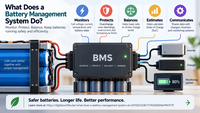
A battery management system, or BMS, is the electronic control system that monitors and helps protect a rechargeable battery pack. It does not create extra battery capacity, and it cannot make every unsafe situation harmless. Instead, a BMS watches important operating conditions and can take action when the battery approaches limits defined by the pack design. This makes it one of the key systems …
- batteries
- blackout
- +2
-
What Is Battery Self-Discharge?
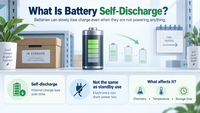
A battery can lose charge even when nothing appears to be using it. Leave a charged battery unused for weeks or months, then check it again, and its state of charge may be lower. Part of that loss can come from electronics connected to the battery, but another part can occur inside the cells themselves. That internal loss is called self-discharge. Self-discharge is the gradual loss of stored charg…
- batteries
- blackout
- +4
-
How Temperature Affects Battery Capacity
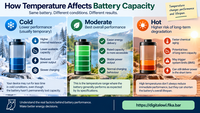
A battery can show the same capacity rating on its label and behave very differently on a cold winter morning, at normal room temperature and after spending hours in excessive heat. That does not necessarily mean its rated capacity has suddenly changed. Temperature affects how easily the battery can deliver and accept energy, how much of its stored energy is practically accessible under the curren…
- electricity
- portable-power-stations
-
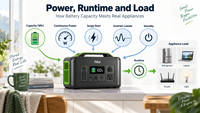
Power, Runtime and Load: How Battery Capacity Meets Real Appliances
Battery capacity tells you how much energy a battery can store. It does not, by itself, tell you whether the battery can start a refrigerator, run a pump, support several devices at once or deliver the runtime you expect. Those questions sit at the intersection of energy, power and load behaviour. A battery rated at 2,000 Wh may contain plenty of energy for a particular task, but the system still …
- blackout
- electricity
- +2
-
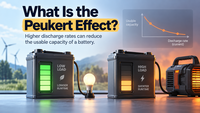
What Is the Peukert Effect?
The Peukert effect describes how a battery can deliver less effective capacity when it is discharged at a higher rate. In simple terms, drawing energy faster can reduce how long some batteries are able to sustain the load compared with what a straightforward capacity calculation would suggest. The effect is particularly important for lead-acid batteries and should not be treated as a universal rul…
- blackout
- electricity
- +1
-
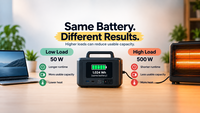
How High Loads Affect Usable Battery Capacity
A battery may have a fixed capacity rating, but that does not mean every watt-hour on the label will be equally easy to use under every load. As power demand rises, current usually rises too, increasing electrical losses inside the battery and the rest of the system. Voltage may fall more noticeably under load, heat generation can increase, and protective limits may be reached sooner. That does no…
- blackout
- electricity
- +2
-
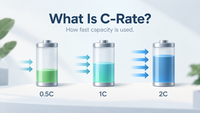
What Is C-Rate?
C-rate is a way to describe how quickly a battery is being charged or discharged relative to its rated capacity. It makes current easier to compare across batteries of different sizes because the rate is expressed as a proportion of the battery's own capacity rather than only as amps. A C-rate does not tell you how much energy a battery stores. It tells you how aggressively that stored capacity is…
- blackout
- electricity
- +2
-
Standby Power Consumption
A battery can lose useful runtime even when the device you care about appears to be doing almost nothing. Displays, control electronics, network connections, chargers and inverters may continue consuming small amounts of power in the background. This is standby power consumption: electrical power used while equipment remains ready to operate rather than performing its main task at full load. A few…

- blackout
- electricity
- +2
-
AC vs DC Battery Runtime
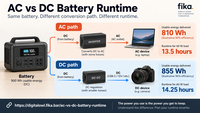
Two devices can require roughly the same useful power and still produce different battery runtimes depending on how that power reaches them. The difference often comes down to the power path. A battery stores energy as DC. If an appliance needs AC power, the system normally has to convert that DC energy through an inverter first. A compatible DC device may sometimes use battery energy more directl…
- electricity
- off-grid
- +1
-
What Is Inverter Efficiency?
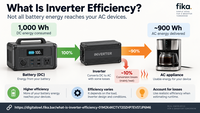
An inverter lets a battery power AC appliances by converting the battery’s direct current into alternating current. That conversion is extremely useful, but it is not perfectly efficient. Some of the battery’s stored energy is lost before it reaches the appliance. Inverter efficiency describes how much of the DC energy entering the inverter becomes usable AC energy at the output. This matters when…
-
Average Power vs Peak Power
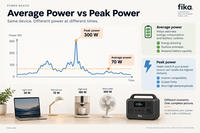
A device does not always consume the same amount of power every second it operates. Its power draw may rise, fall, cycle between different levels or briefly jump much higher than normal. That is why two different figures are useful when analysing a load: average power and peak power. Average power helps estimate how much energy a device uses over time. Peak power helps determine whether a battery …
- blackout
- electricity
- +3
-
Starting Watts vs Running Watts
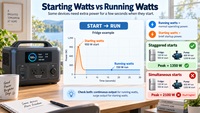
A device may use one amount of power while operating normally and a much larger amount for a few moments when it starts. These two figures are commonly described as running watts and starting watts. Understanding the difference matters when choosing a portable power station, inverter, generator or battery system. A power source can have enough capacity to run an appliance for hours and still fail …
- blackout
- electricity
- +2
-
What Is Surge Power?
Surge power is the short burst of extra electrical power that a power station, inverter or battery system can deliver above its normal continuous output. It matters because some appliances briefly demand much more power when they start than they use once they are running normally. A portable power station might therefore be rated for: Continuous output: 1,000 W Surge output: 2,000 W That does not …

- electricity
- portable-power-stations
-
What Is Continuous Power Output?
Continuous power output tells you how much electrical power a battery system, inverter or portable power station can supply steadily during normal operation. It is usually measured in watts (W) and answers a different question from battery capacity. A battery might store a large amount of energy but still be unable to run a high-power appliance if its inverter cannot continuously deliver enough wa…

- blackout
- electricity
- +3
-
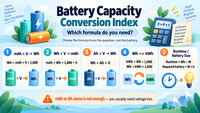
Battery Capacity Conversion Index: Which Formula Do You Need?
Battery calculations become confusing surprisingly quickly because the same battery can be described in mAh, Ah, Wh, kWh and volts. Then another question appears: are you trying to convert units, calculate energy consumption, estimate runtime or work out how much battery capacity a device needs? You do not need to memorise every battery formula. You need to identify what you know, what you want to…
- blackout
- electricity
- +2
-
How to Read a Battery Capacity Label
Battery labels can look surprisingly complicated. A small sticker may contain mAh, Ah, Wh, voltage, charging information and several output ratings, all mixed together. The key is knowing which numbers describe stored capacity, which describe voltage, and which tell you what the battery can actually power. If you need the bigger picture first, this complete guide explains how the main battery-capa…

- blackout
- electricity
- +3
-
How Much Battery Capacity Does a Device Need?
Choosing a battery for a device becomes much easier when you stop thinking in vague labels such as “large battery” or “high capacity” and calculate the energy the device actually needs. For most everyday sizing questions, you need only two starting numbers: the device’s average power consumption in watts and the number of hours you want it to run. The basic relationship comes directly from watt-ho…

- blackout
- electricity
- +2