What Does a Battery Management System Do?
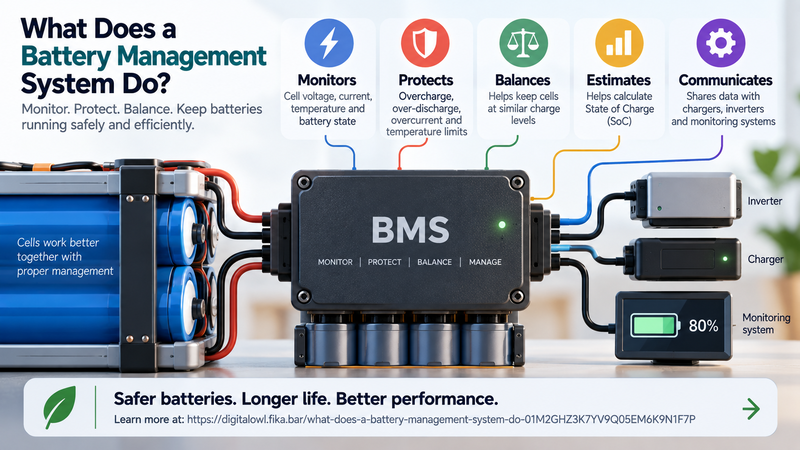
A battery management system, or BMS, is the electronic control system that monitors and helps protect a rechargeable battery pack.
It does not create extra battery capacity, and it cannot make every unsafe situation harmless. Instead, a BMS watches important operating conditions and can take action when the battery approaches limits defined by the pack design.
This makes it one of the key systems connecting battery capacity, charging, usable energy and safety.
For the broader battery-capacity framework, including mAh, Ah and Wh, see:
https://medium.com/@volodymyrzh/battery-capacity-explained-mah-wh-amp-hours-decoded-1dc676be5a38
A BMS Watches What Is Happening Inside the Battery
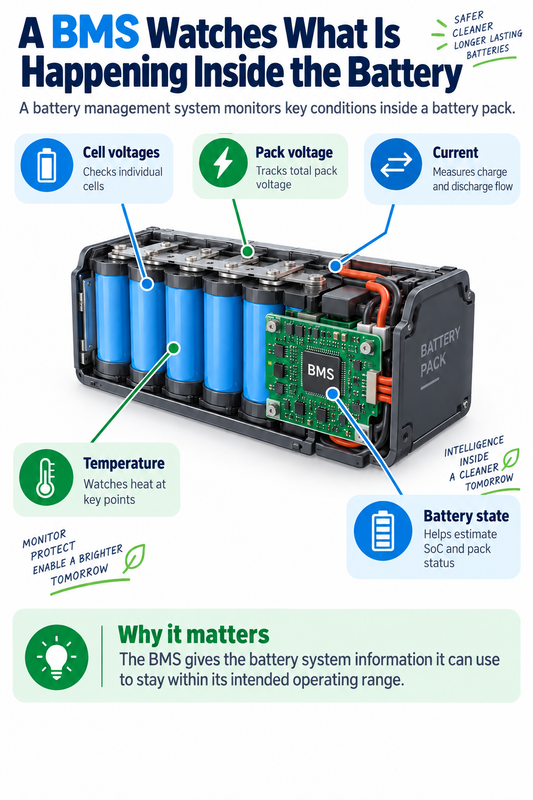
A battery pack may contain many individual cells connected together. Those cells do not always behave identically.
A BMS can monitor information such as:
individual cell voltages;
total pack voltage;
charge and discharge current;
temperature at selected points;
operating state of the battery.
The exact sensors and functions depend on the battery design. A small consumer battery may use a relatively simple protection circuit, while a large electric-vehicle or stationary-storage pack can have a much more sophisticated management system.
The important point is that the BMS gives the battery system information it can use to stay within its intended operating range.
Overcharge Protection
Rechargeable cells have upper voltage limits.
Charging a cell beyond the range intended for its chemistry can accelerate degradation and may create safety risks. A BMS can monitor cell voltage during charging and intervene when a defined threshold is reached.
Depending on the design, that intervention might involve stopping charging, opening a contactor or controlling electronic switches.
The BMS therefore acts as one layer of protection against overcharging.
It should not, however, be treated as permission to use an incompatible charger. Proper charging hardware and correct battery-system design still matter.
Over-Discharge Protection
A battery also has a lower operating limit.
Continuing to discharge cells too far can damage them or shorten their useful life. A BMS can monitor cell voltage and stop or restrict discharge when the system reaches its configured lower threshold.
This connects directly with Depth of Discharge, or DoD.
Depth of Discharge describes how much of the battery's available capacity has been used. It is explained separately here:
The BMS may help enforce practical operating limits, but those limits are determined by the battery design rather than by a universal rule that applies to every chemistry or pack.
Current Protection
Battery packs also have current limits.
Very high charge or discharge current can create excessive heat, voltage drop or stress on cells and electrical components. A BMS can monitor current and respond when the pack exceeds defined limits.
For example, it may disconnect the battery if it detects an extreme overcurrent or short-circuit condition.
The exact response time and thresholds vary greatly between systems, so the presence of a BMS should not be interpreted as proof that any load can safely be connected to the battery.
Cables, connectors, fuses and other protection devices remain important parts of the complete system.
Temperature Monitoring
Battery behaviour depends strongly on temperature.
Charging or discharging outside the temperature range intended by the manufacturer can affect performance, degradation and safety. Many BMS designs therefore monitor temperature sensors placed in or around the pack.
If the battery becomes too hot or too cold, the BMS may limit charging, limit discharge or disconnect the battery entirely.
In larger systems, the BMS may also communicate with active thermal-management equipment.
But the BMS itself does not necessarily cool or heat the cells. It may simply detect the condition and request or trigger another system to respond.
Cell Balancing
Cells connected in a series pack can gradually develop slightly different states of charge.
Suppose most cells reach an acceptable voltage while one cell reaches the upper limit sooner. Charging the entire pack further could push that cell too high even though the other cells are not yet equally charged.
Cell balancing helps reduce these differences.
Many BMS designs use passive balancing, which removes a small amount of energy from higher-voltage cells, commonly by dissipating it as heat through resistive circuits.
Some systems use active balancing, where energy can be transferred between cells or groups of cells.
Not every BMS balances cells in the same way, and some simple protection boards may provide little or no sophisticated balancing.
The BMS Can Help Estimate State of Charge
Users usually want to know one simple number:
How much battery is left?
This is represented by State of Charge, or SoC.
A BMS may contribute to estimating SoC using measurements such as voltage, current and accumulated charge. More advanced systems may also consider temperature, battery behaviour and historical data.
You can read the full explanation of SoC here:
The important word is estimate.
A displayed 60% does not mean the BMS has directly measured a physical container that is exactly 60% full. Battery state has to be inferred from electrical measurements and models, and the accuracy can vary with chemistry, conditions and calibration.
BMS Limits Affect Usable Capacity
A battery might have one theoretical or rated amount of stored energy while the system makes only part of it available to the user.
The BMS can be one reason for this difference.
For example, it may stop discharge before the cells reach an undesirable low-voltage condition. It may also stop charging before conditions move outside the pack's intended limits.
These protective margins help explain why rated capacity and usable capacity are not always identical.
That distinction is covered here:
This does not mean the BMS simply “removes” a fixed percentage of every battery's capacity. Usable energy depends on the complete system design, chemistry, load, temperature, reserve settings and other factors.
Communication Is Another Important BMS Function
In more sophisticated battery systems, the BMS does more than make local protection decisions.
It may communicate battery information to:
an inverter;
a charger;
a vehicle control system;
an energy-management system;
a display or monitoring app.
This allows the rest of the system to respond to battery conditions.
For example, an inverter may reduce power when the battery approaches a limit instead of waiting for the BMS to perform a hard disconnect.
That type of coordination can make battery operation smoother and more predictable.
What a BMS Does Not Do
It is useful to understand the limitations as clearly as the functions.
A BMS does not automatically:
make an incorrectly designed battery safe;
replace the need for proper fusing;
make an incompatible charger appropriate;
eliminate thermal-management requirements;
prevent every possible cell failure;
guarantee perfect State of Charge readings;
increase the actual chemical energy stored in the cells.
It is one part of a battery system.
Good cell selection, mechanical design, wiring, charging, cooling, protection hardware and correct operating limits still matter.
BMS Functions at a Glance
A typical battery management system may perform four broad jobs:
Monitor
Track voltage, current, temperature and other battery conditions.
Protect
Respond to overvoltage, undervoltage, overcurrent and temperature limits.
Balance
Reduce differences between cells where balancing functionality is included.
Estimate and communicate
Help calculate battery state and share information with other parts of the system.
The precise feature set depends on the battery.
Why the BMS Matters
A battery pack is not simply a container holding a fixed number of watt-hours.
Its cells have voltage, current and temperature limits. Individual cells can drift apart. Available capacity changes with conditions, and the wider system needs to know when the battery is approaching its operating boundaries.
The BMS sits in the middle of many of these decisions.
It monitors the battery, helps keep operation within defined limits, may balance cells and often provides information used to estimate the battery's current state.
That makes the BMS an important part of understanding how rated battery specifications become usable real-world battery performance.
Comments
No comments yet. Be the first to comment!