What Is Surge Power?
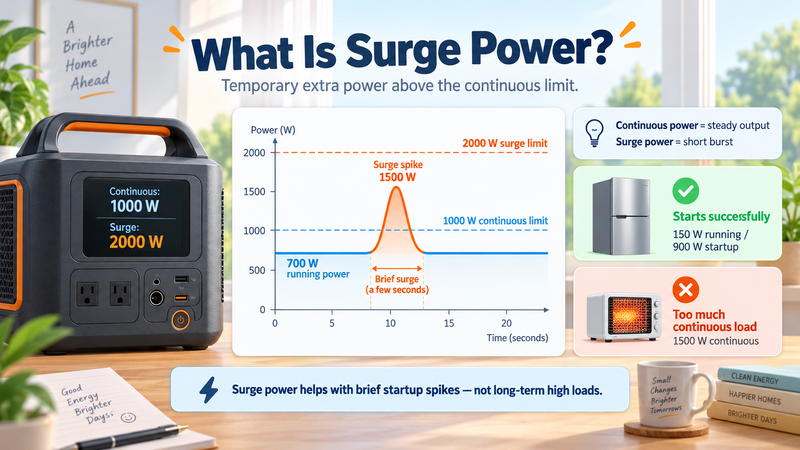
Surge power is the short burst of extra electrical power that a power station, inverter or battery system can deliver above its normal continuous output. It matters because some appliances briefly demand much more power when they start than they use once they are running normally.
A portable power station might therefore be rated for:
Continuous output: 1,000 W
Surge output: 2,000 W
That does not mean it can supply 2,000 W indefinitely. The 2,000 W figure represents a temporary capability designed to handle short power spikes.
For the broader relationship between battery capacity, watts, watt-hours and runtime, see the complete battery capacity guide: https://medium.com/@volodymyrzh/battery-capacity-explained-mah-wh-amp-hours-decoded-1dc676be5a38
Surge Power Is Temporary Power
Continuous power describes what a system can supply steadily during normal operation. Surge power describes what it can supply for a limited period when a load suddenly demands more.
If you need the continuous-power concept first, see: https://digitalowl.fika.bar/what-is-continuous-power-output-01M2JYJBJJHR19Q9ZVAPNTN5GX
Consider a power station with:
1,000 W continuous output
2,000 W surge output
A load drawing 700 W continuously is comfortably within the normal operating limit.
A device that briefly jumps to 1,500 W during startup and then settles at 700 W may also be compatible because the temporary spike remains within the 2,000 W surge rating.
But a device that requires 1,500 W continuously would still exceed the power station's 1,000 W continuous limit.
Surge power does not permanently raise the continuous-output rating.
Why Some Devices Need a Power Surge
Not every electrical device starts smoothly at the same wattage it uses during normal operation.
Equipment containing motors, compressors or pumps can require an extra burst of power when starting. The electrical system must overcome the initial mechanical load and bring the motor or compressor up to operating speed.
Typical examples can include:
refrigerators,
freezers,
air conditioners,
pumps,
compressors,
some power tools,
and other motor-driven equipment.
The size of the startup spike varies considerably between devices. Two appliances with similar normal operating wattage may have very different surge requirements.
That is why the actual specifications of the appliance and power source matter more than assuming one universal multiplier.
Example: A Refrigerator Starting
Imagine a refrigerator that uses approximately 150 W while its compressor is running.
When the compressor starts, however, the demand briefly rises to 900 W.
Now compare that appliance with two hypothetical power stations.
Power Station A
Continuous output: 500 W
Surge output: 700 W
Its continuous rating is easily above the refrigerator's 150 W running demand, but its 700 W surge rating is below the 900 W startup requirement.
The refrigerator may therefore fail to start reliably even though its normal running wattage looks low enough.
Now consider:
Power Station B
Continuous output: 500 W
Surge output: 1,000 W
The same 150 W running load remains within the continuous limit, while the 900 W startup spike also fits within the stated surge limit.
This illustrates why checking only normal wattage can sometimes give an incomplete answer.
Surge Power Is Not Extra Battery Capacity
A common mistake is treating a high surge rating as though it means the battery stores more energy.
It does not.
Suppose a power station has:
Battery capacity: 1,000 Wh
Continuous output: 1,000 W
Surge output: 2,000 W
The 1,000 Wh figure describes stored energy.
The 1,000 W figure describes the normal sustainable power limit.
The 2,000 W figure describes a temporary high-power capability.
These specifications answer three separate questions:
How much energy is stored? → Wh
How much power can it supply continuously? → continuous W
How much temporary extra power can it handle? → surge W
A larger surge rating does not automatically increase runtime.
The Duration of Surge Power Matters
Surge ratings should not be interpreted as unlimited temporary output.
A manufacturer may allow a surge for only a very short period, while another system may support a certain elevated load for longer. The exact behaviour depends on the inverter design, battery-management system, temperature, battery state and manufacturer specifications.
For that reason, a label that simply says:
Surge: 2,000 W
does not tell you everything.
You should also check whether the manufacturer specifies:
how long the surge can be maintained,
whether the rating applies to all outputs,
whether the surge capability changes with battery state,
and what happens when the surge limit is exceeded.
Some systems may shut down or trigger overload protection when demand rises beyond their supported range.
Why a Large Surge Number Can Be Misleading
A very high surge rating can look impressive in marketing material, but it should not be evaluated by itself.
Imagine two power stations:
System A:
1,000 W continuous
2,000 W surge
System B:
1,500 W continuous
1,800 W surge
System A has the larger surge multiple, but System B can continuously support a heavier load.
Which system is more suitable depends on the appliance.
A device with a moderate running load but a strong brief startup spike may benefit from System A's higher surge capability.
A device that continuously consumes 1,300 W would require System B's stronger continuous output instead.
The headline surge number is therefore only one part of the compatibility check.
Check Both Continuous and Surge Requirements
When evaluating a battery system for an appliance, ask two separate questions.
First:
Is the appliance's normal operating load within the continuous output rating?
Then:
Can the system handle any temporary startup or peak demand?
For a simplified example:
Appliance running demand: 400 W
Brief startup demand: 1,200 W
Power station continuous output: 800 W
Power station surge output: 1,600 W
The normal 400 W load fits within the 800 W continuous limit, and the temporary 1,200 W spike fits within the 1,600 W surge rating.
On paper, the power ratings are compatible.
You would still need to consider battery capacity, runtime, output type and the manufacturer's specific operating limits before deciding whether the complete system is suitable.
The Simple Rule to Remember
Surge power is best understood as temporary headroom above continuous output.
A useful specification check is:
Normal load ≤ continuous output
and:
Brief peak load ≤ supported surge output
Both conditions can matter.
Continuous power tells you what the system can deliver steadily. Surge power tells you whether it can survive short periods when a device suddenly asks for more.
The important word is temporary. A 2,000 W surge rating does not turn a 1,000 W power station into a 2,000 W continuous power source. It simply gives the system additional short-term capability for loads that momentarily demand more power.
Comments
No comments yet. Be the first to comment!