AC vs DC Battery Runtime
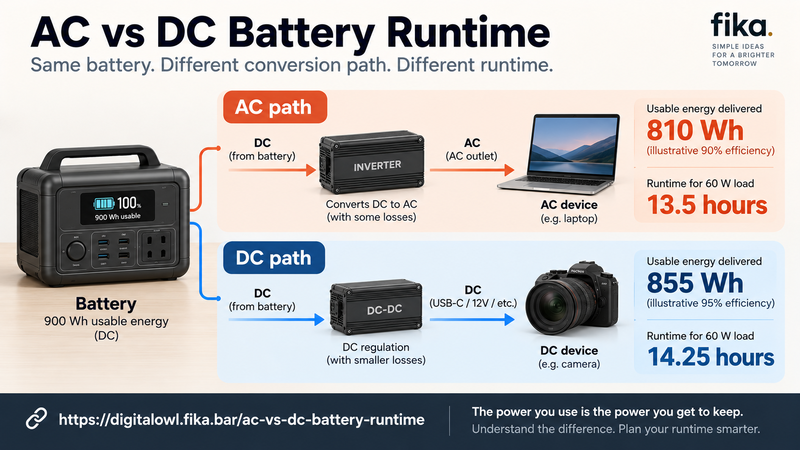
Two devices can require roughly the same useful power and still produce different battery runtimes depending on how that power reaches them.
The difference often comes down to the power path. A battery stores energy as DC. If an appliance needs AC power, the system normally has to convert that DC energy through an inverter first. A compatible DC device may sometimes use battery energy more directly and avoid part of that conversion process.
That does not mean DC is always dramatically more efficient than AC. But when every watt-hour matters, the difference between the two paths can affect real runtime.
For the broader relationship between battery capacity, watts, watt-hours and runtime, see the complete battery capacity guide: https://medium.com/@volodymyrzh/battery-capacity-explained-mah-wh-amp-hours-decoded-1dc676be5a38
The AC Power Path
A typical portable battery stores energy internally as DC.
When you connect an AC appliance, the power path may look roughly like this:
Battery DC → inverter → AC outlet → appliance
The inverter converts the battery’s DC output into AC power suitable for the appliance.
That conversion is not perfectly efficient. Some energy is consumed by the inverter itself and some is lost as heat and through other parts of the system.
Suppose a battery provides 900 Wh of usable DC energy and the relevant inverter path operates at an illustrative 90% efficiency.
The AC energy available to the appliance would be approximately:
900 Wh × 0.90 = 810 Wh
For a 60 W AC load:
810 Wh ÷ 60 W = 13.5 hours
This is only a simplified example, but it shows why the energy stored in the battery and the energy delivered through an AC outlet are not necessarily identical.
For a deeper explanation of these losses, see: https://app.fika.bar/blog/post/what-is-inverter-efficiency-01M2K65Q757EW3H13TCFP3JFJ7
The DC Power Path
A compatible DC-powered device may follow a shorter path:
Battery DC → DC conversion/regulation → device
The exact electronics still vary. A DC output may need voltage regulation or DC-to-DC conversion, so it is incorrect to assume that DC operation is automatically loss-free.
However, the system may be able to avoid the DC-to-AC inverter stage entirely.
If the complete DC path is more efficient than the AC path, more of the battery’s usable energy can reach the device.
Imagine the same 900 Wh of usable battery energy and a hypothetical DC path operating at 95% efficiency:
900 Wh × 0.95 = 855 Wh
For the same 60 W useful load:
855 Wh ÷ 60 W = 14.25 hours
Compared with the previous 13.5-hour AC example, the DC path provides:
14.25 − 13.5 = 0.75 hours
or approximately 45 additional minutes.
The important point is not the exact percentages. They are illustrative. The principle is that a more efficient power path leaves more battery energy available for useful work.
Compare Equivalent Loads, Not Just Connector Labels
An AC-vs-DC comparison is only useful when the two scenarios provide the same useful output.
For example, imagine powering a laptop in two ways.
AC route
Battery → inverter → AC charger → laptop
The system may perform several conversions:
DC → AC → DC
because the laptop ultimately runs internally on DC again.
USB-C DC route
Battery → USB-C power electronics → laptop
This path may avoid the AC inverter and the laptop’s separate AC charger.
If both methods deliver the same power to the laptop, the more efficient path may produce better battery runtime.
But the result depends on the specific power station, charger, voltage conversion and load. A poorly designed DC output is not automatically more efficient than a good AC system.
Why Small Loads Can Show a Bigger Difference
The AC-vs-DC difference can become particularly noticeable with small loads because some inverters consume energy simply by remaining active.
Imagine a 10 W device connected to an AC outlet.
If the inverter itself consumes several additional watts while operating, its overhead becomes a meaningful percentage of the total battery draw.
For example:
Device: 10 W
Illustrative inverter overhead: 5 W
Approximate battery-side demand:
10 W + 5 W = 15 W
The supporting electronics now account for one-third of the total demand in this simplified example.
With a 500 W load, the same few watts of system overhead would represent a much smaller percentage of total consumption.
This is one reason routers, LED lights, small electronics and other low-power devices can sometimes benefit noticeably from an efficient DC connection.
Runtime Calculation Still Starts With Usable Energy and Load
The underlying runtime relationship does not change:
Runtime ≈ energy delivered to the load ÷ load power
The difference is that the amount of energy reaching the load depends partly on the power path.
For the general runtime calculation and the assumptions behind it, see: https://digitalowl.fika.bar/battery-runtime-formula-01M2JVJ0DBC2706XRP728QTZQ3
Consider a battery with 1,000 Wh of rated capacity.
Suppose 900 Wh is realistically usable.
Example AC path
Illustrative path efficiency: 90%
900 Wh × 0.90 = 810 Wh delivered
For a 50 W load:
810 Wh ÷ 50 W = 16.2 hours
Example DC path
Illustrative path efficiency: 96%
900 Wh × 0.96 = 864 Wh delivered
For the equivalent 50 W load:
864 Wh ÷ 50 W = 17.28 hours
Difference:
17.28 − 16.2 = 1.08 hours
Under those assumptions, the DC route would provide slightly more than one additional hour of runtime.
Again, the percentages are examples, not universal efficiency values.
When AC May Still Be the Better Choice
Longer theoretical runtime is not the only consideration.
AC may still be more practical when:
the appliance has no compatible DC input,
the correct DC voltage is unavailable,
the device requires more power than the DC port can supply,
a dedicated AC adapter provides necessary regulation or protection,
or the DC cable and connector requirements are uncertain.
A reliable AC connection is preferable to an incompatible or incorrectly configured DC connection.
Voltage, polarity, connector type and supported power protocols must all match the device requirements.
The Simple Difference to Remember
AC and DC runtime can differ because the battery does not deliver energy through identical conversion paths.
A simplified comparison is:
AC:
Battery DC → inverter → AC appliance
DC:
Battery DC → DC regulation → DC device
If the DC path avoids an inverter and has lower overall conversion losses, the device may run longer from the same battery.
But the useful comparison is not simply AC is inefficient and DC is efficient. Both paths have losses, and their real performance depends on the specific equipment and load.
For battery planning, compare the complete power path, use realistic efficiency data where available and calculate runtime from the energy that actually reaches the device.
Comments
No comments yet. Be the first to comment!