How Temperature Affects Battery Capacity
A battery can show the same capacity rating on its label and behave very differently on a cold winter morning, at normal room temperature and after spending hours in excessive heat.
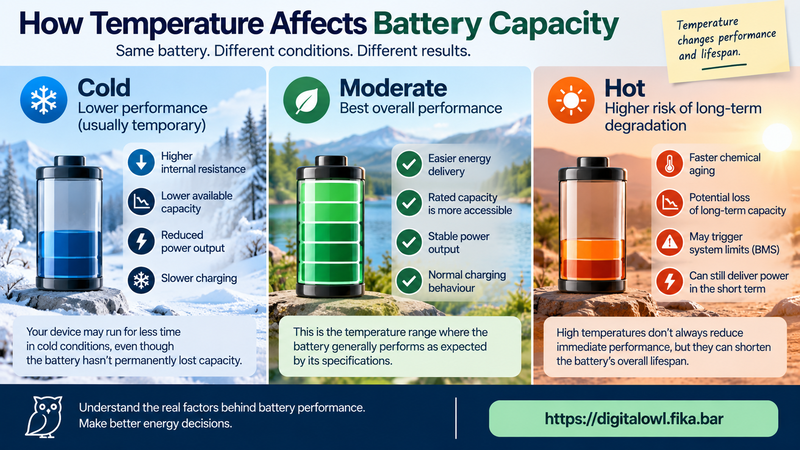
That does not necessarily mean its rated capacity has suddenly changed. Temperature affects how easily the battery can deliver and accept energy, how much of its stored energy is practically accessible under the current conditions and, over longer periods, how quickly the battery ages.
The most important distinction is this:
Cold usually reduces available performance temporarily. Excessive heat can accelerate permanent degradation.
The exact effect depends on battery chemistry, design, state of charge, load, temperature and battery-management limits, so there is no single percentage that applies to every battery.
For the broader concepts behind mAh, Ah, Wh and battery capacity, start with the main guide:
https://medium.com/@volodymyrzh/battery-capacity-explained-mah-wh-amp-hours-decoded-1dc676be5a38
Rated Capacity and Available Capacity Are Not the Same Thing
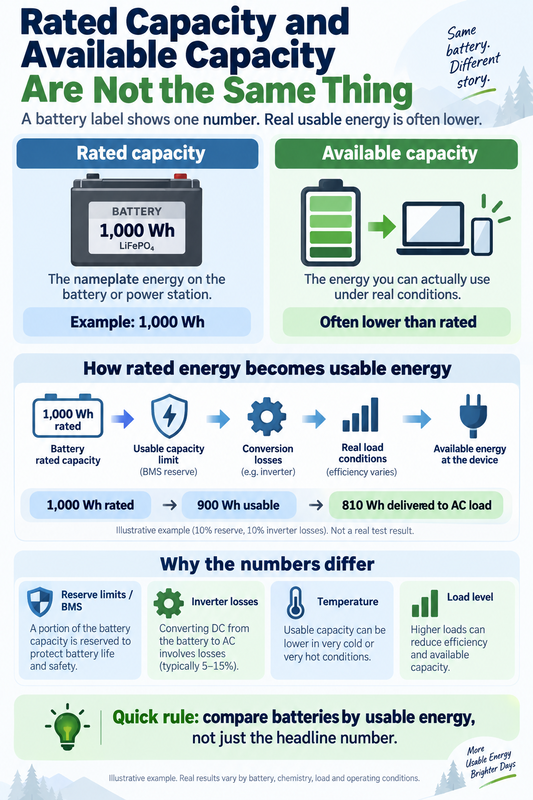
A battery may be labelled 1,000 Wh, but that does not mean every operating condition will allow the device to extract exactly 1,000 Wh.
The difference between rated and practically usable energy is covered here:
Temperature adds another variable to that relationship.
At moderate operating temperatures, the battery may deliver energy close to the behaviour expected by its designers. In cold conditions, internal electrochemical processes generally become slower and internal resistance can increase. Under load, the battery voltage may therefore fall more quickly.
If the voltage reaches the system's cutoff threshold earlier, the battery can appear “empty” even though some chemical energy remains inside it.
The practical result is less accessible energy and weaker power performance while the battery is cold.
Why Cold Batteries Often Seem to Lose Capacity
Battery operation depends on chemical reactions and the movement of ions. Lower temperature slows these processes.
That can produce several effects at the same time:
higher internal resistance;
greater voltage drop under load;
reduced power capability;
less energy available before the system reaches its cutoff voltage;
slower charging behaviour.
This is why a battery-powered device may run for less time in cold conditions even though the battery has not permanently lost the same amount of capacity.
Imagine a battery that normally supports a device comfortably at moderate temperature. Place the same battery in a cold environment and connect the same load. The voltage may sag more strongly when current is drawn, causing the battery-management system or appliance to reach its low-voltage limit sooner.
The user sees shorter runtime.
But part of that lost runtime can return after the battery warms.
That makes cold-weather performance different from long-term degradation.
Cold Capacity Loss Can Be Temporary
This distinction matters.
Suppose a battery performs poorly after being left in a cold vehicle overnight. After returning to a moderate temperature and stabilising, it may again provide more usable energy.
That behaviour should not automatically be described as permanent capacity loss.
A better description is:
cold can temporarily reduce accessible capacity and power.
Actual permanent degradation is a different process involving aging and irreversible changes inside the battery.
This is especially important in product testing. If one battery is measured warm and another is measured cold, a simple runtime comparison may say more about the test conditions than about the batteries themselves.
Temperature therefore belongs in any serious battery testing methodology.
Load Makes the Temperature Effect More Visible
Temperature and load also interact.
A battery under a light load may behave relatively well in conditions where the same battery struggles under a much heavier load. Higher current creates a larger voltage drop across internal resistance, and cold conditions can make that resistance more significant.
The broader relationship between heavy loads and usable energy is explained here:
https://digitalowl.fika.bar/how-high-loads-affect-usable-battery-capacity-01M2R293PTD04WHPQT5NKFP9R4
This means two runtime tests performed at the same temperature can still produce very different results if the loads are different.
A useful way to think about it is:
Cold battery + light load → one result
Cold battery + heavy load → potentially much stronger performance limitation
That is one reason battery capacity cannot be treated as a fixed runtime promise.
Heat Creates a Different Problem
Warm conditions can reduce some of the immediate resistance-related limitations seen in cold batteries. But that does not mean hotter is always better.
Excessive heat accelerates many unwanted chemical reactions inside batteries. Over time, this can contribute to faster aging and permanent capacity loss.
So cold and heat create different problems:
Cold: often reduces current performance and accessible capacity.
Heat: can accelerate long-term degradation and shorten useful life.
A battery that performs strongly during one hot test may therefore still be experiencing conditions that are undesirable for its long-term health.
This distinction is essential when discussing battery performance. Immediate output and long-term durability are not the same metric.
Temperature Also Matters During Charging
Discharging is only half of battery use.
Charging behaviour also changes with temperature, and battery-management systems may restrict charging when conditions fall outside an acceptable operating range.
This is especially important for lithium-ion systems. Charging a very cold lithium-ion battery can create conditions that are harmful to the cell, so well-designed systems may reduce charging current or stop charging until the battery reaches a suitable temperature.
The exact limits depend on the battery chemistry and manufacturer specifications.
For that reason, the correct approach is not to memorise one universal temperature threshold. Check the operating and charging temperature ranges specified for the actual battery.
Chemistry Changes the Result
Different battery chemistries do not respond identically to temperature.
Lead-acid, lithium iron phosphate, NMC and other chemistries have different electrochemical characteristics and operating limits. Even batteries using the same general chemistry can behave differently because of cell design, thermal management, battery-management settings and pack construction.
This is why statements such as:
“A battery loses X% capacity at temperature Y”
need context.
For which chemistry?
At what discharge rate?
Was the battery stabilised at that temperature?
What cutoff voltage was used?
Was the result measured during discharge or inferred from a device runtime test?
Without those details, an apparently precise number can be misleading.
Battery Management Can Hide Some Temperature Effects
Modern battery packs often include temperature sensors connected to the battery-management system.
The BMS may respond to extreme temperatures by restricting:
charging current;
discharge current;
maximum output power;
charging entirely;
discharge entirely.
This can make battery behaviour look different even when two packs use similar cells.
One manufacturer may allow more power at a particular temperature, while another uses more conservative limits to protect the pack.
From the user's perspective, both appear to be “temperature effects”, but part of the difference may actually come from control strategy rather than cell chemistry alone.
We will examine BMS behaviour in more detail later in this Battery graph.
How to Compare Battery Performance Across Temperatures
A useful temperature comparison needs controlled conditions.
At minimum, document:
Battery chemistry and model — what is actually being tested.
Starting state of charge — tests should begin from comparable conditions.
Battery temperature — not simply outdoor air temperature.
Load — especially because heavier loads can magnify voltage sag.
Energy path — direct DC load or inverter-powered AC device.
Cutoff conditions — when the test is considered finished.
Measured Wh delivered — more useful than simply reporting how long an unspecified device operated.
When those variables are visible, temperature data becomes much easier to interpret and compare.
This connects directly with a broader publishing problem: technical battery claims need enough context to be verified. I use a practical fact-checking workflow for that here:
Temperature is a good example of why isolated performance claims should not be copied without checking how the result was obtained.
A Simple Mental Model
You do not need a universal temperature-loss table to understand the basic relationship.
Think of battery performance in three zones:
Cold:
Energy delivery becomes harder. Voltage sag and internal resistance become more important. Available runtime and power may temporarily decrease.
Moderate operating range:
The battery is generally closer to the conditions its normal performance specifications are intended to represent.
Excessive heat:
Short-term performance may not look poor, but chemical aging can accelerate, contributing to permanent degradation over time.
The boundaries between those zones are battery-specific. Always use the manufacturer's operating specifications for an actual product.
Temperature Should Be Part of Runtime Expectations
When someone asks, “How long will this battery run my device?”, temperature is one of the variables hidden behind the answer.
The same battery, same appliance and same nominal capacity can produce different results in winter and summer. The difference may come from internal resistance, power limits, conversion efficiency, thermal-management behaviour or the battery-management system.
That is why a realistic battery estimate should not treat capacity as an isolated number.
Capacity tells you how much energy the battery is designed to store. Temperature helps determine how much of that energy can be practically delivered under current conditions — and how quickly the battery may age over time.
Cold-weather performance and heat-driven degradation should therefore never be treated as the same phenomenon. One can be largely temporary; the other can gradually reduce the battery's future capacity.
Understanding that difference is the first step toward understanding battery health, self-discharge, cycle life and long-term capacity retention — the next group of topics in this Battery graph.
Comments
No comments yet. Be the first to comment!