What Is the Peukert Effect?

The Peukert effect describes how a battery can deliver less effective capacity when it is discharged at a higher rate. In simple terms, drawing energy faster can reduce how long some batteries are able to sustain the load compared with what a straightforward capacity calculation would suggest. The effect is particularly important for lead-acid batteries and should not be treated as a universal rule that affects every battery chemistry in exactly the same way.
This concept sits inside the wider subject of battery capacity, runtime and load. For the broader explanation of mAh, Ah, Wh and battery capacity, see:
https://medium.com/@volodymyrzh/battery-capacity-explained-mah-wh-amp-hours-decoded-1dc676be5a38
The Same Battery Can Behave Differently at Different Discharge Rates
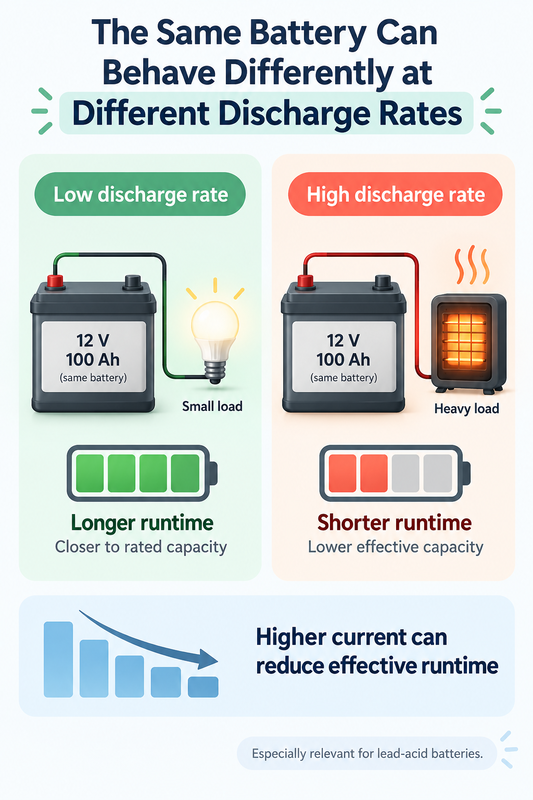
Imagine a battery rated at a particular amp-hour capacity. It is tempting to assume that doubling the discharge current will simply halve the runtime.
For an ideal battery, that relationship would be straightforward:
twice the current → half the runtime
Real batteries do not always behave so neatly. With lead-acid batteries especially, increasing the discharge rate can cause effective capacity to fall, meaning runtime may decrease by more than the simple proportional calculation predicts.
That rate-dependent behaviour is what the Peukert effect helps describe.
Why Higher Discharge Rates Can Reduce Effective Capacity
A battery is not a perfectly efficient container of electrical charge. Chemical reactions, internal resistance, ion movement and voltage behaviour all affect how efficiently stored energy can be delivered.
At higher discharge currents, several things can become more significant:
internal voltage drop;
resistive heating;
limitations in the electrochemical reaction;
faster approach to the discharge cutoff voltage;
and reduced access to part of the battery's theoretical stored capacity.
The battery has not necessarily “lost” that energy permanently. Instead, the chosen discharge rate makes less of the rated capacity practically available under those conditions.
Peukert's Law Describes the Relationship
Peukert's law is a mathematical model used to estimate how discharge current affects battery runtime. Several equivalent versions of the equation are used, but the central relationship is simple:
as discharge current rises, expected runtime falls faster than a perfectly proportional model would predict.
A key part of the model is the Peukert exponent. This value describes how strongly a particular battery responds to changes in discharge rate.
An exponent closer to 1 represents weaker rate-dependent capacity loss. A higher exponent represents a stronger Peukert effect.
The exact value depends on the battery and test conditions, so it should come from appropriate manufacturer data or testing rather than being assumed.
A Simple Example
Suppose a lead-acid battery is tested at a relatively modest discharge rate and delivers its expected rated capacity. If the current is increased substantially, a simple calculation might predict that runtime should fall in direct proportion to the increase in current.
But the real battery may stop supplying usable voltage earlier than that calculation predicts. The effective capacity observed during the high-current test is therefore lower.
This is why a capacity rating should always be interpreted together with the conditions under which it was measured.
A battery labelled 100 Ah does not necessarily provide exactly 100 Ah under every possible discharge current.
C-Rate Helps Put the Discharge Rate in Context
The Peukert effect is closely related to how aggressively a battery is being discharged. C-rate is a useful way to express that discharge rate relative to battery capacity.
A separate explanation of C-rate is available here:
https://digitalowl.fika.bar/what-is-c-rate-01M2NW656JMX8NS28G44TJW4MC
For a simplified 100 Ah battery:
0.1C means 10 A;
0.5C means 50 A;
1C means 100 A.
The same battery is being asked to deliver energy much more quickly at 1C than at 0.1C. For a chemistry with a meaningful Peukert effect, that difference can change the effective capacity observed during discharge.
Peukert Effect vs General High-Load Losses
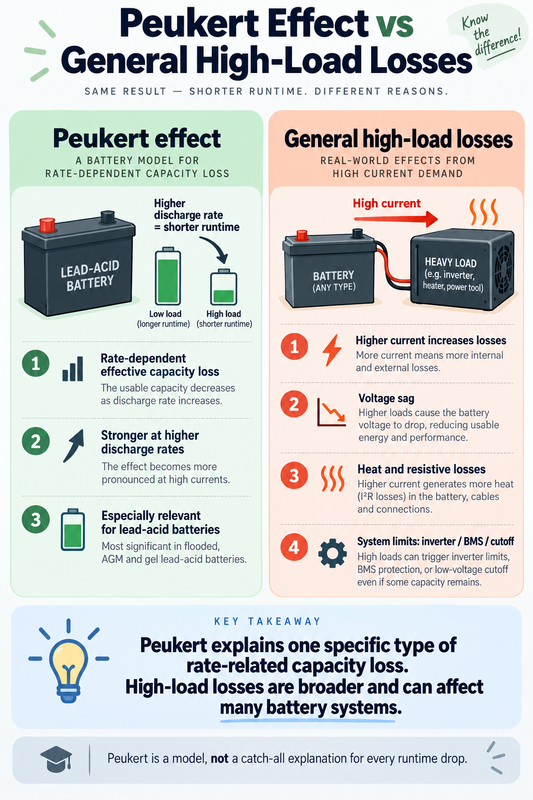
Peukert behaviour should not be used as a catch-all explanation for every situation where high loads reduce runtime. Other mechanisms can also matter.
High currents may increase internal resistive losses, create more heat and cause greater voltage sag. Battery-management systems and inverters may also reach operating limits earlier under demanding loads.
Those broader effects are explained here:
https://digitalowl.fika.bar/how-high-loads-affect-usable-battery-capacity-01M2R293PTD04WHPQT5NKFP9R4
Peukert's law is therefore best understood as one specific model of rate-dependent effective capacity, especially relevant to lead-acid batteries, rather than a complete model of every high-load battery behaviour.
The Effect Is Especially Important for Lead-Acid Batteries
Peukert's law was developed around lead-acid battery behaviour, and that remains its most important practical application. Lead-acid batteries can show substantial differences in effective capacity depending on discharge rate.
This matters in systems such as:
traditional backup batteries;
some off-grid installations;
marine battery banks;
recreational vehicle systems;
and older uninterruptible power supply designs.
A lead-acid battery capacity quoted at a slow discharge rate may therefore perform differently when subjected to a much heavier load.
Whenever possible, check the manufacturer's capacity tables at several discharge rates rather than assuming the headline Ah rating applies unchanged.
Lithium Batteries Behave Differently
Modern lithium batteries generally show a much smaller Peukert-type capacity effect than traditional lead-acid batteries within their intended operating range. That does not mean high discharge rates have no consequences.
Lithium systems can still experience:
voltage sag;
resistive losses;
heating;
battery-management limits;
and reduced efficiency under demanding conditions.
However, using a traditional lead-acid Peukert calculation as though it automatically describes LiFePO4, NMC or every other lithium chemistry can be misleading.
For lithium batteries, manufacturer discharge curves and actual system specifications are usually more useful than applying a generic Peukert exponent.
Temperature and Battery Condition Also Matter
Discharge rate is not the only factor affecting available capacity. Temperature, battery age, state of charge and state of health can all influence voltage and usable energy.
A cold or aged battery may therefore behave differently under the same current than a warm, healthy battery. If runtime measurements are compared, the test conditions need to remain reasonably consistent.
This is another reason why a single Peukert exponent should not be interpreted as a permanent physical constant for every operating situation.
It is a useful model, not a complete description of the battery.
Why Peukert Matters for Runtime Calculations
The basic battery runtime formula is often introduced as:
Runtime ≈ battery capacity ÷ load
That is an excellent starting point, but for lead-acid systems under significant load it can overestimate runtime if rate-dependent capacity loss is ignored.
A more realistic process is:
1. Identify rated battery capacity.
2. Check the discharge rate used for that rating.
3. Estimate the current required by the real load.
4. Check manufacturer discharge data or an appropriate Peukert model.
5. Include system losses and cutoff limits.
This produces a much better estimate than assuming the headline Ah rating remains constant at every discharge current.
Do Not Turn Peukert Into a Universal Correction Percentage
A common mistake is trying to simplify the effect into a rule such as:
“High current reduces capacity by 20%.”
There is no universal percentage. The result depends on the particular battery, discharge rate, Peukert exponent, temperature, age and cutoff conditions.
Two lead-acid batteries with the same nominal Ah rating can show different rate behaviour. Lithium and lead-acid batteries can differ even more significantly.
The correct question is therefore not:
“How much capacity does the Peukert effect remove?”
It is:
“How does this specific battery's effective capacity change at the discharge rate I plan to use?”
The Key Idea
The Peukert effect explains why battery capacity and runtime do not always scale perfectly with discharge current. When a battery with a significant Peukert effect is discharged more aggressively, its effective usable capacity can decrease and runtime can become shorter than a simple proportional calculation predicts.
The effect is most important when working with lead-acid batteries. Modern lithium systems generally show much weaker Peukert behaviour, although high loads can still create other losses and operating limitations.
So use Peukert's law where it belongs: as a tool for understanding rate-dependent capacity in batteries where the effect is meaningful, not as a universal correction formula for every battery technology.
Comments
No comments yet. Be the first to comment!