Battery Capacity Conversion Index: Which Formula Do You Need?
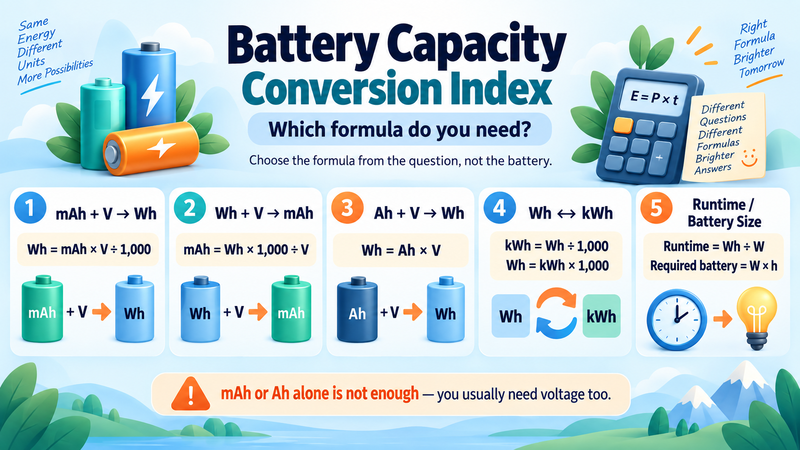
Battery calculations become confusing surprisingly quickly because the same battery can be described in mAh, Ah, Wh, kWh and volts. Then another question appears: are you trying to convert units, calculate energy consumption, estimate runtime or work out how much battery capacity a device needs?
You do not need to memorise every battery formula. You need to identify what you know, what you want to find, and which formula connects the two.
For the broader explanation of how battery capacity, mAh, Ah, Wh and voltage fit together, use the complete reference guide: https://medium.com/@volodymyrzh/battery-capacity-explained-mah-wh-amp-hours-decoded-1dc676be5a38
If the individual battery terms themselves are still unfamiliar, the earlier reading map provides the best starting path before moving into calculations: https://digitalowl.fika.bar/battery-capacity-reading-map-from-mah-to-depth-of-discharge-01M2JAWZM2YYT1NZJN87CWTEKF
You Have mAh and Voltage and Need Wh
Use:
Wh = mAh × V ÷ 1,000
This is one of the most useful conversions for power banks, phone batteries and other products whose headline capacity is given in milliamp-hours.
For example:
20,000 mAh × 3.7 V ÷ 1,000 = 74 Wh
The important part is voltage. A mAh figure cannot be converted meaningfully into Wh without knowing the voltage associated with that capacity rating.
For worked examples and guidance on which voltage to use, see the dedicated mAh-to-Wh guide: https://app.fika.bar/blog/post/how-to-convert-mah-to-wh-formula-and-examples-01M2JBK5A9Y9F9F4C4KN1CK124
You Have Wh and Voltage and Need mAh
Reverse the calculation:
mAh = Wh × 1,000 ÷ V
For example:
74 Wh × 1,000 ÷ 3.7 V = 20,000 mAh
This can be useful when one manufacturer gives energy in Wh while another markets a similar battery in mAh.
The key limitation remains the same: changing the voltage changes the resulting mAh figure. The complete reverse-conversion method is here: https://digitalowl.fika.bar/how-to-convert-wh-to-mah-formula-and-examples-01M2JCPZQN3RM4MFAX2RT83Q1Z
You Have Ah and Voltage and Need Wh
For larger batteries and battery systems, capacity is often listed in amp-hours rather than milliamp-hours.
Use:
Wh = Ah × V
A 100 Ah battery rated at 12 V therefore represents:
100 Ah × 12 V = 1,200 Wh
The same 100 Ah at 24 V would represent 2,400 Wh, which is why Ah values should not be compared without voltage.
The dedicated Ah-to-Wh conversion guide includes examples across common system voltages: https://digitalowl.fika.bar/how-to-convert-ah-to-wh-formula-and-examples-01M2JD3P2228S1SEFQ0MADZ8EV
You Have Wh and Voltage and Need Ah
Use the reverse formula:
Ah = Wh ÷ V
If a battery stores 1,200 Wh at 12 V:
1,200 Wh ÷ 12 V = 100 Ah
At 24 V, the same 1,200 Wh would correspond to only 50 Ah.
That is not a contradiction. Wh measures energy, while Ah describes charge capacity at a particular voltage. For more examples, use the Wh-to-Ah guide: https://digitalowl.fika.bar/how-to-convert-wh-to-ah-formula-and-examples-01M2JDM1Q8AE3Y8Y4N96M99BFF
You Need to Move Between Wh and kWh
These two conversions do not require voltage.
To convert Wh to kWh:
kWh = Wh ÷ 1,000
So:
2,500 Wh = 2.5 kWh
For more examples involving portable batteries and larger storage systems, see: https://digitalowl.fika.bar/how-to-convert-wh-to-kwh-formula-and-examples-01M2JE8YDBE05JCVYQWXA7P4G6
To convert in the opposite direction:
Wh = kWh × 1,000
Therefore:
3.2 kWh = 3,200 Wh
The reverse conversion is covered here: https://digitalowl.fika.bar/how-to-convert-kwh-to-wh-formula-and-examples-01M2JERZC348V2DGJC2AX482ZT
You Know Device Power and Need Energy Consumption
Once the question changes from battery specifications to actual device use, the formula changes too.
Use:
Energy (Wh) = Power (W) × Time (h)
A 60 W device operating for 5 hours uses:
60 W × 5 h = 300 Wh
This calculation is particularly useful before sizing a battery because it tells you how much energy the load requires. For variable loads, average consumption is normally more informative than simply multiplying maximum wattage by time.
The detailed energy-consumption method is here: https://digitalowl.fika.bar/how-to-calculate-energy-consumption-in-watt-hours-01M2JV4C868ADYBRWME82PGTB6
You Know Battery Capacity and Need Runtime
If capacity is already expressed in Wh and the load is expressed in W, theoretical runtime starts with:
Runtime (h) = Battery capacity (Wh) ÷ Load (W)
For example:
600 Wh ÷ 60 W = 10 hours
Real runtime can be lower because rated capacity, usable capacity and conversion losses are not always identical.
Use the dedicated runtime guide when you need to move beyond the theoretical number: https://digitalowl.fika.bar/battery-runtime-formula-01M2JVJ0DBC2706XRP728QTZQ3
You Know the Device and Required Runtime and Need Battery Size
This is essentially the runtime calculation in reverse.
Start with:
Required Wh = Device power (W) × Required runtime (h)
If a 75 W device must operate for 8 hours:
75 W × 8 h = 600 Wh
That 600 Wh is a theoretical energy requirement. A practical battery target may need to be larger after usable capacity, efficiency and reserve margin are considered.
The full single-device sizing workflow is here: https://digitalowl.fika.bar/how-much-battery-capacity-does-a-device-need-01M2JVYX8GC5RDZQS859RWT5XB
You Are Looking at a Battery Label and Do Not Know Which Number to Use
Sometimes the hardest part is not the calculation. It is identifying the correct specification.
A battery label may show 20,000 mAh, 3.7 V, 74 Wh and 100 W at the same time. Those numbers are not interchangeable.
Capacity in mAh or Ah describes charge. Voltage tells you the electrical potential associated with that rating. Wh describes energy. W usually describes power output or input.
Before doing any conversion, identify which number belongs to which category. The annotated label guide explains that process: https://digitalowl.fika.bar/how-to-read-a-battery-capacity-label-01M2JWYNTJEB0JKKS97MQVRP36
Choose the Formula From the Question, Not the Battery
The easiest way to avoid mistakes is to start with the result you want.
If you want energy, convert the available capacity information into Wh. If you want runtime, divide usable energy by the load. If you want to know how much battery you need, calculate the device's energy requirement first. If you are only changing between Wh and kWh, voltage is not part of the calculation.
Most battery calculations are therefore variations of a small set of relationships:
Wh = Ah × V
Wh = mAh × V ÷ 1,000
Energy used = W × hours
Runtime = Wh ÷ W
Once you identify the correct relationship, the arithmetic is usually the easy part. The more important skill is recognising which units describe charge, voltage, energy and power — and choosing the calculation that matches the question you are actually trying to answer.
Comments
No comments yet. Be the first to comment!