What Is Battery Cycle Life?
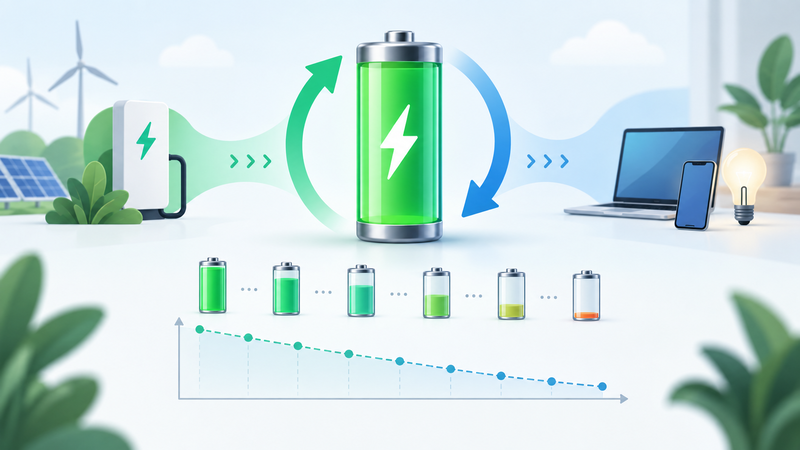
Battery cycle life tells you roughly how many charge-and-discharge cycles a battery can complete before its ability to store energy falls to a specified level.
It is one of the most useful battery longevity specifications, but it is also easy to misunderstand. A battery rated for 2,000 cycles does not normally work perfectly for cycle 1,999 and suddenly fail at cycle 2,000. Capacity usually declines gradually over time.
If you first need the broader framework for understanding battery capacity, including mAh, Ah and Wh, see:
https://medium.com/@volodymyrzh/battery-capacity-explained-mah-wh-amp-hours-decoded-1dc676be5a38
What Counts as a Battery Cycle?
The simplest example is a battery that starts fully charged, is discharged, and is then charged again. That looks like one complete cycle.
Real-world use is often less tidy.
You might use 50% of a battery today, recharge it, then use another 50% tomorrow. From an energy-throughput perspective, those two partial discharges together are roughly equivalent to one full cycle.
This is why battery discussions often use the idea of full-equivalent cycles, sometimes abbreviated as FEC.
For example:
100% discharged once ≈ 1 full-equivalent cycle
50% discharged twice ≈ 1 full-equivalent cycle
25% discharged four times ≈ 1 full-equivalent cycle
This does not mean every battery manufacturer or battery management system counts cycles in exactly the same way. Cycle counters may use different algorithms, so a displayed cycle count should not automatically be treated as a universal laboratory measurement.
Cycle Life Does Not Mean “Cycles Until Failure”
Suppose a battery specification says:
3,000 cycles to 80% capacity
The important part is not just the number 3,000.
The specification means that under the stated test conditions, the battery is expected to retain around 80% of a defined initial capacity after approximately 3,000 cycles.
It does not necessarily mean the battery becomes unusable after that point.
A battery that originally provided 1,000 Wh might, in a simplified example, provide around 800 Wh when it reaches the specified 80% retention threshold. It may still continue operating after that, but with progressively less usable energy.
This makes a cycle-life rating a capacity-retention benchmark, not an expiration date.
Why Cycle-Life Numbers Need Test Conditions
Two batteries can both advertise thousands of cycles while being tested under very different conditions.
Cycle life can be affected by:
depth of discharge
charge and discharge rate
temperature
charge voltage limits
discharge cutoff limits
battery chemistry
cell design
thermal management
the capacity-retention threshold used to define end of life
Because of this, a headline such as “5,000-cycle battery” is incomplete by itself.
A more useful specification would tell you something closer to:
5,000 cycles at a specified depth of discharge, temperature and charge/discharge rate until the battery reaches a defined percentage of its original capacity.
The exact wording varies between manufacturers, but the principle is the same: the conditions behind the number matter.
Depth of Discharge Can Change Cycle Life
Depth of discharge, or DoD, describes how much of the battery's available capacity is used during a discharge.
A 100% DoD cycle uses far more of the available capacity than a 20% DoD cycle.
Shallower cycling can often reduce stress and increase the number of cycles a battery completes before reaching a specified capacity-retention threshold. But this should not be turned into a universal rule such as “never discharge below 50%.”
Different battery chemistries, products and control systems have different recommended operating ranges.
For a more detailed explanation of DoD, see:
Later, cycle life and depth of discharge can be compared directly. For now, the key point is simply that a cycle-life number only makes sense when you know how deeply the battery was being cycled.
One Cycle Is Not Always Equally Stressful
Imagine two batteries that each accumulate 1,000 full-equivalent cycles.
Battery A spends most of its life at moderate temperatures and moderate charge and discharge rates.
Battery B frequently operates hot and is repeatedly charged or discharged at high rates.
Their cycle counts may look similar, but their remaining capacity may not be.
Battery ageing depends on more than the counter.
This is why cycle life is best interpreted as one part of a larger battery-health picture rather than as a standalone prediction of exactly how many years a battery will last.
What Does the BMS Have to Do With Cycle Life?
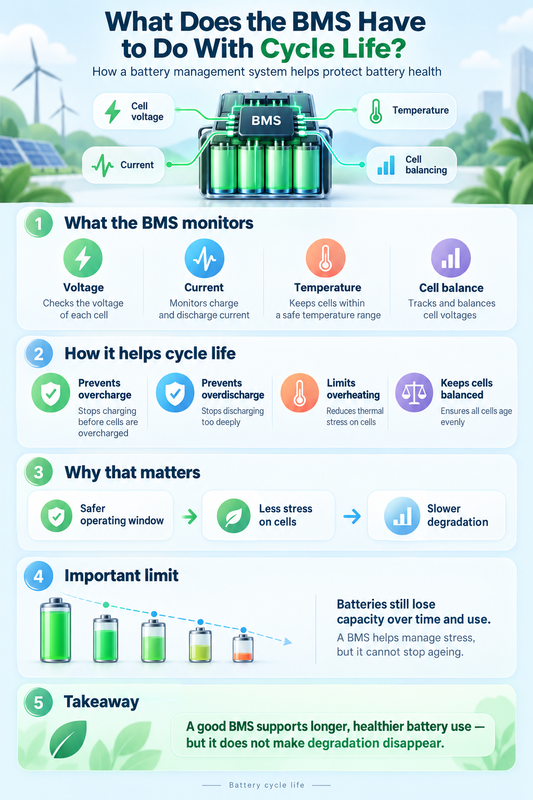
A battery management system, or BMS, monitors and controls important operating conditions inside many modern battery packs.
Depending on the system, it may monitor cell voltage, current and temperature, balance cells and intervene when operating limits are approached.
A BMS can therefore help keep a battery inside its intended operating window.
For a fuller explanation of what the system actually does, see:
https://digitalowl.fika.bar/what-does-a-battery-management-system-do-01M2VNAVCRSBTWHF3T6SPZMX9P
However, a BMS does not make battery degradation disappear. It manages operating limits; the cells still age through use and time.
Cycle Life vs Battery Lifespan
Cycle life and lifespan are related, but they are not identical.
Cycle life describes degradation associated with accumulated cycling.
Calendar time also matters. A battery can age even when it is rarely cycled.
That means a battery rated for thousands of cycles will not necessarily last for decades simply because it is used only occasionally. Temperature, storage conditions, state of charge and time can still contribute to degradation.
This distinction becomes important when comparing heavily cycled batteries, such as those in daily energy-storage systems, with batteries that spend long periods in storage.
How to Read a Cycle-Life Specification
When you see a cycle-life claim, do not stop at the largest number on the specification sheet.
Look for four things:
Number of cycles
Depth of discharge used during testing
Capacity-retention threshold
Test conditions such as temperature and charge/discharge rate
For example, “4,000 cycles” tells you much less than “4,000 cycles to 80% remaining capacity under specified test conditions.”
The second statement gives you a reference point that can actually be compared with another battery specification.
The Main Idea
Battery cycle life is a way of describing how a battery's capacity changes as it repeatedly stores and releases energy.
A cycle does not have to happen as one perfect 100%-to-0%-to-100% event. Partial use can accumulate into full-equivalent cycles, and batteries normally degrade gradually rather than failing at a fixed cycle number.
Most importantly, cycle count should never be separated from the conditions under which it was measured.
Depth of discharge, temperature, charge and discharge rates, battery design and the chosen capacity-retention threshold can all change what a cycle-life rating means in practice.
So when comparing batteries, treat “number of cycles” as the beginning of the specification—not the whole specification.
Comments
No comments yet. Be the first to comment!