How High Loads Affect Usable Battery Capacity

A battery may have a fixed capacity rating, but that does not mean every watt-hour on the label will be equally easy to use under every load. As power demand rises, current usually rises too, increasing electrical losses inside the battery and the rest of the system. Voltage may fall more noticeably under load, heat generation can increase, and protective limits may be reached sooner.
That does not mean a high load simply “removes” a fixed percentage of battery capacity. The effect depends on battery chemistry, internal resistance, temperature, state of charge, battery age, system voltage, inverter behaviour and the size of the load. The useful question is therefore not just how much energy is stored, but how effectively the system can deliver that energy at the required power.
For the broader battery-capacity framework, including mAh, Ah and Wh, see:
https://medium.com/@volodymyrzh/battery-capacity-explained-mah-wh-amp-hours-decoded-1dc676be5a38
Rated Capacity Is Not Always the Same as Usable Energy
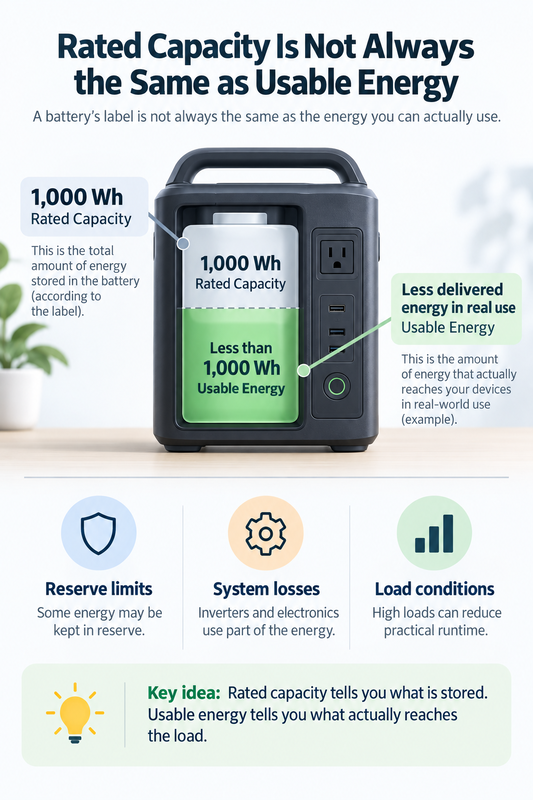
A capacity label describes the battery under defined conditions. The amount of energy that actually reaches a device can be lower because the complete system introduces losses, operating limits and reserves.
The distinction between rated and usable capacity is explained here:
Several things can sit between the headline capacity number and useful output:
battery-management limits;
voltage conversion;
inverter losses;
wiring and connection losses;
internal battery resistance;
low-voltage cutoffs;
and capacity intentionally kept in reserve.
High loads can make some of these effects more significant. A battery that performs efficiently with a modest load may behave differently when asked to provide power close to its output limits.
Higher Power Usually Means Higher Current
Electrical power can be simplified as:
Power = Voltage × Current
If voltage stays roughly similar, demanding more power requires more current. For example, a low-voltage battery system supplying a large load may need substantially more current than the same load supplied from a higher-voltage architecture.
Higher current matters because every real electrical path has some resistance. When current passes through that resistance, some energy becomes heat rather than useful output.
A simplified relationship for resistive loss is:
Loss ∝ Current² × Resistance
This is one reason current matters so much. Doubling current does not necessarily mean the resistive loss simply doubles; the relationship can increase much faster.
Internal Resistance Turns Some Energy Into Heat
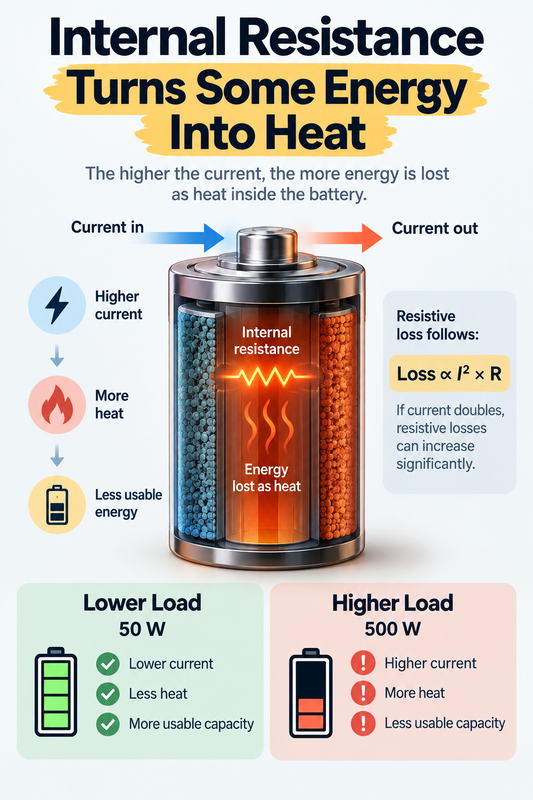
Every battery has internal resistance. It may be low, but it is not zero.
When current rises, the battery experiences greater internal voltage loss and greater heat generation. Some stored chemical energy therefore ends up as heat inside the cell rather than useful energy delivered to the appliance.
Imagine two identical batteries with the same starting state of charge. One supplies a small electronics load, while the other supplies a much more demanding appliance. The second battery may experience greater voltage sag and internal heating even though both began with the same rated capacity.
This does not justify assigning a universal “high-load penalty”. Different cells and battery packs can behave very differently under the same apparent load.
Voltage Sag Can Make Capacity Look Smaller
A battery's terminal voltage can fall temporarily when a heavy load is applied. This is commonly called voltage sag.
The battery may still contain stored energy, but the system does not necessarily have unlimited access to it. If voltage under load falls to a protection threshold, the battery management system or inverter may reduce output or shut the system down.
The important point is that the battery can reach the system's operating limit before every theoretical watt-hour has been delivered. Remove the heavy load and the measured voltage may partially recover.
That is why apparent capacity under a demanding load can differ from capacity observed under gentler conditions.
C-Rate Helps Describe How Demanding the Load Is
A 100 W load is not equally demanding for every battery. Its significance depends partly on the size and voltage of the battery supplying it.
C-rate provides a useful way to describe charge or discharge rate relative to battery capacity:
https://digitalowl.fika.bar/what-is-c-rate-01M2NW656JMX8NS28G44TJW4MC
For a simplified 100 Ah example:
25 A is 0.25C;
50 A is 0.5C;
100 A is 1C;
200 A is 2C.
This makes the load easier to interpret. A current that represents a gentle discharge for one battery may represent a demanding discharge for a much smaller battery.
However, C-rate alone does not tell you exactly how much capacity will remain usable. It describes the relative discharge rate, while actual performance still depends on chemistry, cell design, temperature, state of charge and other conditions.
High Load Can Affect Runtime in More Than One Way
Runtime is usually introduced with a simple relationship:
Runtime ≈ usable battery energy ÷ load power
That formula remains useful, but a high load can affect both sides of the real-world calculation. The load consumes energy faster, while higher current may also increase losses and make protection thresholds relevant sooner.
Suppose a battery could theoretically provide 1,000 Wh to a perfectly efficient system.
At a 100 W load:
1,000 Wh ÷ 100 W = 10 hours
At a 500 W load:
1,000 Wh ÷ 500 W = 2 hours
Even before considering additional losses, the second load naturally produces much shorter runtime. If high-current losses are also greater, real runtime may move further away from the simple theoretical calculation.
The mistake is assuming that multiplying the load by five must produce exactly one-fifth of the observed runtime in every real system.
Battery Chemistry Matters
High-rate behaviour varies substantially between battery types. A statement that is reasonable for one chemistry may be misleading when applied to another.
Lead-acid batteries are especially known for delivering less effective capacity as discharge rate increases. This behaviour is commonly described using the Peukert effect, which deserves separate treatment rather than being applied indiscriminately to every battery.
Modern lithium batteries can generally maintain capacity more effectively across a wider range of discharge rates, but they are not immune to internal losses, voltage sag, temperature effects or manufacturer-defined current limits. Cell design and pack engineering still matter.
So avoid claims such as:
“A high load reduces every battery's usable capacity by 20%.”
Without defined battery chemistry, load, temperature and test conditions, such a percentage is not meaningful.
Temperature Can Amplify the Effect
Battery behaviour under a heavy load is also influenced by temperature. Internal resistance can change with temperature, which means the same electrical demand may produce different voltage behaviour under different environmental conditions.
Cold batteries may experience more noticeable voltage sag, while excessive heat can create different performance and longevity concerns. The result depends on chemistry and design, so temperature should be treated as another variable rather than a universal correction factor.
This is particularly important when comparing manufacturer tests with real-world use. A result measured under controlled laboratory conditions may not transfer perfectly to a battery operating outdoors, inside a vehicle or in an unheated building.
Battery Age Can Change High-Load Performance
A battery does not necessarily behave exactly the same throughout its life. As cells age, capacity and internal characteristics can change.
A battery may still appear adequate during light use but show greater voltage drop when asked to supply a demanding load. This is one reason capacity, state of health and power capability should not be treated as interchangeable concepts.
High-load testing can therefore reveal limitations that are less obvious during low-power operation. It does not necessarily mean the remaining capacity suddenly disappeared; it may mean the battery is less capable of delivering energy at the required rate.
Output Limits Can Matter Before Capacity Does
Sometimes the problem is not reduced usable capacity at all. The battery or power station may simply have an output limit below the appliance's requirement.
For example, a system might contain enough stored energy to theoretically support a 1,500 W appliance for a useful period. If its inverter is only rated for 1,000 W continuously, the energy calculation does not matter because the appliance exceeds the system's power capability.
This is why battery explanations should keep several questions separate:
How much energy is stored?
How much of that energy is usable?
How quickly can the system deliver it?
How long can it support this particular load?
A useful broader explanation of these distinctions is available here:
Compare Batteries at Meaningful Loads
When comparing batteries or portable power systems, capacity should not be the only specification considered. A better comparison looks at how the battery is expected to be used.
Useful questions include:
What is the rated energy capacity?
What usable-capacity limitations are disclosed?
What is the continuous output limit?
What current or C-rate does the intended load create?
How does voltage behave under heavier loads?
What temperature range applies?
Are runtime claims based on realistic test conditions?
A battery intended for small electronics and a battery intended for high-power backup applications may need different design priorities even when their headline energy capacities look similar.
High Loads Do Not Change the Meaning of Capacity
A useful way to think about this is that rated capacity describes stored energy under specified conditions, while high-load performance describes how effectively that energy can be delivered under demanding conditions.
As load rises, current can rise, internal losses can increase, voltage sag may become more noticeable and system protection thresholds can become relevant sooner. The practical result may be less delivered energy or shorter runtime than a simple headline-capacity calculation suggests.
But there is no single percentage that applies to every battery. Chemistry, C-rate, internal resistance, temperature, age and system design all influence the result.
The safest conclusion is therefore simple: use the battery's capacity rating to understand how much energy is available, then check load-specific performance before assuming all of that energy will be equally usable at any power level.
Comments
No comments yet. Be the first to comment!