Average Power vs Peak Power
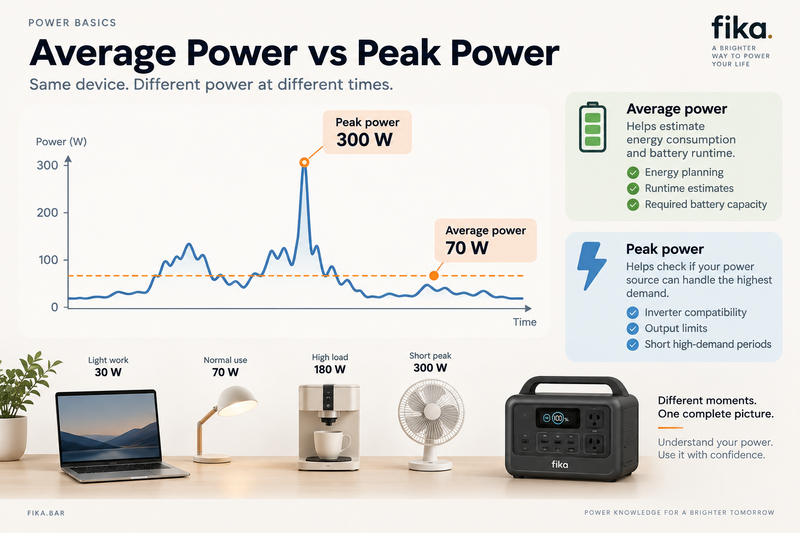
A device does not always consume the same amount of power every second it operates. Its power draw may rise, fall, cycle between different levels or briefly jump much higher than normal.
That is why two different figures are useful when analysing a load: average power and peak power.
Average power helps estimate how much energy a device uses over time. Peak power helps determine whether a battery system, inverter or portable power station can handle the device's highest short-term demand.
For the broader relationship between battery capacity, watts, watt-hours and runtime, see the complete battery capacity guide: https://medium.com/@volodymyrzh/battery-capacity-explained-mah-wh-amp-hours-decoded-1dc676be5a38
What Is Average Power?
Average power is the device's mean power consumption over a period of time.
Imagine a laptop whose power draw changes throughout a four-hour session:
30 W during light work
70 W during demanding tasks
45 W during ordinary browsing
20 W while mostly idle
The laptop does not have one fixed consumption value throughout the session.
If the total energy used over four hours is 180 Wh, average power can be calculated as:
Average power = Energy used ÷ Time
180 Wh ÷ 4 h = 45 W
So the laptop's average power during that period was 45 W.
That figure is particularly useful for estimating energy consumption and battery runtime.
What Is Peak Power?
Peak power is the highest power demand reached by a device during the period being considered.
Using the same laptop example, its average consumption may be 45 W while its highest momentary demand reaches 90 W.
You could therefore describe the load approximately as:
Average power: 45 W
Peak power: 90 W
These figures answer different questions.
The 45 W average helps estimate how quickly the battery's stored energy will be consumed.
The 90 W peak helps determine whether the power source can safely provide the highest demand when it occurs.
Peak power should therefore not automatically be used as the device's normal consumption.
Why Average Power Matters for Battery Runtime
Suppose a battery system can provide 900 Wh of usable energy.
A device reaches a peak of 100 W but averages only 40 W during normal operation.
Using the peak value for the entire runtime calculation would give:
900 Wh ÷ 100 W = 9 hours
But if the device actually averages 40 W:
900 Wh ÷ 40 W = 22.5 hours
The difference is enormous.
The first calculation assumes the device consumes its maximum 100 W continuously. The second uses its actual average load.
For variable devices, average power is therefore often much more useful when estimating energy consumption over several hours.
Why Peak Power Still Matters
Average power alone cannot tell you whether a power station is capable of supporting the device.
Imagine a battery system with:
Continuous output: 80 W
and a device with:
Average power: 45 W
Peak power: 100 W
Looking only at the 45 W average could make the system appear comfortably adequate.
But when the load rises to 100 W, it exceeds the power station's 80 W continuous limit.
The system could overload or shut down even though its average power requirement is relatively low.
This is why output capability must be checked separately from energy consumption.
For a detailed explanation of sustainable output limits, see: https://digitalowl.fika.bar/what-is-continuous-power-output-01M2JYJBJJHR19Q9ZVAPNTN5GX
Average Power Can Be Calculated From Different Operating States
When a device cycles between known power levels, you can estimate average power using a time-weighted calculation.
Consider a simplified appliance that operates for one hour:
15 minutes at 200 W
30 minutes at 80 W
15 minutes at 20 W
Convert each period into hours and calculate the energy used.
First period:
200 W × 0.25 h = 50 Wh
Second period:
80 W × 0.5 h = 40 Wh
Third period:
20 W × 0.25 h = 5 Wh
Total energy:
50 + 40 + 5 = 95 Wh
Because the complete period is one hour:
95 Wh ÷ 1 h = 95 W average
The device reached 200 W at one point, but its average power across the hour was only 95 W.
That distinction is exactly why load profiles matter.
Peak Power Is Not Always the Same as Starting Watts
Peak power and starting watts can overlap, but they are not necessarily identical concepts.
A refrigerator may experience its highest power demand when its compressor starts. In that case, starting watts may also represent the most important peak.
But another device might reach peak power during normal operation rather than specifically at startup.
For example, a computer may briefly draw more power during an intense workload. A variable-speed tool may peak under heavy mechanical load. A device with a heating element may switch between different operating stages.
Starting watts specifically describe the higher demand associated with startup. Peak power describes the highest observed or specified demand more generally.
The difference between starting and running watts is covered here: https://digitalowl.fika.bar/starting-watts-vs-running-watts-01M2K3FNMK1HM1FQDAYVFRT1PM
Example: A Cycling Appliance
Imagine an appliance that alternates between:
Active mode: 180 W
Idle mode: 20 W
During a ten-hour period it spends three hours active and seven hours idle.
Energy used while active:
180 W × 3 h = 540 Wh
Energy used while idle:
20 W × 7 h = 140 Wh
Total:
540 Wh + 140 Wh = 680 Wh
Average power over ten hours:
680 Wh ÷ 10 h = 68 W
The device's average power is therefore 68 W, even though it regularly reaches 180 W.
For battery-capacity planning, the 68 W average is much more representative of long-term consumption.
But the power source still needs to support the 180 W active demand.
Do Not Design Around Only One Number
A useful battery-system check therefore has two separate parts.
For energy planning:
Average power × operating time ≈ energy required
For power compatibility:
Peak demand must remain within the relevant output limits
Suppose a device has:
Average power: 70 W
Peak power: 300 W
and must operate for eight hours.
Estimated energy requirement:
70 W × 8 h = 560 Wh
That gives you a starting point for battery-capacity planning.
But your power source must also be capable of supplying the 300 W peak when it occurs.
A 1,000 Wh battery with only 200 W of supported output could contain plenty of energy for the job and still be unsuitable because the device's peak demand exceeds its power capability.
The Simple Difference to Remember
Average power tells you how quickly a device consumes energy over time.
Peak power tells you how demanding the device can become at its highest point.
Use average power when estimating:
energy consumption,
battery runtime,
and required battery capacity.
Use peak power when checking:
inverter compatibility,
output limits,
and whether the power source can handle temporary high-demand periods.
A good battery calculation needs both sides of the load profile. The average shows what the device typically costs you in energy. The peak shows what the system must be capable of delivering when demand is highest.
Comments
No comments yet. Be the first to comment!