What Is Continuous Power Output?
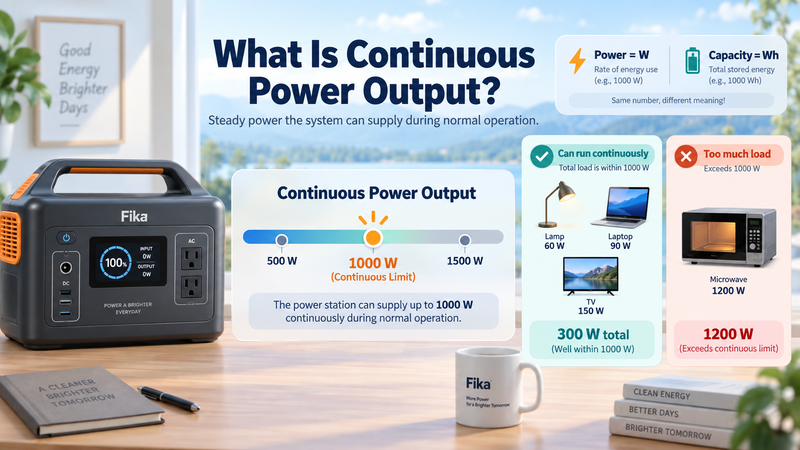
Continuous power output tells you how much electrical power a battery system, inverter or portable power station can supply steadily during normal operation. It is usually measured in watts (W) and answers a different question from battery capacity.
A battery might store a large amount of energy but still be unable to run a high-power appliance if its inverter cannot continuously deliver enough watts. Conversely, a system may support a powerful appliance but have relatively little stored energy, meaning it can run that appliance only for a short time.
For the broader relationship between battery capacity, mAh, Ah, Wh and power, see the complete battery capacity guide: https://medium.com/@volodymyrzh/battery-capacity-explained-mah-wh-amp-hours-decoded-1dc676be5a38
Continuous Power Output Means Sustainable Power
If a portable power station lists:
Continuous output: 1,000 W
it means the unit is designed to supply up to approximately 1,000 watts continuously under the operating conditions specified by the manufacturer.
That does not mean the battery contains 1,000 Wh of energy.
Watts measure power — how quickly electrical energy is being delivered or consumed. Watt-hours measure energy — how much energy is available over time.
This difference is fundamental when reading battery specifications. A detailed comparison is available here: https://digitalowl.fika.bar/watts-vs-watt-hours-what-s-the-difference-01M2GNJJ68FM3605JW1JW54A99
Imagine two power stations:
Power Station A
Capacity: 2,000 Wh
Continuous output: 500 W
Power Station B
Capacity: 1,000 Wh
Continuous output: 1,500 W
Power Station A stores twice as much energy, but Power Station B can continuously support a much larger electrical load.
Capacity and continuous power therefore describe different capabilities.
Why Continuous Output Matters
Before connecting an appliance, you need to know how many watts it requires while operating.
Suppose a device normally draws 800 W.
A power station with:
500 W continuous output
is not suitable for running that device normally, even if the battery has several thousand watt-hours of stored energy.
The problem is not capacity. The load is asking the inverter to deliver more power than its continuous rating.
A power station rated for:
1,000 W continuous output
would have sufficient continuous-power headroom for the same 800 W load, assuming there are no other important compatibility limitations.
This gives you two separate checks whenever you evaluate a battery-powered system:
Can it deliver enough watts to run the device?
Does it contain enough watt-hours to run the device for long enough?
The first question is about power. The second is about capacity and runtime.
Continuous Power Is Not the Same as Battery Capacity
Consider a 1,500 Wh portable power station with a 1,000 W continuous inverter.
The 1,500 Wh specification tells you approximately how much rated energy is stored.
The 1,000 W specification tells you the maximum continuous power the inverter is designed to provide.
If you connect a 100 W device, the power station is operating far below its continuous-output limit. The theoretical energy calculation would start from:
1,500 Wh ÷ 100 W = 15 hours
Real runtime would normally be lower after usable capacity and system losses are considered.
Now connect a device that continuously requires 1,200 W.
The battery may still contain 1,500 Wh, but the inverter's 1,000 W continuous rating becomes the limiting factor. Having enough stored energy does not automatically mean the system can deliver it fast enough for that load.
A useful analogy is a water tank.
Battery capacity is similar to the size of the tank.
Continuous power output is similar to how quickly the outlet can supply water.
A large tank can still have a small outlet.
Add the Loads That Run at the Same Time
Continuous output becomes especially important when multiple devices are connected simultaneously.
Imagine a portable power station supplying:
Laptop charger: 80 W
Television: 120 W
Lighting: 40 W
Small refrigerator while compressor is running: 150 W
The combined running load is:
80 W + 120 W + 40 W + 150 W = 390 W
A power station rated for 500 W continuous output could theoretically support that 390 W combined running load.
However, adding another 200 W device would raise the total to:
390 W + 200 W = 590 W
That would exceed a 500 W continuous rating.
This is why checking individual appliance wattage is not enough when several devices will operate together. The relevant figure is the combined simultaneous load.
It is also sensible not to design a system that must operate permanently at its exact maximum rating. Some margin can make planning more robust, particularly when appliance consumption varies.
Why Appliance Labels Can Be Misleading
The number printed on an appliance is not always identical to its real continuous consumption.
Some labels indicate maximum input, while actual operating power may change with workload. A laptop, for example, may use much less than its charger's maximum rating during light use. Other equipment may cycle between active and idle periods.
For continuous-output planning, you therefore need to understand whether the wattage figure represents:
typical operating power,
maximum operating power,
a rated electrical input,
or a brief startup requirement.
These distinctions become particularly important for refrigerators, pumps, compressors and motors, because some loads temporarily require more power when starting.
That temporary requirement is not the same as continuous power output and is covered separately when evaluating surge power.
Continuous Output and Runtime Must Be Checked Separately
Suppose you have a 1,000 Wh battery system with 1,200 W continuous output.
An 800 W heater fits within the continuous-power limit:
800 W < 1,200 W
But theoretical runtime is only:
1,000 Wh ÷ 800 W = 1.25 hours
So the system can provide enough power, but it cannot provide that power for very long.
Now consider a 100 W device.
It is easily within the same 1,200 W continuous-output limit, and the theoretical runtime becomes:
1,000 Wh ÷ 100 W = 10 hours
The battery has not changed. Only the load has.
That is why continuous power tells you whether the system can run the load, while capacity helps determine how long it can run it.
The Simple Rule to Remember
When comparing a battery system with an appliance, do not ask only how many watt-hours the battery has.
Check both specifications:
Continuous output (W) ≥ simultaneous running load (W)
and separately:
Battery energy (Wh) ÷ load (W) ≈ theoretical runtime
A high-capacity battery is not automatically a high-power battery, and a high-power inverter does not automatically provide long runtime.
Continuous power output is therefore best understood as the system's sustainable delivery limit. It tells you how demanding a load the battery system can support continuously, while battery capacity tells you how much energy is available to keep that load running.
Comments
No comments yet. Be the first to comment!