Power, Runtime and Load: How Battery Capacity Meets Real Appliances
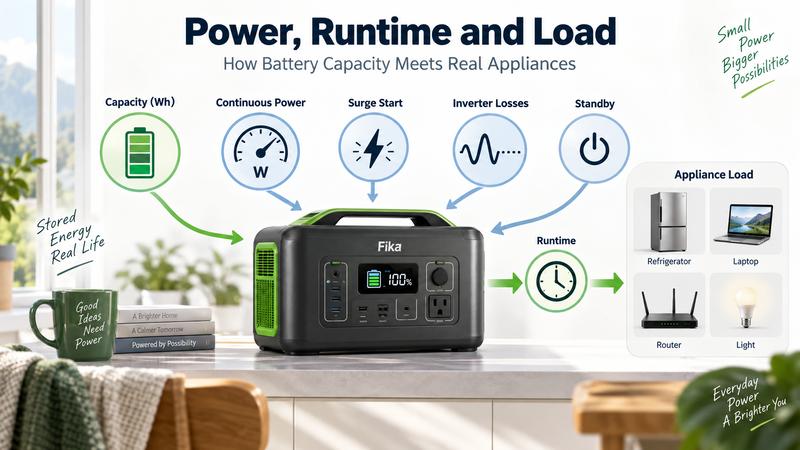
Battery capacity tells you how much energy a battery can store. It does not, by itself, tell you whether the battery can start a refrigerator, run a pump, support several devices at once or deliver the runtime you expect.
Those questions sit at the intersection of energy, power and load behaviour.
A battery rated at 2,000 Wh may contain plenty of energy for a particular task, but the system still needs enough continuous output for the normal load and enough short-duration power for startup peaks. Inverter losses, standby consumption and high discharge rates can then reduce the amount of energy that reaches the appliance.
If you need the broader foundation first, start with the main battery-capacity guide:
https://medium.com/@volodymyrzh/battery-capacity-explained-mah-wh-amp-hours-decoded-1dc676be5a38
For conversions between mAh, Ah, Wh and related units, use the calculation index:
This article focuses on the next step: what happens when stored battery energy meets real appliances.
Capacity and Power Answer Different Questions
Suppose a battery stores 1,000 Wh.
That tells us about energy. It does not tell us how quickly the battery system can deliver that energy.
A 100 W device and a 1,000 W device can both theoretically consume energy from the same 1,000 Wh battery, but they create very different demands on the inverter, cells and battery-management system.
This is why battery specifications usually include a continuous power output in watts:
https://digitalowl.fika.bar/what-is-continuous-power-output-01M2JYJBJJHR19Q9ZVAPNTN5GX
Continuous output answers a practical question:
Can the system sustain the load while it is operating normally?
If your combined appliances require 1,200 W and the power station supports only 1,000 W continuously, having enough watt-hours does not solve the problem.
Some Appliances Need More Power When They Start
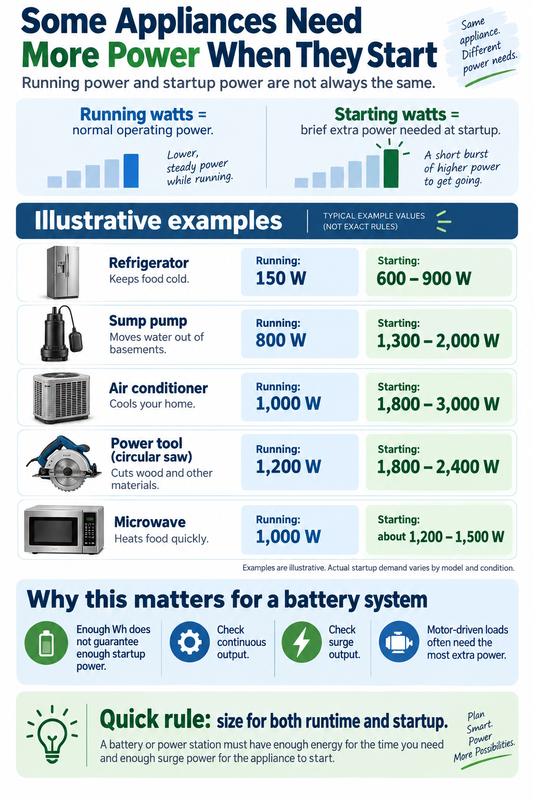
Normal operating power is only part of the picture.
Compressors, pumps and other motor-driven appliances can briefly require considerably more power during startup. Battery systems therefore often specify a separate surge power rating:
https://digitalowl.fika.bar/what-is-surge-power-01M2K2K8B9PG9S22DCM3774NKM
Surge capacity is not additional stored energy. It is the system's ability to support a short period of higher power demand.
That distinction becomes easier to understand when comparing starting watts and running watts:
https://digitalowl.fika.bar/starting-watts-vs-running-watts-01M2K3FNMK1HM1FQDAYVFRT1PM
A refrigerator might operate comfortably within the continuous output rating once its compressor is running but briefly exceed that normal load when the compressor starts.
This also explains why simply adding all appliance nameplate wattages can produce a poor system estimate.
Average Load Helps With Energy; Peak Load Helps With Power
Another useful distinction is between average power and peak power.
Average power helps estimate how much energy a device consumes over time. Peak power helps determine whether the battery system can handle the highest instantaneous demand.
The two concepts are compared here:
https://digitalowl.fika.bar/average-power-vs-peak-power-01M2K4KCTV720ZHP7EVSTJP6M6
Imagine a load that averages 200 W over several hours but occasionally reaches 900 W. The 200 W figure is useful when estimating Wh consumption and runtime. The 900 W figure matters when checking inverter compatibility.
That gives us two separate questions:
Energy question: How many watt-hours will the load consume?
Power question: What is the highest wattage the system may need to deliver?
Good battery planning needs both answers.
Runtime Depends on More Than Wh ÷ W
The simplest theoretical runtime calculation is:
Runtime = Battery energy (Wh) ÷ Load (W)
But energy normally passes through other components before reaching the appliance.
For an AC device, the path may be:
Battery → inverter → appliance
The inverter introduces conversion losses. That is why inverter efficiency belongs in more realistic runtime calculations:
https://app.fika.bar/blog/post/what-is-inverter-efficiency-01M2K65Q757EW3H13TCFP3JFJ7
The energy path also explains why equivalent AC and DC loads can produce different runtime results. When a suitable device can operate through a more direct DC path, an inverter stage may be avoided, although DC conversion can still introduce its own losses.
The practical difference is covered here:
https://digitalowl.fika.bar/ac-vs-dc-battery-runtime-01M2K6Q8Q0Y9MB6ZG35RGN2W8Y
So a useful runtime estimate asks not only how large the battery is, but also how the energy reaches the load.
Do Not Forget the Power the System Uses Itself
The visible appliance may not be the only load.
Inverters, displays, monitoring electronics and other always-on components can consume energy even when the main device is relatively small.
This is standby power consumption:
https://app.fika.bar/blog/post/standby-power-consumption-01M2N3G16AGDKD6RQPH2K3S8NE
A 10 W hidden load may seem insignificant beside a 500 W appliance. But when powering a 30 W router or communications system for many hours, that same 10 W becomes a significant fraction of total consumption.
For long-duration, low-power use, standby draw deserves much more attention than its small wattage suggests.
High Loads Can Change Battery Behaviour
Even when the inverter can technically supply a load, the discharge rate itself can matter.
C-rate describes charging or discharging relative to battery capacity:
https://digitalowl.fika.bar/what-is-c-rate-01M2NW656JMX8NS28G44TJW4MC
A higher discharge rate generally places greater demand on the battery. Internal resistance, voltage sag and heat can affect how much useful energy the system delivers under heavy loads.
The broader relationship is explained here:
https://digitalowl.fika.bar/how-high-loads-affect-usable-battery-capacity-01M2R293PTD04WHPQT5NKFP9R4
This does not mean every battery loses the same percentage of usable energy at high load. Chemistry, design, temperature and battery-management limits all matter.
For lead-acid batteries in particular, another useful concept is the Peukert effect:
https://app.fika.bar/blog/post/what-is-the-peukert-effect-01M2R90J0CQTA65NA7WY5XASTA
Peukert behaviour helps explain why effective capacity can fall as discharge rate increases. The effect is especially relevant to lead-acid systems and should not be applied mechanically to modern lithium batteries as though every chemistry behaved identically.
A Practical Way to Read the Whole System
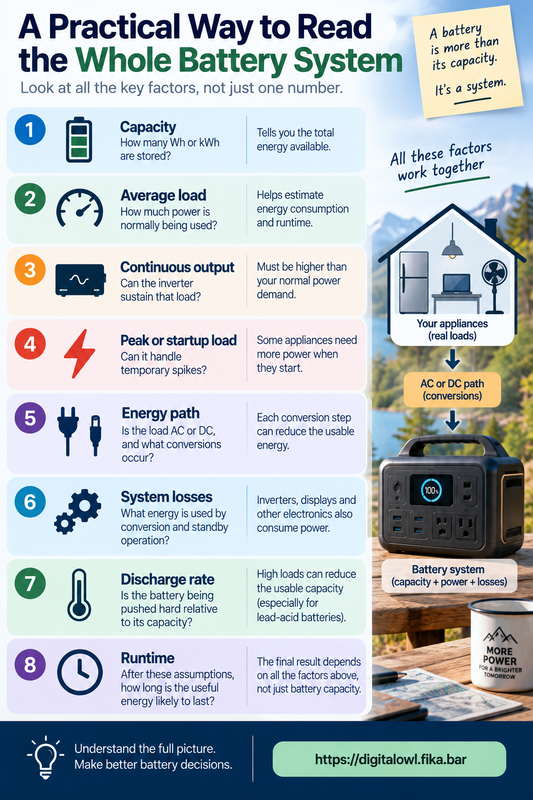
Instead of choosing a battery from one headline specification, work through the problem in this order:
Capacity: How many Wh or kWh are stored?
Average load: How much power is normally being used?
Continuous output: Can the inverter sustain that load?
Peak or startup load: Can it handle temporary spikes?
Energy path: Is the load AC or DC, and what conversions occur?
System losses: What energy is consumed by conversion and standby operation?
Discharge rate: Is the battery being pushed hard relative to its capacity?
Runtime: After those assumptions, how long is the useful energy likely to last?
This sequence prevents the most common mistake: treating battery capacity as though it answers every question about appliance compatibility.
A 2 kWh battery with insufficient output cannot run a demanding appliance merely because it stores enough energy. A powerful inverter attached to a small battery can support a large load but may drain the available energy quickly.
Capacity and power need to be evaluated together.
The Useful Question Is Not “How Big Is the Battery?”
The better question is:
Can this battery system deliver the required power for the required amount of time?
That combines stored energy, continuous power, startup behaviour, average load, losses and real battery performance into one practical decision.
For a broader explanation of why capacity and runtime should be presented separately rather than collapsed into one number, see:
Once these relationships are clear, battery specifications become much easier to interpret. Watt-hours tell you how much energy is available. Watts tell you how quickly that energy must be delivered. Runtime connects those numbers to time, while efficiency, standby consumption and discharge behaviour explain why real appliances rarely match the simplest theoretical calculation exactly.
That is the point where battery capacity stops being an isolated specification and becomes part of a real energy system.
Comments
No comments yet. Be the first to comment!