Starting Watts vs Running Watts
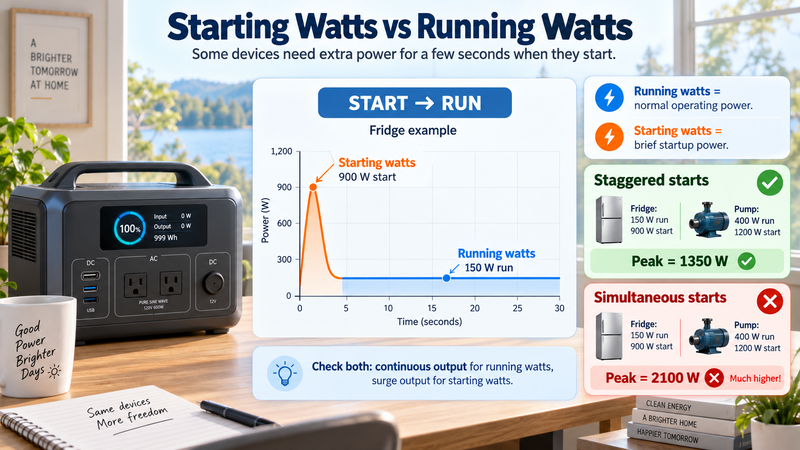
A device may use one amount of power while operating normally and a much larger amount for a few moments when it starts. These two figures are commonly described as running watts and starting watts.
Understanding the difference matters when choosing a portable power station, inverter, generator or battery system. A power source can have enough capacity to run an appliance for hours and still fail to start it if the initial power demand is too high.
For the broader relationship between battery capacity, watts, watt-hours and runtime, see the complete battery capacity guide: https://medium.com/@volodymyrzh/battery-capacity-explained-mah-wh-amp-hours-decoded-1dc676be5a38
What Are Running Watts?
Running watts are the power a device requires during normal operation once it has started and reached its usual working state.
Imagine a refrigerator that uses approximately:
150 W running
Once the compressor is operating normally, the power source needs to keep supplying roughly that level of power while the compressor is active.
If several devices operate at the same time, their running watts must be added together.
For example:
Laptop: 90 W
Television: 120 W
Lighting: 40 W
Refrigerator: 150 W
Combined running load:
90 + 120 + 40 + 150 = 400 W
A power source therefore needs sufficient continuous output to support the combined simultaneous load.
Continuous power output is explained separately here: https://digitalowl.fika.bar/what-is-continuous-power-output-01M2JYJBJJHR19Q9ZVAPNTN5GX
What Are Starting Watts?
Starting watts describe the short-term power a device may require when it first switches on or when a motor, compressor or pump starts.
Suppose the same refrigerator requires:
150 W running
900 W starting
Most of the time, the appliance is not demanding 900 W. That higher figure may occur only briefly when the compressor starts.
This temporary increase is one reason a power station with a 500 W continuous rating may still need considerably more than 500 W of short-term surge capability to start certain appliances.
Surge power and its limitations are covered in more detail here: https://digitalowl.fika.bar/what-is-surge-power-01M2K2K8B9PG9S22DCM3774NKM
Why Motors and Compressors Can Need More Power at Startup
Motor-driven equipment does not always begin operating at its normal steady-state power level.
When a motor starts from rest, the electrical system must produce the force needed to begin rotation and bring the equipment up to operating speed. Compressors and pumps can place additional mechanical resistance on that startup process.
Devices where this distinction can matter include:
refrigerators and freezers,
water pumps,
air compressors,
air conditioners,
workshop equipment,
some power tools,
and other motor-driven appliances.
The starting requirement can vary greatly between models. There is no single multiplier that accurately predicts the starting watts of every motor or compressor.
Whenever possible, use the manufacturer's specifications or measured startup demand rather than assuming that starting watts are always two, three or five times the running load.
Example: Can a Power Station Start a Refrigerator?
Imagine a refrigerator with these illustrative requirements:
Running power: 150 W
Starting power: 900 W
Now consider a portable power station rated for:
Continuous output: 600 W
Surge output: 1,000 W
During normal refrigerator operation:
150 W < 600 W
The running load is comfortably inside the continuous-output limit.
During startup:
900 W < 1,000 W
The short startup demand also remains inside the stated surge limit.
From a power-rating perspective, the combination appears suitable.
Now change only the power station's surge rating:
Continuous output: 600 W
Surge output: 700 W
The refrigerator still requires only 150 W while running, but its 900 W startup demand exceeds the 700 W surge capability.
The system may therefore overload or shut down when the compressor attempts to start.
The problem is not the refrigerator's normal consumption. It is the brief starting demand.
Starting Watts Do Not Determine Normal Battery Runtime
Starting watts are important for compatibility, but they should not normally be treated as though the device consumes that amount continuously.
Consider the same refrigerator:
150 W running
900 W starting
Calculating runtime using 900 W for the entire operating period would greatly exaggerate its energy use if the 900 W demand lasts only briefly.
For energy and runtime estimates, average power consumption over time is usually more useful.
Starting watts answer:
Can the system handle the device switching on?
Running or average watts help answer:
How much power does the device use during operation?
These are related but different questions.
Simultaneous Starts Can Create a Larger Problem
A system that can start one motor-driven appliance may still struggle if several devices start at almost the same moment.
Imagine two appliances:
Refrigerator
Running: 150 W
Starting: 900 W
Water pump
Running: 400 W
Starting: 1,200 W
If both are already running, their combined load is:
150 W + 400 W = 550 W
But if both attempt to start at the same time, the temporary requirement could reach:
900 W + 1,200 W = 2,100 W
Now imagine a power station rated for:
1,000 W continuous
1,800 W surge
The 550 W combined running load is easily within the continuous limit.
However, the illustrative simultaneous startup demand of 2,100 W exceeds the 1,800 W surge rating.
This is why a system can appear comfortably oversized when you look only at normal running watts yet still experience overloads during startup events.
Staggering Startup Can Reduce Peak Demand
If two high-starting-load devices do not need to switch on simultaneously, staggering their startup may reduce the maximum instantaneous demand.
Using the previous example, starting the refrigerator first could require up to 900 W temporarily. Once it settles to approximately 150 W, the pump can start.
During the pump startup, the approximate combined requirement would then be:
150 W refrigerator running + 1,200 W pump starting = 1,350 W
That is much lower than the 2,100 W simultaneous-start example.
Real appliances can cycle automatically, however, so manual staggering is not always possible. Refrigerators, pumps and compressors may restart whenever their controls require them to.
A system intended for unattended operation should therefore account for plausible overlapping startup events rather than assuming every load will always start in a convenient sequence.
Check Running and Starting Requirements Separately
A useful power-system check has two parts.
For normal operation:
Combined running watts ≤ continuous power output
For startup events:
Expected temporary starting demand ≤ supported surge output
Suppose your system has:
Continuous output: 1,500 W
Surge output: 2,500 W
and the devices likely to operate together require:
Combined running load: 900 W
Maximum expected startup combination: 2,000 W
Both requirements fit within the respective ratings.
That still does not answer how long the battery will run the equipment. Runtime depends on battery energy in Wh, usable capacity, efficiency and the actual load over time.
Power compatibility and energy capacity should therefore be checked separately.
The Simple Difference to Remember
Running watts are the power a device needs during normal operation.
Starting watts are the temporarily higher power some devices need when starting.
A battery system must be able to satisfy both.
Running watts are compared primarily with the system's continuous output. Starting watts are compared with its short-term surge capability.
The biggest mistake is checking only one side of the problem. A system can have enough continuous power but insufficient startup headroom, or excellent surge capability but insufficient continuous output for the load once everything is running.
When motors, pumps or compressors are involved, always consider both — and remember that several devices starting at once can create a much larger peak than their normal combined running load suggests.
Comments
No comments yet. Be the first to comment!