Standby Power Consumption
A battery can lose useful runtime even when the device you care about appears to be doing almost nothing. Displays, control electronics, network connections, chargers and inverters may continue consuming small amounts of power in the background.
This is standby power consumption: electrical power used while equipment remains ready to operate rather than performing its main task at full load.
A few watts may not sound important. But when that load continues for many hours, the energy consumption adds up — and with a small device or modest battery, the effect can be surprisingly significant.
For the broader relationship between battery capacity, watts, watt-hours and runtime, see the complete battery capacity guide: https://medium.com/@volodymyrzh/battery-capacity-explained-mah-wh-amp-hours-decoded-1dc676be5a38
Standby Power Is Still Real Power Consumption
Suppose a device draws only:
5 W in standby
If it remains in that state for 24 hours:
5 W × 24 h = 120 Wh
That small continuous load therefore consumes 120 Wh per day.
At 10 W:
10 W × 24 h = 240 Wh
The wattage is small, but the operating time is extremely long.
This is why standby consumption should be treated as an energy calculation rather than dismissed because the instantaneous power number looks insignificant.
The basic relationship is the same as for any other electrical load:
Energy consumption (Wh) = Power (W) × Time (hours)
For a more detailed explanation of this calculation, see: https://digitalowl.fika.bar/how-to-calculate-energy-consumption-in-watt-hours-01M2JV4C868ADYBRWME82PGTB6
Portable Power Stations Can Have Their Own Standby Load
The connected appliance is not necessarily the only thing consuming energy.
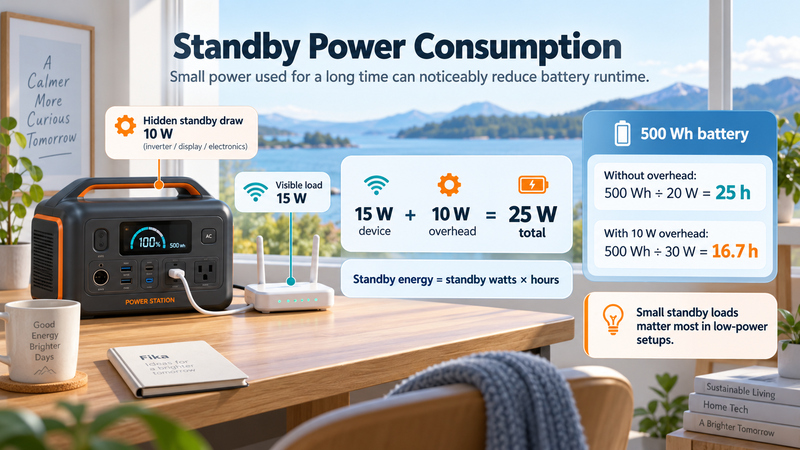
A portable power station may use some power to keep its internal electronics active. If its AC inverter remains switched on, the inverter itself can consume energy even when the connected AC device is drawing little or no power.
The exact idle consumption depends on the product and operating mode, so it should not be treated as one universal number.
For an illustrative example, imagine:
Device load: 15 W
Power-system overhead: 10 W
The battery is not supplying only the 15 W device.
The approximate total load becomes:
15 W + 10 W = 25 W
Over eight hours:
25 W × 8 h = 200 Wh
If you had calculated energy consumption using only the visible 15 W load:
15 W × 8 h = 120 Wh
you would underestimate total energy use by 80 Wh in this example.
Small Loads Can Be Affected Disproportionately
Standby and inverter overhead matter most when the useful load itself is small.
Consider the previous example:
Useful device load: 15 W
System overhead: 10 W
Total:
25 W
The 10 W overhead represents 40% of the total 25 W battery load.
Now compare that with a much larger device:
Useful load: 200 W
System overhead: 10 W
Total:
210 W
The same 10 W overhead now represents less than 5% of the total load.
Nothing about the standby consumption changed. Its importance relative to the useful load changed.
This is why idle consumption can have a particularly noticeable effect when powering routers, small communications equipment, LED lighting, low-power electronics and other devices designed to operate for many hours.
Example: Overnight Router Backup
Suppose a router consumes:
12 W
You want it to operate for 10 hours overnight.
Ignoring all other consumption:
12 W × 10 h = 120 Wh
Now imagine the battery system itself adds an illustrative 8 W of continuous overhead while providing the required output.
Actual total load becomes:
12 W + 8 W = 20 W
Over 10 hours:
20 W × 10 h = 200 Wh
The difference is substantial:
200 Wh − 120 Wh = 80 Wh
A calculation based only on the router would underestimate the required energy by about one third of the total consumption in this example.
This is one reason low-power backup systems should be evaluated using total system consumption, not only the wattage printed on the device.
Always-On Electronics Add Up
Standby consumption is not limited to inverters.
A system may include several components that remain continuously active, such as:
displays,
monitoring circuits,
Wi-Fi or Bluetooth modules,
control boards,
smart plugs,
chargers,
network equipment,
indicator lights,
battery-management electronics,
and external adapters.
One small load may be negligible. Several small loads operating continuously can become meaningful.
Imagine four always-on components consuming:
2 W + 3 W + 4 W + 6 W = 15 W
Across a full day:
15 W × 24 h = 360 Wh
Across three days:
360 Wh × 3 = 1,080 Wh
A collection of tiny loads can therefore consume more than 1 kWh over several days in this illustrative scenario.
The important factor is not only wattage. It is wattage multiplied by time.
Standby Is Different From Battery Self-Discharge
Standby power should not be confused with a battery gradually losing stored charge internally.
Standby consumption involves active electrical loads drawing energy from the battery.
For example, an inverter remaining switched on and consuming several watts is a load. A display or communication module staying active is a load.
Battery self-discharge is a different process in which stored energy gradually decreases even without an external operating load.
Keeping these concepts separate makes troubleshooting much easier. If a battery is losing charge faster than expected, the cause might be an always-on load, inverter overhead, internal electronics, self-discharge or a combination of several effects.
Standby Power Changes Runtime
The standard theoretical runtime calculation starts with:
Runtime = Battery energy (Wh) ÷ Load (W)
But the load should represent the power the battery system actually has to supply.
Suppose you have 500 Wh of usable energy.
With a 20 W device and no additional overhead:
500 Wh ÷ 20 W = 25 hours
Now add an illustrative 10 W continuous system load:
20 W + 10 W = 30 W
The theoretical calculation becomes:
500 Wh ÷ 30 W ≈ 16.7 hours
That is a dramatic difference caused by what initially looked like a small 10 W load.
For the broader runtime calculation and its limitations, see: https://digitalowl.fika.bar/battery-runtime-formula-01M2JVJ0DBC2706XRP728QTZQ3
Measure the Whole System When Runtime Matters
If accurate runtime is important, measuring only the main appliance may not be enough.
Consider which components remain active for the entire operating period:
Main device
inverter or converter overhead
always-on electronics
other standby loads
= total battery-side demand
Not every system exposes all of these values clearly in its specifications. In those cases, real-world measurement can provide a more useful estimate than relying entirely on individual product labels.
It is also worth checking whether outputs that are not needed can be disabled. If an AC inverter consumes energy while active but your device can operate directly from an available DC output, the total system behaviour may be different.
The most efficient configuration depends on the specific equipment, so measurements and manufacturer data are preferable to universal assumptions.
The Simple Rule to Remember
Standby power is small power used for a long time.
That makes this equation especially important:
Standby energy = Standby watts × Standby hours
A 5 W load is only 5 W at any single moment, but it becomes 120 Wh after 24 hours.
For high-power devices operating briefly, that may be relatively unimportant. For low-power equipment expected to run overnight or for several days, standby consumption can become a major part of the energy budget.
When estimating battery runtime, therefore, do not count only the watts you can easily see. Count the loads that stay quietly active in the background as well.
Comments
No comments yet. Be the first to comment!