What Is Inverter Efficiency?
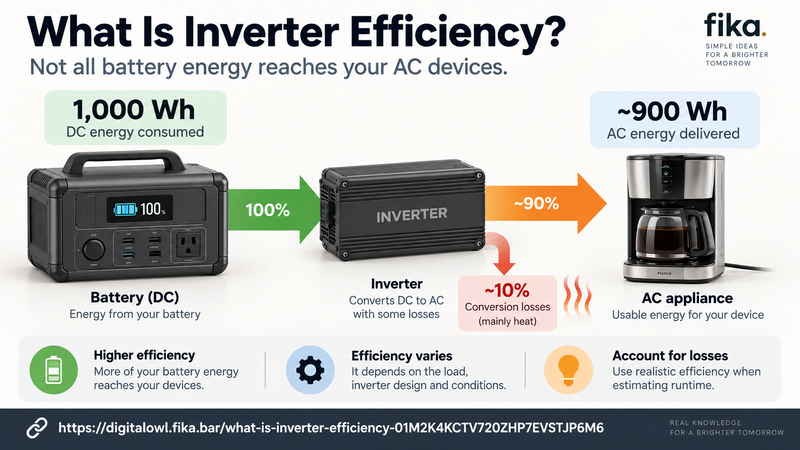
An inverter lets a battery power AC appliances by converting the battery’s direct current into alternating current. That conversion is extremely useful, but it is not perfectly efficient. Some of the battery’s stored energy is lost before it reaches the appliance.
Inverter efficiency describes how much of the DC energy entering the inverter becomes usable AC energy at the output.
This matters whenever you estimate battery runtime. A device labelled 100 W does not necessarily remove exactly 100 Wh from the battery for every hour it operates through an inverter.
For the broader relationship between battery capacity, watt-hours and electrical loads, see the complete battery capacity guide: https://medium.com/@volodymyrzh/battery-capacity-explained-mah-wh-amp-hours-decoded-1dc676be5a38
What Does Inverter Efficiency Mean?
Imagine an inverter receiving 100 Wh of energy from a battery.
If 90 Wh reaches the AC appliance while 10 Wh is lost during conversion, the inverter is operating at an efficiency of:
90 Wh ÷ 100 Wh × 100 = 90%
In simplified form:
Efficiency = AC energy delivered ÷ DC energy consumed × 100%
The missing energy has not disappeared. It is mainly converted into heat and consumed by the inverter’s own electronics.
A higher efficiency means a larger proportion of the battery’s stored energy reaches the appliance.
However, inverter efficiency is rarely one fixed number under every possible operating condition.
Why an AC Appliance Uses More Battery Energy Than Its Label Suggests
Suppose an AC appliance consumes 100 W while operating.
If it runs for five hours, the appliance itself requires:
100 W × 5 h = 500 Wh
It might therefore seem that a battery providing 500 Wh of usable energy should run it for exactly five hours.
But the inverter also needs energy.
If the complete conversion path is assumed to be 90% efficient for this example, the battery energy required becomes approximately:
500 Wh ÷ 0.90 ≈ 556 Wh
The appliance still receives 500 Wh.
The battery, however, supplies roughly 556 Wh because part of that energy is lost during conversion.
This is one reason real battery runtime can be lower than a simple battery Wh ÷ appliance W calculation suggests.
For the full runtime calculation process, see: https://digitalowl.fika.bar/battery-runtime-formula-01M2JVJ0DBC2706XRP728QTZQ3
Inverter Efficiency Is Not a Universal Percentage
It is tempting to assume that every inverter loses a fixed percentage of energy.
Real behaviour is more complicated.
Efficiency can change with:
load level,
inverter design,
input voltage,
temperature,
operating mode,
power factor of the connected load,
and other electrical conditions.
An inverter advertised with a high maximum efficiency may not achieve that number across its entire operating range.
That does not mean the specification is necessarily wrong. It means peak efficiency and real operating efficiency are not always the same thing.
For practical battery calculations, manufacturer efficiency curves or measured data are more useful than assuming one universal percentage for every system.
Light Loads Can Be Surprisingly Important
Inverter losses can become particularly noticeable when powering very small loads.
Imagine an inverter supplying a 10 W device.
If the inverter itself requires several watts merely to remain active, its own consumption may represent a significant share of the total energy leaving the battery.
For example, consider a simplified situation where:
Device consumption: 10 W
Inverter internal consumption: 5 W
Total battery-side demand would be approximately:
10 W + 5 W = 15 W
Only two-thirds of that illustrative total is reaching the device.
Now compare the same 5 W inverter overhead with a 500 W load.
The inverter’s idle or operating overhead becomes a much smaller proportion of the total system demand.
This is why very small AC loads can sometimes produce poorer overall battery utilisation than expected.
Rated Capacity Is Not the Same as AC Energy Available
Another common mistake is taking the battery’s rated Wh figure and assuming every watt-hour can reach an AC appliance.
Consider a portable power station labelled:
Battery capacity: 1,000 Wh
That does not automatically mean an AC device can consume the full 1,000 Wh.
Several factors may reduce what ultimately reaches the load, including battery-management limits, reserve capacity and conversion losses.
The distinction between the number printed on the battery and the energy that is practically available is explained here: https://digitalowl.fika.bar/rated-capacity-vs-usable-capacity-what-s-the-difference-01M2GQ5Y5KA68T9JHJQKWPD6TE
Suppose, purely as an example, a 1,000 Wh system provides 900 Wh of usable battery energy before inverter losses are considered.
If the inverter path then operates at 90% efficiency:
900 Wh × 0.90 = 810 Wh
Approximately 810 Wh would reach the AC load under those simplified assumptions.
This example should not be treated as a universal rule. Actual usable energy and conversion efficiency depend on the specific product and conditions.
How Inverter Efficiency Changes Runtime
Suppose you have 900 Wh of usable battery energy and want to run a 100 W AC appliance.
Ignoring inverter losses:
900 Wh ÷ 100 W = 9 hours
Now assume an illustrative inverter efficiency of 90%.
Energy delivered to the AC side:
900 Wh × 0.90 = 810 Wh
Estimated runtime:
810 Wh ÷ 100 W = 8.1 hours
The appliance itself has not changed.
The difference comes from the extra battery energy required to perform the DC-to-AC conversion.
This is why battery runtime should be calculated from the complete power path rather than from the appliance label alone.
Do Not Subtract the Same Loss Twice
Efficiency adjustments are useful only when you understand what the published capacity figure already represents.
For example, some manufacturers may publish tested AC output energy rather than requiring you to estimate it yourself.
If a specification already represents energy measured at the AC outlet, applying another arbitrary inverter-loss deduction could underestimate the available runtime.
Before modifying a capacity figure, ask:
Is this rated battery capacity, usable DC energy or measured AC output energy?
Those are different quantities.
A good calculation identifies the starting point first and then applies only the losses that have not already been included.
The Simple Rule to Remember
An inverter does not create energy. It converts battery DC power into AC power, and that conversion requires energy of its own.
The basic relationship is:
Battery energy → inverter losses → AC energy delivered to the appliance
So when estimating AC runtime, do not assume that every watt-hour stored in the battery becomes a watt-hour available at the socket.
Use the battery’s realistic usable energy, account for inverter performance when necessary and avoid assuming that one efficiency percentage applies to every load.
Inverter efficiency is therefore best understood as the conversion cost of using AC power from a DC battery. It usually reduces the energy available to the appliance, and the size of that reduction depends on how the inverter and load are actually operating.
Comments
No comments yet. Be the first to comment!