What Is Battery Self-Discharge?
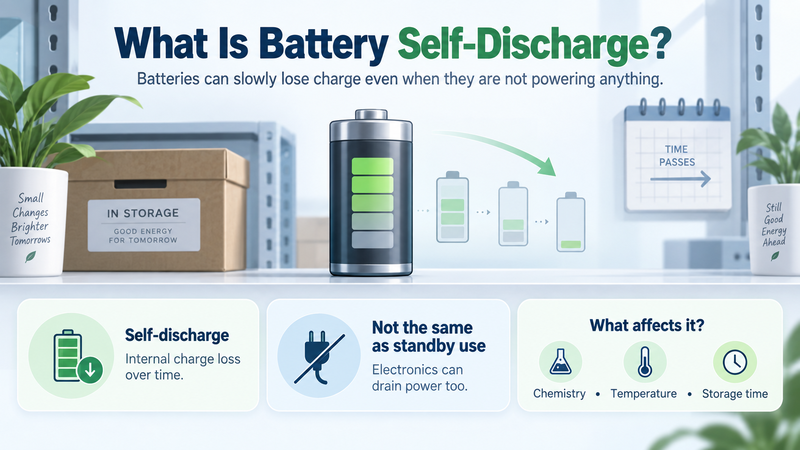
A battery can lose charge even when nothing appears to be using it.
Leave a charged battery unused for weeks or months, then check it again, and its state of charge may be lower. Part of that loss can come from electronics connected to the battery, but another part can occur inside the cells themselves.
That internal loss is called self-discharge.
Self-discharge is the gradual loss of stored charge caused by chemical and electrochemical processes inside a battery while it is not supplying an external load. It happens to different degrees in virtually all rechargeable battery chemistries, although the rate varies substantially with chemistry, temperature, battery condition and storage time.
For the broader relationship between battery capacity, mAh, Ah and Wh, start with the main battery-capacity guide:
https://medium.com/@volodymyrzh/battery-capacity-explained-mah-wh-amp-hours-decoded-1dc676be5a38
The key idea is simple: a battery does not have to be powering a device to gradually lose some of its stored charge.
Self-Discharge Is Not the Same as Using the Battery
Imagine a battery charged to a particular state of charge and then disconnected from every external device.
If its state of charge is lower several months later, at least part of that decline may be self-discharge.
This is different from ordinary battery consumption. When a laptop, lamp or inverter is operating, energy is intentionally leaving the battery to power a load.
Battery runtime depends on that external demand. The difference between stored capacity and load-dependent runtime is explained here:
Self-discharge happens even when there is no intended external load.
That distinction becomes especially important when evaluating batteries that spend long periods in storage, emergency equipment, backup systems, spare battery packs and seasonal devices.
Why Batteries Self-Discharge
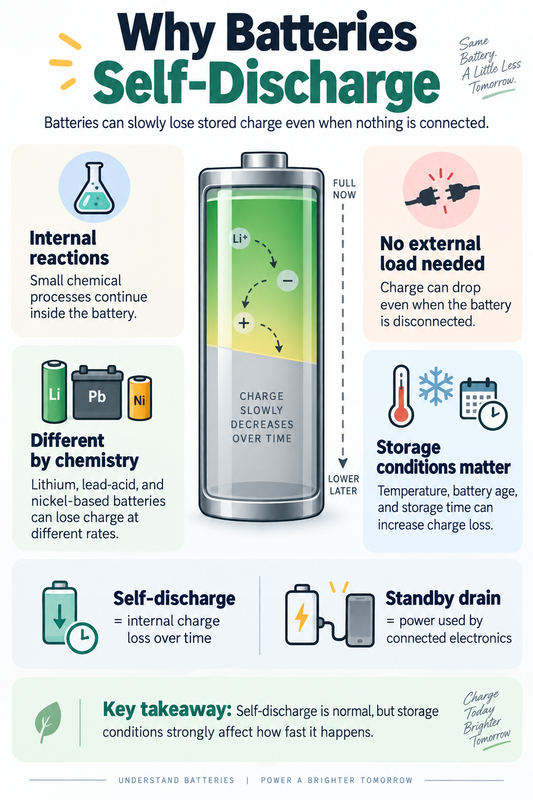
A charged battery stores energy through chemical conditions that are not perfectly static.
Even when the battery is disconnected, small internal reactions can continue. These reactions gradually move the battery away from its fully charged state.
The exact processes depend on chemistry and construction, but the practical result is the same:
stored charge slowly decreases over time.
This does not mean the battery is defective. Some level of self-discharge is normal.
The useful questions are how quickly it happens, whether the rate is reasonable for that chemistry and whether storage conditions are making it worse.
Battery Chemistry Matters
Different chemistries can have very different self-discharge characteristics.
A lithium-ion battery, a lead-acid battery and a nickel-based rechargeable battery should not automatically be expected to retain charge at the same rate during storage.
Even batteries using the same broad chemistry can behave differently because of cell design, age, manufacturing quality and internal protection electronics.
This is why universal claims such as:
“Batteries lose X% per month”
should be treated cautiously unless the chemistry and testing conditions are defined.
A useful self-discharge figure should ideally tell you:
battery chemistry;
temperature;
starting state of charge;
storage duration;
whether the pack was electrically disconnected;
how state of charge was measured.
Without those details, a percentage can look much more precise than the underlying test actually is.
Temperature Can Increase Storage Losses
Temperature is one of the major factors affecting battery behaviour during storage.
Higher temperatures generally accelerate chemical reactions, including unwanted reactions that contribute to self-discharge and long-term degradation.
Cold conditions create a different problem. A cold battery may temporarily deliver less usable energy or show stronger voltage sag under load, even when the stored charge has not permanently disappeared.
That broader distinction is explained here:
https://digitalowl.fika.bar/how-temperature-affects-battery-capacity-01M2TH5RCYRERSTQCFZ39M5J2N
For storage, the important point is that temperature changes both short-term battery behaviour and the rate at which batteries age or lose charge over time.
This is another reason battery storage recommendations should come from the actual manufacturer rather than a universal temperature rule applied to every chemistry.
Self-Discharge and Standby Consumption Are Different
These two losses are often confused.
Self-discharge occurs inside the cells because of internal electrochemical processes.
Standby consumption occurs because electronics connected to the battery continue drawing power.
For example, a portable power station may contain:
a battery-management system;
display electronics;
wireless connectivity;
monitoring circuits;
an inverter in standby mode.
If those systems remain active, the battery can lose charge faster than the cells would through self-discharge alone.
So when a stored power station drops from 100% to 80%, you should not automatically conclude that the battery has a 20% self-discharge rate.
Some of that energy may have been consumed by the system itself.
This distinction is useful enough to express as:
Stored-charge loss = cell self-discharge + any connected standby consumption
The two mechanisms can happen simultaneously, but they are not the same thing.
Time Makes Small Losses Matter
Self-discharge is usually most important when a battery sits unused for a long time.
A small storage loss over one day may be irrelevant. The same process repeated over several months can become operationally important.
This matters for:
emergency power supplies;
stored tool batteries;
seasonal equipment;
backup battery systems;
vehicles or devices kept unused for long periods;
spare batteries.
A battery intended for emergency use should not simply be charged once and forgotten indefinitely.
Periodic checks may be necessary, depending on the battery and manufacturer recommendations.
Storage State of Charge Can Also Matter
The amount of charge present during storage can influence battery aging, particularly over long periods.
For some lithium-ion systems, storing a battery at maximum state of charge for extended periods can contribute to faster degradation, especially at elevated temperatures.
But the best storage state of charge is not universal.
Different manufacturers may specify different recommendations depending on chemistry, battery-management design and intended storage duration.
That means a generic instruction such as “always store every battery at 50%” should not be treated as a universal rule.
For a real battery, follow its storage instructions.
Self-Discharge Is Not the Same as Capacity Degradation
Another important distinction is between losing charge and losing capacity.
Suppose a battery originally stores 1,000 Wh.
After sitting unused, it may contain only 850 Wh because some charge has been lost. If the battery is recharged and can still store close to its original capacity, that storage loss was not equivalent to permanent 15% capacity degradation.
Permanent degradation means the battery's ability to store energy has declined.
Self-discharge means energy that was already stored gradually disappeared.
A useful mental model is:
Self-discharge: “How much charge remains after storage?”
Degradation: “How much energy can the battery still hold when fully charged?”
Those questions become increasingly important as we move deeper into battery health and lifespan.
How to Evaluate a Battery That Loses Charge in Storage
If a battery seems to lose charge unusually quickly, work through the problem systematically.
First, check whether anything remains connected to it. A power station with active electronics is different from an electrically isolated cell.
Second, consider the storage temperature. Long periods in a hot environment can increase both self-discharge and degradation.
Third, check the battery's age and condition. An older or damaged battery may behave differently from a healthy new pack.
Fourth, compare the behaviour with the manufacturer's specifications where available.
Finally, make sure the state-of-charge indicator itself is reliable. Displayed percentages are estimates produced by the battery-management system, not a direct measurement of energy sitting inside the battery.
Self-Discharge Matters Because Storage Is Part of Battery Use
Battery performance is often discussed only while the battery is powering something.
But storage is also part of the battery lifecycle.
A useful battery needs to do more than deliver energy efficiently today. It may also need to retain enough charge for tomorrow, next month or the next emergency.
That is why self-discharge belongs alongside temperature, state of charge, cycle life and long-term degradation when evaluating battery performance.
The key distinction is:
A battery can lose stored charge without powering an external device, and that loss is not automatically the same thing as permanent capacity degradation.
Self-discharge tells us how well a battery retains charge during storage. Temperature, chemistry and time influence that process, while connected electronics can add a separate standby drain.
Understanding those differences makes it much easier to interpret what a falling battery percentage actually means.
Comments
No comments yet. Be the first to comment!