How to Read a Battery Capacity Label
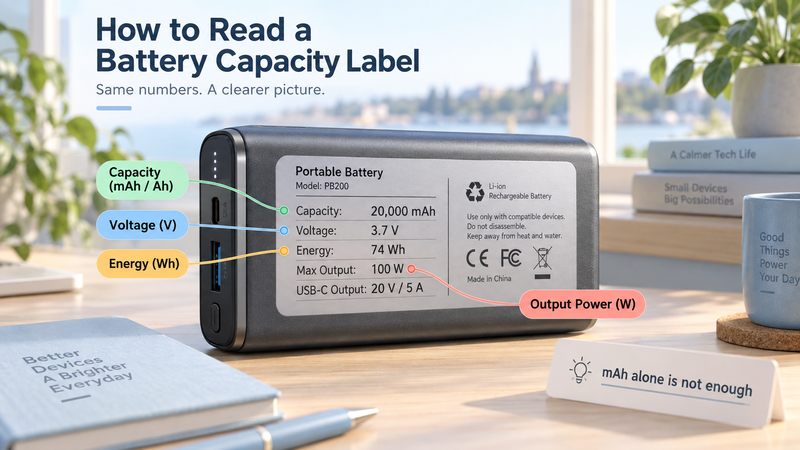
Battery labels can look surprisingly complicated. A small sticker may contain mAh, Ah, Wh, voltage, charging information and several output ratings, all mixed together. The key is knowing which numbers describe stored capacity, which describe voltage, and which tell you what the battery can actually power.
If you need the bigger picture first, this complete guide explains how the main battery-capacity units relate to each other: https://medium.com/@volodymyrzh/battery-capacity-explained-mah-wh-amp-hours-decoded-1dc676be5a38
Once you understand the basic structure of a label, you can usually extract the important information in less than a minute.
Start With the Capacity Rating
The first number people often notice is a capacity figure such as:
10,000 mAh
or:
100 Ah
These numbers describe charge capacity rather than energy by themselves.
mAh means milliamp-hours. It is especially common on phones, power banks and smaller rechargeable batteries. A more detailed explanation of this unit is available here: https://digitalowl.fika.bar/what-is-mah-milliamp-hours-explained-simply-01M2GD3RKJD95V79BPHEW37S32
Ah means amp-hours and is simply a larger version of the same unit. One amp-hour equals 1,000 milliamp-hours:
1 Ah = 1,000 mAh
You will often see Ah used for larger batteries such as 12 V batteries, backup systems and energy-storage products. For more context, see: https://digitalowl.fika.bar/what-is-ah-amp-hours-explained-simply-01M2GGB34443JC68WVPZBGPX3K
The important warning is that mAh or Ah alone does not tell you the battery's total stored energy unless voltage is also known.
Find the Voltage Next
A battery label may show something like:
3.7 V
12.8 V
25.6 V
Voltage is essential because the same Ah or mAh rating can represent very different amounts of energy at different voltages.
For example, compare two theoretical batteries:
10 Ah × 12 V = 120 Wh
10 Ah × 24 V = 240 Wh
Both are labelled 10 Ah, but the second contains twice the theoretical energy because its voltage is twice as high.
This is why comparing batteries only by Ah or mAh can be misleading. If voltage is unfamiliar, this guide explains the concept in practical battery terms: https://digitalowl.fika.bar/what-is-voltage-battery-voltage-explained-simply-01M2GH66XEB0MHMG3Z2Y7SNBEE
When reading a label, look specifically for terms such as nominal voltage, rated voltage or simply V.
Look for Watt-Hours When Comparing Stored Energy
If the label includes a value in Wh, that is often the most useful figure for comparing how much energy batteries store.
Imagine a portable battery label showing:
Capacity: 20,000 mAh
Nominal voltage: 3.7 V
Energy: 74 Wh
The Wh figure already combines capacity and voltage into an energy measurement.
This makes it easier to compare batteries whose internal voltages or architectures differ.
For example:
Battery A: 74 Wh
Battery B: 100 Wh
Battery B has the larger rated energy capacity even if Battery A happens to display a more impressive-looking mAh number.
When Wh is available, it is usually more useful than headline mAh for direct energy comparisons.
Do Not Confuse Capacity With Output Power
Battery labels often contain another group of specifications describing output, not capacity.
You might see something like:
USB-C Output: 5 V ⎓ 3 A
USB-C PD Output: 20 V ⎓ 5 A
Maximum Output: 100 W
These figures tell you about the power the battery can deliver through a particular port.
They do not mean that the battery contains 100 Wh.
For example, a battery might have:
Capacity: 500 Wh
Maximum AC output: 700 W
The 500 Wh figure describes stored energy. The 700 W figure describes how much power the unit can supply at a given moment within its specified operating limits.
A large capacity does not automatically mean a high output capability, and a high output rating does not automatically mean long runtime.
When checking whether a battery can power a particular device, capacity and output therefore need to be treated as separate specifications.
Be Careful With Headline mAh Numbers
Some product listings put an enormous mAh figure at the top while making voltage and Wh much less prominent.
For example:
50,000 mAh
may sound much larger than:
15,000 mAh
But those numbers cannot be fairly compared without knowing the voltage at which each capacity is specified.
A useful battery-label checklist is:
Find the mAh or Ah rating.
Find the nominal or rated voltage.
Look for a stated Wh value.
Identify the maximum output in W if relevant.
Check whether separate ports have different output limits.
Distinguish input specifications from output specifications.
Avoid comparing headline mAh values across different voltages without conversion.
If Wh is missing but Ah and voltage are provided, you can estimate energy using:
Wh = Ah × V
If the label provides mAh instead:
Wh = mAh × V ÷ 1,000
These calculations help reveal whether two apparently different capacity claims are actually comparable.
A Simple Way to Read Any Battery Label
Instead of trying to interpret every symbol at once, read the label in a fixed order.
First identify capacity in mAh or Ah. Then find the battery's voltage. Next check whether the manufacturer already provides the resulting energy in Wh. Finally, inspect the input and output limits separately.
That sequence separates four different questions:
How much charge is rated? → mAh or Ah
At what voltage? → V
How much energy does that represent? → Wh
How much power can the battery deliver? → W
Once those categories are separated, most battery labels become far easier to understand. The biggest mistake is treating every large number on the sticker as another way of describing the same thing. It is not. Capacity, voltage, energy and output power describe different parts of how the battery works.
Comments
No comments yet. Be the first to comment!