Digitalowl
- Home
- Why Beginners Should Build Small Projects Before Learning Everything
- What to Power First During a 72-Hour Blackout
Recent posts
-
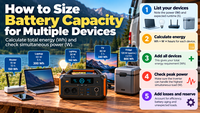
How to Size Battery Capacity for Multiple Devices
Sizing a battery for one device is relatively simple. Sizing for several devices is harder because you must answer two different questions at the same time: how much power might the devices need simultaneously, and how much energy will they consume over the full operating period? Those are not the same calculation. A system can have enough battery capacity in Wh but still fail because the inverter…
- batteries
- content
- +5
-
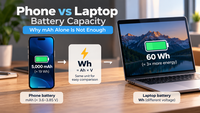
Phone vs Laptop Battery Capacity: Why mAh Alone Is Not Enough
A phone may have a 5,000 mAh battery while a laptop is labelled 60 Wh. At first glance, those numbers are difficult to compare because they use different units. The important point is that mAh measures electric charge, while Wh measures stored energy. To compare a phone battery with a laptop battery properly, voltage must be included. For the broader battery-capacity framework: https://medium.com/…
- batteries
- blackout
- +3
-
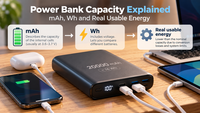
Power Bank Capacity Explained: mAh, Wh and Real Usable Energy
A power bank may be labelled 10,000 mAh, 20,000 mAh or even 30,000 mAh, but that number does not tell you exactly how much energy will reach your phone, tablet or other device. The reason is simple: the advertised mAh rating usually refers to the internal battery cells, while the USB output operates at a different voltage and introduces conversion losses. Understanding power bank capacity therefor…
- blackout
- electricity
- +2
-
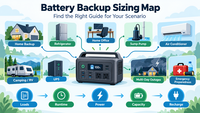
Battery Backup Sizing Map: Find the Right Guide for Your Scenario
Battery backup sizing becomes confusing when every scenario is treated as the same problem. A refrigerator, home office, air conditioner, RV and multi-day outage all require different assumptions. The easiest approach is to begin with the load and outage scenario, then move to the appropriate sizing method. This guide acts as a map across the main battery-backup use cases. Start With Three Questio…
- batteries
- blackout
- +4
-
Battery Capacity for Emergency Preparedness
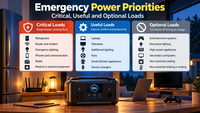
Emergency battery planning is different from buying the largest battery you can afford. The goal is not to keep every appliance running as if the grid were still available. The goal is to identify the loads that matter most, calculate how much energy they require, and build enough battery capacity to support those priorities for a realistic period. That starts with one simple question: What absolu…
- batteries
- blackout
- +3
-
UPS Runtime and Battery Capacity
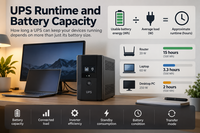
A UPS is designed to keep equipment running when grid power disappears, but its advertised battery size alone does not tell you how long connected devices will stay online. Runtime depends on battery capacity, connected load, inverter efficiency, standby consumption, battery condition and the way the UPS operates during an outage. A practical starting point is: usable battery energy ÷ average load…
- batteries
- electricity
- +2
-
Battery Capacity for Camping and RV Use
Battery sizing for camping or RV use is not really about choosing between a 1 kWh, 2 kWh or 4 kWh power station. The useful starting point is simpler: How much energy will you use during one day away from the grid? A weekend setup with LED lights, phones and a small fridge may need relatively little stored energy. Add laptops, cooking appliances, water pumps or air conditioning, and the requiremen…

- blackout
- electricity
- +4
-
How Much Battery Capacity Does an Air Conditioner Need?
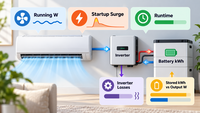
Air conditioning can be one of the most demanding loads in a home-backup system. Unlike a router or laptop, an air conditioner may draw hundreds or even thousands of watts while operating. Many models also use a compressor that can create a short startup surge significantly above normal running power. That means AC backup requires answering two different questions: Can the inverter start and run t…
- batteries
- electricity
- +3
-
How Much Battery Capacity Does a Sump Pump Need?
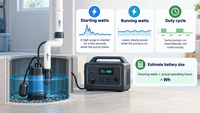
A sump pump is very different from a light, router or laptop when it comes to battery backup. It may remain idle for long periods, switch on only when water reaches a certain level, and then draw a relatively high amount of power for a short time. Its motor can also require a much larger burst of power at startup than during normal operation. That means sump-pump backup sizing depends on three sep…
- batteries
- electricity
- +2
-
How Much Battery Capacity Does a Home Office Need?
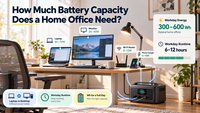
A home office looks simple from a backup-power perspective. A laptop, monitor, router and phone charger seem like small loads compared with appliances such as air conditioners or heaters. But home-office battery sizing still depends on one thing many people underestimate: how long all of those devices need to stay powered together. A 60 W laptop running for one hour is a small energy load. The sam…
- batteries
- electricity
- +4
-
How Much Battery Capacity Does a Refrigerator Need?
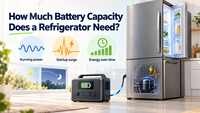
A refrigerator looks like a simple backup load. Check its wattage, multiply by the number of hours you want it to run, and choose a battery. In practice, refrigerators are more complicated because the compressor does not normally run continuously. A refrigerator may consume power for several minutes, stop after reaching the target temperature, and start again later. Each compressor start can also …
- batteries
- electricity
- +4
-
How Much Battery Capacity Do You Need for Home Backup?
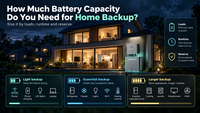
Home backup battery sizing sounds simple until you start listing everything you might want to keep running during an outage. A few lights and a router need very little energy. A refrigerator, freezer and laptop need more. Add a well pump, heating controls, medical equipment or several hours of higher-power appliances, and the required battery capacity can increase quickly. The useful question is n…
- blackout
- electricity
- +3
-
Generator and Battery Hybrid Charging
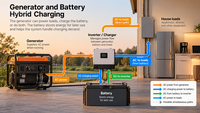
A generator does not have to power every appliance directly for the entire time it is running. In a hybrid backup system, it can instead become one part of a larger energy flow: supplying loads, charging a battery, or doing both depending on the capabilities of the system. This changes the role of the generator. Rather than acting as the only power source, it can replenish stored energy while the …
- batteries
- blackout
- +2
-
What Is Pass-Through Charging?
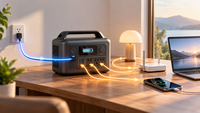
Pass-through charging is a feature that allows a battery system or portable power station to receive power while supplying power to connected devices at the same time. In simple terms, energy comes in from a charger, solar panel or another source while the system continues powering its loads. That sounds straightforward, but the actual energy flow can be more complex than simply “charging and disc…
- batteries
- blackout
- +3
-
What Is Charging Efficiency?
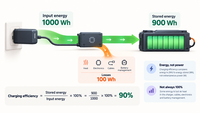
Charging efficiency describes how much of the energy supplied to a battery system actually becomes stored battery energy. If a charger draws 1,000 Wh from a power source but the battery gains only 900 Wh, the missing energy has not disappeared. Part of it has been consumed or converted into heat by the charger, battery, cables, electronics and other components. The basic relationship is: Charging…
- batteries
- blackout
- +2
-
12V vs 24V vs 48V Battery Banks
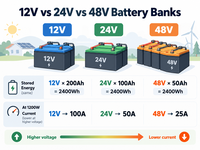
Battery banks are commonly described as 12V, 24V or 48V systems, but a higher voltage does not automatically mean a battery stores more energy. Voltage is only one part of the specification. The same amount of stored energy can be arranged as a lower-voltage bank with more amp-hours or a higher-voltage bank with fewer amp-hours. The major practical difference appears when the system needs to deliv…
- batteries
- blackout
- +3
-
Batteries in Series vs Parallel
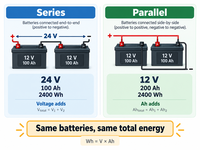
Connecting batteries in series or parallel changes how the battery bank behaves electrically. The simplest distinction is: Series increases voltage while amp-hours stay the same. Parallel increases amp-hours while voltage stays the same. But there is an important third number: watt-hours. When identical batteries are combined, both series and parallel arrangements can produce the same total sto…
- batteries
- blackout
- +3
-
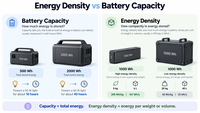
Energy Density vs Battery Capacity
Battery capacity and energy density are closely related concepts, but they answer different questions. Battery capacity tells you how much energy a battery stores. Energy density tells you how much energy is stored relative to its weight or volume. That distinction matters when comparing batteries for portable power stations, electric vehicles, home storage, electronics and other applications wher…
- batteries
- blackout
- +3