Energy Density vs Battery Capacity
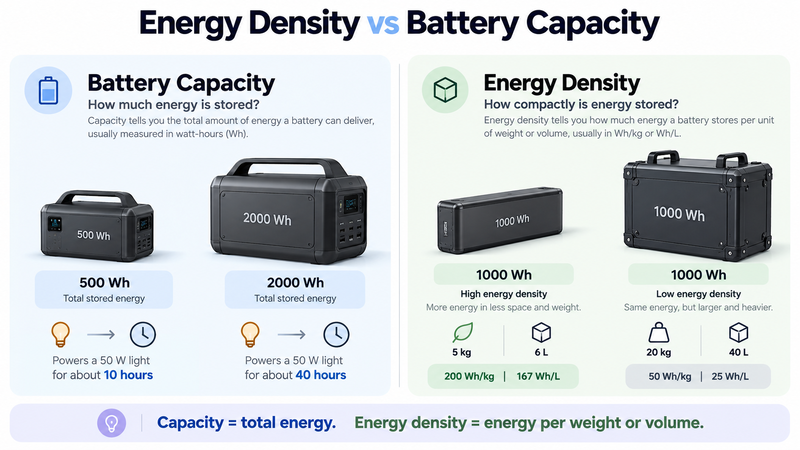
Battery capacity and energy density are closely related concepts, but they answer different questions.
Battery capacity tells you how much energy a battery stores. Energy density tells you how much energy is stored relative to its weight or volume.
That distinction matters when comparing batteries for portable power stations, electric vehicles, home storage, electronics and other applications where size and weight can be just as important as total stored energy.
A battery can have high capacity without having high energy density. Another battery can have excellent energy density while storing less total energy simply because the battery itself is smaller.
Battery Capacity Measures Total Stored Energy
For practical battery comparisons, capacity is often expressed in watt-hours (Wh) or kilowatt-hours (kWh).
A 1,000 Wh battery stores roughly twice the nominal energy of a 500 Wh battery, regardless of whether the larger battery is physically compact or extremely heavy.
Capacity therefore answers:
How much energy is stored in the battery?
It does not directly answer:
how heavy the battery is;
how large it is;
how long it will last under every load;
how much power it can deliver at once.
Battery runtime depends on capacity together with load and system losses. That distinction is explained in more detail here:
For the broader relationship between mAh, Ah and Wh, see:
https://medium.com/@volodymyrzh/battery-capacity-explained-mah-wh-amp-hours-decoded-1dc676be5a38
Energy Density Measures How Compactly Energy Is Stored
Energy density adds another dimension to the comparison.
Two common forms are:
Gravimetric energy density: energy relative to mass, usually expressed in Wh/kg.
Volumetric energy density: energy relative to volume, often expressed in Wh/L.
Gravimetric energy density answers:
How much energy can be stored for each kilogram of battery?
Volumetric energy density answers:
How much energy can be stored in a given amount of physical space?
These are not interchangeable.
A battery technology can perform well by weight without being equally impressive by volume, and packaging, cooling, protection systems and other pack components can change the result.
Same Capacity, Different Weight
Consider two simplified battery packs that each store 1,000 Wh.
Battery A weighs 10 kg:
1,000 Wh ÷ 10 kg = 100 Wh/kg
Battery B weighs 5 kg:
1,000 Wh ÷ 5 kg = 200 Wh/kg
Both batteries have the same energy capacity.
But Battery B has twice the gravimetric energy density.
That means the user gets the same nominal stored energy with half the battery mass.
This distinction becomes extremely important when batteries need to move.
Higher Energy Density Matters Most When Weight or Space Is Limited
Energy density is particularly important in applications such as:
electric vehicles;
drones;
portable electronics;
mobile equipment;
power tools;
portable battery systems.
In these applications, increasing capacity by simply making the battery larger and heavier may create another problem.
An electric vehicle must carry its battery everywhere it travels. A drone must lift its battery. A portable power system has to remain portable.
Higher energy density can therefore allow more stored energy without a proportional increase in mass or volume.
Stationary systems face different priorities.
A home battery installed permanently against a wall may tolerate additional weight far more easily than a vehicle or portable device. Cycle life, cost, thermal characteristics, available installation space and system durability may matter more than maximizing Wh/kg.
High Energy Density Does Not Mean High Capacity
This is one of the easiest mistakes to make.
Imagine a small battery with excellent energy density and a much larger battery using a lower-energy-density chemistry.
The smaller battery could have the higher Wh/kg value while still containing less total energy.
For example:
Battery A: 500 Wh at 250 Wh/kg
Battery B: 2,000 Wh at 125 Wh/kg
Battery A has twice the gravimetric energy density.
Battery B has four times the total capacity.
Neither metric replaces the other.
The first comparison tells us about mass efficiency. The second tells us how much energy is actually available.
Chemistry Can Change Energy Density
Battery chemistry strongly influences achievable energy density.
NMC lithium-ion batteries are commonly associated with higher energy density than LiFePO4 batteries, which can make NMC attractive when pack weight and size are important.
LiFePO4, however, may offer advantages in areas such as cycle-life potential and thermal stability.
That broader comparison is covered here:
https://digitalowl.fika.bar/lifepo4-vs-nmc-01M399CP24380Y52X0BBYXTMVV
The important point is that higher energy density is one engineering advantage, not a universal measure of battery quality.
A battery design balances several priorities at once.
Cell-Level and Pack-Level Energy Density Are Not the Same
Energy-density figures also need context.
A manufacturer may describe the energy density of an individual cell, while the final battery pack contains much more than cells.
A complete pack may also include:
structural materials;
wiring and busbars;
cooling components;
insulation;
battery-management electronics;
protective housing.
Those components add weight and volume without adding the same amount of stored energy.
As a result, cell-level Wh/kg can be higher than pack-level Wh/kg.
When comparing real products, make sure the quoted figures refer to comparable measurement levels.
Capacity and Energy Density Should Be Used Together
For most practical decisions, asking only about capacity or only about energy density provides an incomplete picture.
A better sequence is:
Determine how much energy is required.
Choose an appropriate capacity in Wh or kWh.
Check whether weight or physical space creates a constraint.
Compare energy density if those constraints matter.
Then consider chemistry, cycle life, power capability, charging and other system requirements.
This prevents an impressive Wh/kg figure from distracting from the actual energy requirement.
The Key Difference
The distinction can be reduced to two questions:
Battery capacity: How much total energy does the battery store?
Energy density: How much energy does it store for its weight or volume?
Capacity is an amount.
Energy density is a ratio.
A larger battery may store much more energy while having lower energy density. A smaller battery may store less total energy while using its weight and space more efficiently.
That is why meaningful battery comparisons need both metrics — especially when the application places limits on size or weight.
Comments
No comments yet. Be the first to comment!