Generator and Battery Hybrid Charging
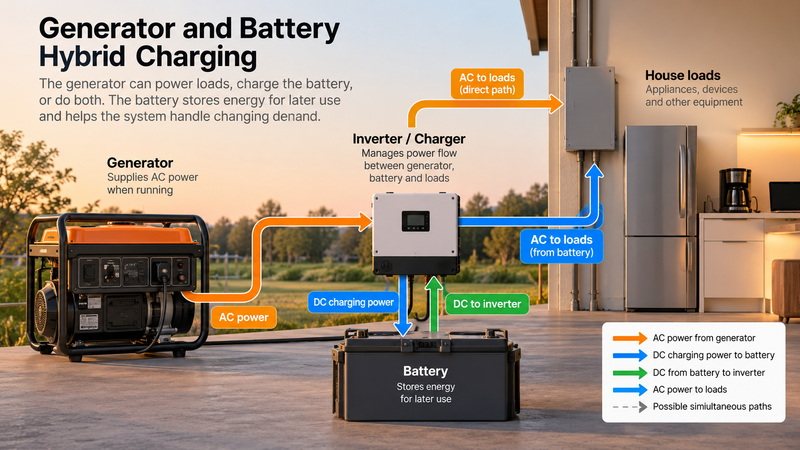
A generator does not have to power every appliance directly for the entire time it is running. In a hybrid backup system, it can instead become one part of a larger energy flow: supplying loads, charging a battery, or doing both depending on the capabilities of the system.
This changes the role of the generator. Rather than acting as the only power source, it can replenish stored energy while the battery handles periods when the generator is off, responds to changing loads, or supports devices that need continuous power.
The important idea is not simply “generator plus battery.” It is how energy moves between the generator, charger, battery and loads.
The Basic Hybrid Energy Flow
A simplified system can be represented like this:
Generator → charger → battery → inverter → loads
But real systems may have another path:
Generator → loads
while excess available generator power is used for:
Generator → charger → battery
This distinction matters because energy sent through the battery normally passes through more conversion stages than energy supplied directly to an AC load.
The battery therefore acts as an energy buffer. The generator creates electrical energy when it is running, while the battery stores part of that energy for later use.
For the broader concepts behind Wh, Ah and usable stored energy, see Battery Capacity Explained: mAh, Wh & Amp Hours Decoded.
Generator Power and Battery Capacity Are Different Numbers
One common mistake is comparing generator watts directly with battery watt-hours.
They describe different things.
A generator rated in watts or kilowatts describes power — how quickly it can supply energy at a particular moment. Battery capacity in Wh or kWh describes energy — how much energy can be stored.
A 2 kW generator and a 2 kWh battery therefore do not represent equivalent specifications.
The battery could theoretically store enough energy to supply a 2 kW load for about one hour before accounting for usable-capacity limits and conversion losses. The generator, by contrast, may continue supplying power as long as its operating conditions allow.
This distinction becomes especially important when determining how much generator output can actually be used for charging. For a deeper explanation, see Charging Power vs Battery Capacity.
The Charger Is the Gatekeeper
A larger generator does not automatically make the battery charge faster.
The battery system can accept energy only as quickly as its charger, battery-management system and battery itself permit. If the generator can supply 2,000 W but the charger accepts only 700 W, the battery will not suddenly charge at 2,000 W.
Other loads may also be consuming part of the generator's available output.
Imagine a generator supporting:
600 W of active loads
700 W of battery charging
additional unused capacity
The important value for battery replenishment is still the power actually reaching the charging system, not simply the generator's headline rating.
Some inverter/charger systems can dynamically reduce battery charging when other loads require more of the available AC input. The exact behaviour depends on the hardware and its configuration.
How Long Does the Generator Need to Run?
A useful first estimate starts with the energy that must be returned to the battery.
Suppose a battery needs approximately 2,000 Wh replenished and can accept 700 W of charging power.
The ideal calculation is:
2,000 Wh ÷ 700 W ≈ 2.86 hours
That does not mean the real system will necessarily finish charging in exactly 2.86 hours.
Conversion losses, charging efficiency, changing charge rates and charging taper can extend the actual time. The charger may also reduce its power because other loads are operating.
The full calculation method is covered in Battery Charge Time Formula.
This is one reason hybrid systems are easier to understand when charging power, battery capacity and active loads are considered separately.
Why Run a Generator to Charge a Battery?
At first, adding a battery may appear inefficient. Why convert generator output into stored battery energy instead of simply powering everything directly?
Because efficiency is only one design goal.
A battery can allow the system to separate when energy is generated from when energy is consumed.
The generator might operate during a concentrated charging period. After sufficient energy has been stored, the battery can supply smaller loads without requiring the generator to remain the active source.
This can be particularly useful when electricity demand varies significantly over time.
Instead of expecting the generator to follow every small change in demand, the battery becomes the buffer between energy production and consumption.
Hybrid Charging Does Introduce Conversion Losses
Stored energy does not pass through a hybrid system without losses.
When generator electricity charges a battery and the battery later powers an AC appliance, several stages may be involved:
Generator AC → charger conversion → stored battery energy → inverter conversion → AC load
Each conversion has some loss.
That means one kilowatt-hour produced by the generator does not necessarily become one kilowatt-hour delivered later to an appliance.
However, this does not automatically make the architecture inefficient in every operating scenario. If the generator can directly supply active loads while charging the battery with remaining available power, some energy can avoid the full charge-store-invert pathway.
The actual balance depends on the design of the inverter/charger and how it manages incoming power.
What Happens When Loads Operate During Charging?
Some battery systems can accept charging power while simultaneously supplying connected loads.
This is closely related to pass-through charging.
However, “charging while powering loads” can describe several different internal behaviours.
In one system, incoming AC may largely pass directly to the loads while additional power charges the battery. In another architecture, energy may follow a different conversion path. Some systems can even use the battery to supplement an AC source temporarily when demand rises above a configured input limit.
For this reason, pass-through capability should never be assumed simply because a product has both an input and an output port.
The manufacturer's specifications determine what the system actually supports.
The Battery Changes How Backup Capacity Is Used
Without recharging, battery capacity creates a relatively simple energy budget.
If you begin with a certain amount of usable Wh, every load reduces that stored-energy budget until another source replenishes it.
Adding a generator changes the system from a single stored-energy budget into a repeating cycle:
Use energy → recharge → use stored energy again
The required battery capacity may therefore depend not only on total daily consumption but also on how long the battery must operate between charging opportunities.
A larger battery provides a longer buffer.
Higher charging power can refill that buffer faster.
A generator adds another potential source of replenishment.
None of these specifications replaces the others.
Hybrid Systems Are About Energy Management
Generator-and-battery systems are easiest to understand as energy-management systems rather than as two competing power sources.
The generator provides energy when operating. The charger determines how quickly part of that energy can enter the battery. The battery stores energy. The inverter makes stored energy usable for appropriate loads. Meanwhile, the system may also route generator power directly to loads when the hardware supports that operating mode.
That creates several variables to consider together:
generator output → active loads → available charging power → battery capacity → recharge time → later battery runtime
The best configuration is therefore not automatically the largest generator or the largest battery.
It is a system in which generation, charging capability, stored energy and expected loads are reasonably matched.
The result is a backup architecture where the generator does not have to do everything continuously and the battery does not have to store all the energy the system may eventually use.
Comments
No comments yet. Be the first to comment!