How Much Battery Capacity Does an Air Conditioner Need?
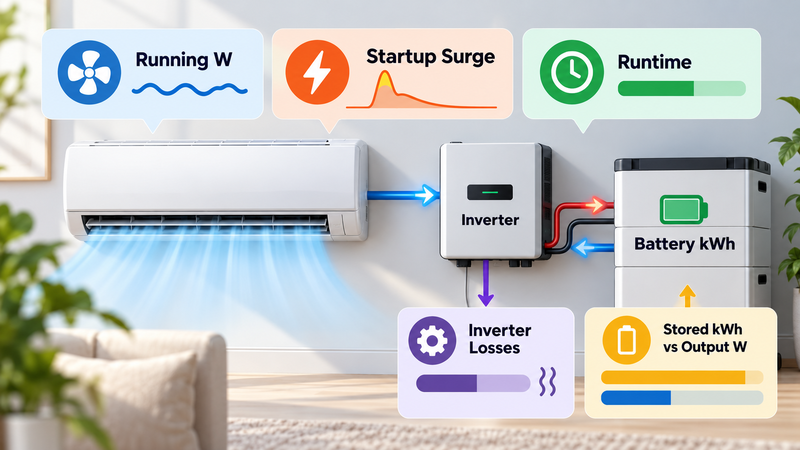
Air conditioning can be one of the most demanding loads in a home-backup system.
Unlike a router or laptop, an air conditioner may draw hundreds or even thousands of watts while operating. Many models also use a compressor that can create a short startup surge significantly above normal running power.
That means AC backup requires answering two different questions:
Can the inverter start and run the air conditioner?
and:
Does the battery contain enough energy to keep it operating for the required time?
Those are not the same calculation.
For the broader battery-capacity framework:
https://medium.com/@volodymyrzh/battery-capacity-explained-mah-wh-amp-hours-decoded-1dc676be5a38
Start With the Actual Air Conditioner
There is no universal battery size for “an air conditioner.”
A small window unit, portable AC, mini-split and large central system can have very different power requirements.
Cooling capacity is often described in BTU/h, but BTU rating alone does not tell you exactly how many watts the appliance will consume.
Two air conditioners with similar cooling capacity can have different electrical demand because of differences in:
efficiency
compressor technology
fan design
operating conditions
temperature set point
model and age
For backup sizing, use the electrical specifications of the actual unit whenever possible.
Running Watts Determine the Energy Burn Rate
Suppose an example air conditioner consumes:
1,000 W while running
If it operated continuously for one hour:
1,000 W × 1 h = 1,000 Wh
or:
1 kWh
For four continuous hours:
1,000 W × 4 h = 4,000 Wh
So even a relatively straightforward 1,000 W load can consume several kilowatt-hours during a long outage.
This is why air conditioning can increase battery requirements much faster than low-power household electronics.
Startup Surge Is a Separate Requirement
Many compressor-based air conditioners briefly need more power when starting than they consume during normal operation.
An illustrative AC might draw:
1,000 W running
but require:
2,500 W or more briefly at startup
The exact value depends on the model.
This does not mean you need 2,500 Wh of battery energy for every startup. Surge watts describe power, not stored energy.
The distinction is explained here:
https://digitalowl.fika.bar/starting-watts-vs-running-watts-01M2K3FNMK1HM1FQDAYVFRT1PM
The inverter must be capable of handling that startup event.
A battery may contain 5 kWh of energy and still fail to operate the AC if the inverter cannot deliver enough surge power.
Inverter Air Conditioners Can Behave Differently
Not every air conditioner has the same startup behaviour.
Traditional fixed-speed compressors often switch fully on and off.
Many modern inverter-driven air conditioners can ramp compressor speed more gradually and adjust output according to cooling demand.
That can reduce large startup spikes and change average energy consumption.
But “inverter air conditioner” should not be confused with the battery system's DC-to-AC inverter.
They are two different components.
The AC unit may use inverter technology internally, while the backup battery may also use an inverter to convert stored DC energy into AC power for household equipment.
You still need to check the actual electrical specifications of both systems.
Duty Cycle Can Reduce Average Energy Use
An air conditioner does not always run at full rated power continuously.
Once the room reaches the target temperature, a fixed-speed unit may cycle off and later restart. Variable-speed systems may reduce compressor output rather than stop completely.
Suppose a 1,000 W AC effectively operates at full-load equivalent for half of an eight-hour period.
A simplified energy estimate would be:
1,000 W × 4 h = 4,000 Wh
or:
4 kWh
If hotter weather causes it to run almost continuously:
1,000 W × 8 h = 8 kWh
The same appliance can therefore create dramatically different battery demand depending on operating conditions.
Temperature Changes the Result
Air-conditioning energy use depends heavily on the environment.
Important variables include:
outdoor temperature;
indoor starting temperature;
thermostat setting;
insulation;
room size;
direct sunlight;
humidity;
air leakage;
number of people in the space.
An AC may cycle lightly on a mild day but run almost continuously during extreme heat.
For resilient backup planning, sizing should therefore consider demanding conditions rather than only the easiest operating day.
A Small AC Example
Imagine a smaller unit drawing approximately:
600 W while operating
Suppose it effectively runs for four hours during a six-hour backup window.
Energy consumption:
600 W × 4 h = 2,400 Wh
or:
2.4 kWh
Now add inverter losses and reserve.
The required nominal battery capacity could move toward roughly 3 kWh or more, depending on system efficiency and desired margin.
This is only an illustrative planning example.
The real requirement must come from the actual unit and operating conditions.
A Larger AC Example
Now consider a system consuming:
1,500 W
If it operates for five effective hours:
1,500 × 5 = 7,500 Wh
or:
7.5 kWh
Once conversion losses and reserve are included, the storage requirement can move significantly above that number.
This illustrates why whole-home air-conditioning backup often requires much larger battery systems than basic essential-load backup.
The broader home-backup framework is here:
Inverter Losses Matter More With Large Loads
If an AC consumes several kilowatt-hours during an outage, even modest conversion losses become meaningful.
The battery stores DC energy, while most household air conditioners require AC power.
The energy path may look like:
Battery DC → inverter → AC load
The inverter itself is not perfectly efficient.
For example, if the air conditioner needs 5 kWh of delivered AC energy, the battery may need to supply more than 5 kWh from storage.
The relationship is explained here:
https://app.fika.bar/blog/post/what-is-inverter-efficiency-01M2K65Q757EW3H13TCFP3JFJ7
This is why sizing directly from appliance energy consumption can underestimate the required battery capacity.
Stored Wh and Inverter Watts Must Both Be Large Enough
A realistic AC backup system must pass two separate tests.
Power test
Can the inverter handle:
normal running watts
and:
compressor startup or peak demand?
Energy test
Can the battery supply enough usable Wh or kWh for the expected operating period?
A system can pass one test and fail the other.
For example:
10 kWh battery + undersized inverter = AC may not start
while:
high-power inverter + 1 kWh battery = AC may start but run only briefly
This distinction is central to sizing high-power appliances.
Other Household Loads Share the Same Battery
During an outage, the air conditioner may compete with:
refrigerator
freezer
lighting
router
computers
pumps
other essential devices
Suppose the AC requires:
5 kWh
during the backup period, while the rest of the home requires another:
2 kWh
The combined load becomes:
7 kWh
before losses and reserve.
The inverter must also handle simultaneous power demand.
An AC compressor starting while another motor load is running can create a much larger short-term requirement than either appliance alone.
This relationship between real-world loads and storage sizing is covered here:
Cooling Strategy Can Reduce Battery Size
Air-conditioning backup does not always have to mean maintaining normal whole-home cooling throughout an outage.
A more energy-efficient backup strategy might include:
cooling only one occupied room
raising the thermostat slightly
reducing direct sunlight with blinds
using fans where practical
pre-cooling while grid power is available
avoiding unnecessary heat-generating appliances
Reducing average AC consumption by even several hundred watts can save substantial battery energy over many hours.
For example, reducing average demand by:
300 W for 8 hours
saves:
2,400 Wh
or:
2.4 kWh
That can materially change the battery requirement.
A Better AC Battery-Sizing Workflow
Use this sequence:
1. Identify the exact AC model and electrical specifications.
Do not size from BTU alone.
2. Find or measure running watts.
This determines the basic energy-consumption rate.
3. Check startup or peak power.
Make sure the inverter can support it.
4. Estimate realistic operating time.
Do not automatically assume either zero cycling or continuous full-power operation.
5. Calculate energy consumption.
Running watts × effective operating hours = Wh
6. Account for inverter efficiency.
The battery must provide more energy than the AC receives.
7. Add reserve.
Weather and compressor runtime are variable.
8. Include other loads using the same battery.
Whole-home backup must be sized as one system.
Air Conditioning Is Both a Power and Energy Problem
The biggest mistake in AC backup sizing is looking at only one specification.
Battery capacity answers:
How much energy is stored?
Inverter output answers:
How much power can the system provide at once?
And the air conditioner's duty cycle determines:
how quickly that stored energy disappears.
For air-conditioning backup, all three matter.
Use the electrical data from the actual AC, estimate how long it is likely to run under realistic conditions, calculate the resulting Wh or kWh, account for inverter losses and reserve, and separately verify startup and continuous power requirements.
That gives a much more realistic battery target than choosing capacity from BTU rating alone.
Comments
No comments yet. Be the first to comment!