12V vs 24V vs 48V Battery Banks
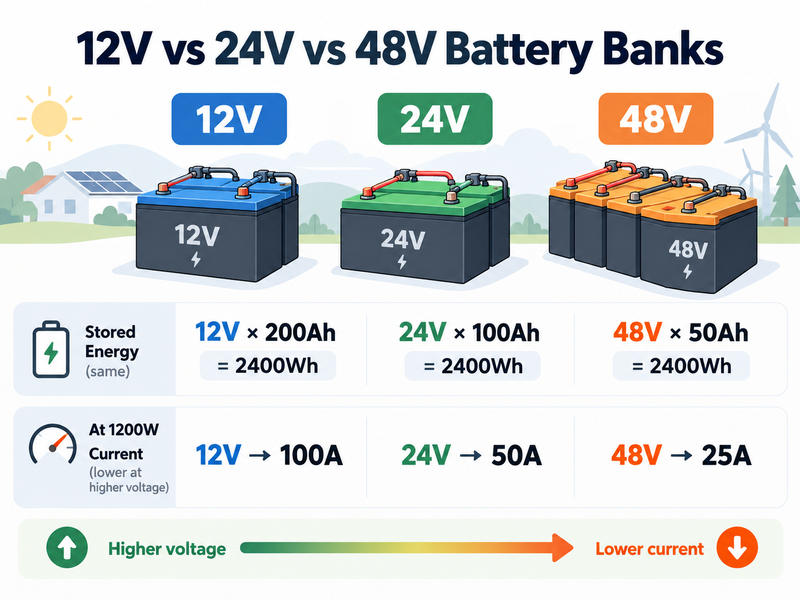
Battery banks are commonly described as 12V, 24V or 48V systems, but a higher voltage does not automatically mean a battery stores more energy.
Voltage is only one part of the specification.
The same amount of stored energy can be arranged as a lower-voltage bank with more amp-hours or a higher-voltage bank with fewer amp-hours.
The major practical difference appears when the system needs to deliver power:
for the same power, higher voltage means lower current.
Battery Bank Voltage Is a System Characteristic
A battery bank combines cells or batteries to create the voltage required by the wider system.
Series connections increase voltage, while parallel connections increase amp-hour capacity. The underlying relationship is explained here:
https://digitalowl.fika.bar/batteries-in-series-vs-parallel-01M3ADSFCS839DE87JYK879SPD
This makes it possible to build battery banks around different nominal voltage classes.
Typical labels include:
12V — common in smaller battery and vehicle-related systems;
24V — often used where power requirements are higher;
48V — increasingly common in larger energy-storage and inverter systems.
These are system classes rather than guarantees that the battery always operates at exactly 12, 24 or 48 volts.
Nominal Pack Voltage May Not Match the Label Exactly
Battery chemistry affects the actual nominal voltage of the pack.
For example, a LiFePO4 cell is typically around 3.2V nominal. Connecting four in series gives:
4 × 3.2V = 12.8V
Eight cells give:
8 × 3.2V = 25.6V
Sixteen cells give:
16 × 3.2V = 51.2V
Those packs may still belong to system categories commonly described as 12V, 24V and 48V.
The relationship between individual cells and complete battery-pack voltage is explained in more detail here:
https://digitalowl.fika.bar/cell-voltage-vs-pack-voltage-01M3AENP96N8XCVC6ZJFN5SCQG
So when comparing battery banks, distinguish the system-voltage class from the exact nominal and operating voltages listed by the manufacturer.
Higher Voltage Does Not Automatically Mean More Stored Energy
Battery energy depends on both voltage and amp-hour capacity:
Wh = V × Ah
Consider three simplified battery banks:
12V × 200Ah = 2,400Wh
24V × 100Ah = 2,400Wh
48V × 50Ah = 2,400Wh
All three represent approximately the same nominal stored energy.
Their voltage and Ah ratings look very different, but their watt-hour capacity is equal.
This is why comparing battery banks by voltage or Ah alone can be misleading.
For a deeper explanation of converting Ah into Wh:
https://digitalowl.fika.bar/how-to-convert-ah-to-wh-formula-and-examples-01M2JD3P2228S1SEFQ0MADZ8EV
The broader battery-capacity framework is available here:
https://medium.com/@volodymyrzh/battery-capacity-explained-mah-wh-amp-hours-decoded-1dc676be5a38
Higher Voltage Reduces Current at the Same Power
The important difference appears when the battery bank delivers power.
Ignoring conversion losses for a simple conceptual comparison:
Power = Voltage × Current
or:
Current = Power ÷ Voltage
Suppose a system needs approximately 1,200W.
At 12V:
1,200W ÷ 12V = 100A
At 24V:
1,200W ÷ 24V = 50A
At 48V:
1,200W ÷ 48V = 25A
The required power has not changed.
But doubling voltage halves the current in this simplified example.
That relationship becomes increasingly important as system power rises.
Why Current Matters
Electrical current influences several parts of system design.
Higher current generally increases the importance of:
conductor resistance;
voltage drop;
heat produced by resistive losses;
connector and protection-device ratings;
current capability of system components.
Resistive power loss is related to current squared:
Loss ∝ I²R
That means reducing current can substantially reduce resistive losses when the other conditions are comparable.
This is one reason higher-voltage architectures become attractive as system power increases.
It does not mean that every system should simply use the highest available battery voltage. The entire system must be designed around the chosen voltage.
12V Battery Banks
A 12V-class architecture can make sense for relatively modest power requirements and products already designed around 12V equipment.
Its strengths can include:
broad availability of compatible equipment;
familiarity across many small battery applications;
straightforward integration with existing 12V systems.
The limitation becomes more visible as power rises.
Delivering several kilowatts from a low-voltage battery bank can require substantial current. Current rather than stored energy can then become one of the major system constraints.
24V Battery Banks
Moving from 12V to 24V roughly halves current for the same ideal power.
A 2,400W load illustrates the difference:
at 12V: approximately 200A;
at 24V: approximately 100A.
A 24V architecture can therefore provide a middle ground between low-voltage systems and higher-voltage battery banks.
But compatibility matters.
A system designed for 12V equipment cannot be assumed to operate directly from a 24V battery bank. Voltage is a system-level design choice, not just a battery specification.
48V Battery Banks
At still higher power, 48V-class battery banks can reduce current further.
For the same theoretical 2,400W example:
2,400W ÷ 48V = 50A
This helps explain why larger inverter and stationary energy-storage systems frequently use higher battery-bank voltages.
The advantage is not additional energy by itself.
It is the ability to deliver the same power at lower current.
Higher-voltage systems also require equipment designed for that voltage range and appropriate system-level protection. The voltage decision therefore affects the complete architecture, not only the battery.
Battery Voltage and Capacity Should Be Compared Separately
A useful battery-bank comparison should answer two different questions.
How much energy is stored?
Use Wh or kWh.
At what voltage does the system operate?
Use the battery-bank voltage specification.
For example, two systems could both contain 5kWh while one operates around 24V and another around 48V.
Their stored energy may be similar, but their current requirements and compatible equipment can be very different.
12V vs 24V vs 48V: The Core Trade-Off
The main relationship is simple:
Lower voltage → higher current for the same power
Higher voltage → lower current for the same power
Voltage alone does not determine battery capacity
Wh depends on both voltage and Ah
So the useful question is not:
Which battery-bank voltage is best?
It is:
What voltage fits the power level and architecture of the complete system?
For smaller systems, 12V may be entirely appropriate. As power requirements increase, 24V or 48V can reduce current significantly.
But battery-bank voltage is only one part of the design. Capacity, power capability, chemistry, inverter compatibility and operating requirements still need to be considered together.
The most useful comparison sequence is:
Required energy → required power → battery-bank voltage → current requirements → compatible system components
That makes 12V, 24V and 48V meaningful system choices rather than competing capacity ratings.
Comments
No comments yet. Be the first to comment!