Battery Capacity for Emergency Preparedness
Emergency battery planning is different from buying the largest battery you can afford.
The goal is not to keep every appliance running as if the grid were still available. The goal is to identify the loads that matter most, calculate how much energy they require, and build enough battery capacity to support those priorities for a realistic period.
That starts with one simple question:
What absolutely needs to stay powered during an emergency?
For a broader explanation of battery capacity, watt-hours, amp-hours and the units used to describe stored energy, see:
https://medium.com/@volodymyrzh/battery-capacity-explained-mah-wh-amp-hours-decoded-1dc676be5a38
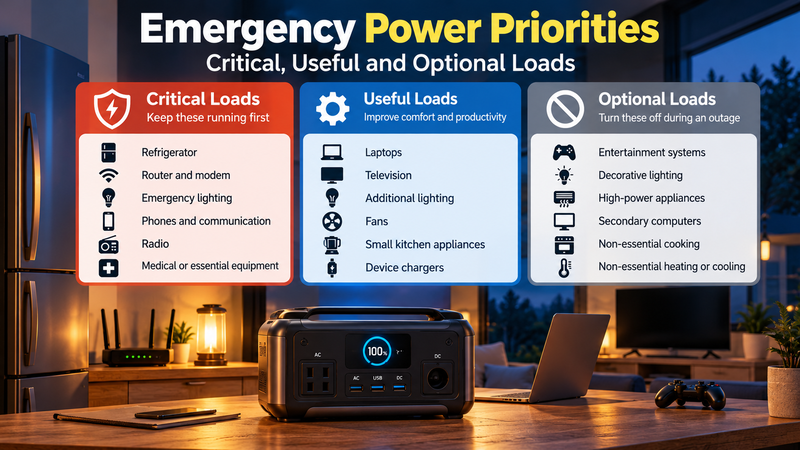
Divide Loads Into Critical, Useful and Optional
A useful emergency-power plan separates devices into three groups.
Critical Loads
These are devices that directly support basic communication, safety, food preservation or other essential functions.
Examples may include:
mobile phones
router or modem
emergency lighting
refrigerator
radio
essential communication equipment
other site-specific critical loads
The exact list depends on the household and location.
The important point is that these loads receive priority when battery energy is limited.
Useful Loads
These improve comfort or productivity but may not need to operate continuously.
Examples include:
laptops
television
additional lighting
fans
small kitchen appliances
device chargers
Their runtime can usually be reduced if stored energy becomes scarce.
Optional Loads
These are loads that can often be switched off completely during a prolonged outage.
They may include:
entertainment systems
decorative lighting
high-power appliances that are not essential
secondary computers
non-essential heating or cooling equipment
Separating loads this way prevents optional devices from consuming energy needed by essential ones.
Start With a Daily Emergency Energy Budget
Once you know which devices matter most, estimate their daily energy consumption.
For each device:
Daily energy = power × operating time
Suppose your emergency plan includes:
Refrigerator: 900Wh/day
Router and modem: 250Wh/day
Lighting: 200Wh/day
Phones and small electronics: 150Wh/day
Laptop: 300Wh/day
Total:
1,800Wh/day
That means your essential and useful loads require approximately:
1.8kWh per day
This daily figure is more useful than simply looking at the watt rating of the battery system.
A device that uses only 20W but runs continuously can consume more energy over a full day than a 500W device used for a few minutes.
Decide How Long You Want the Battery to Cover
The next question is autonomy.
How long should the system operate without reliable grid power?
If your emergency energy budget is 1.8kWh per day:
1 day = 1.8kWh
2 days = 3.6kWh
3 days = 5.4kWh
The calculation is straightforward, but the required battery size rises quickly as the planned outage duration increases.
For general household backup sizing, see:
That guide focuses on matching household loads to battery capacity. Emergency preparedness adds another layer: prioritisation.
Instead of asking how to support everything, you decide what must continue operating when energy becomes limited.
Do Not Plan Around 100% of Rated Capacity
A battery advertised as 2,000Wh should not automatically be treated as exactly 2,000Wh available to connected devices.
Real systems may lose energy through:
inverter conversion
standby consumption
wiring
battery-management electronics
temperature effects
reserved state of charge
For emergency planning, it is safer to maintain some reserve rather than design a system that must reach its theoretical limit every time.
If your calculated requirement is 3.6kWh, choosing exactly 3.6kWh of nominal storage leaves little room for uncertainty.
A practical plan usually includes additional margin.
Build the System Around Priorities, Not Convenience
Imagine your full household normally consumes 12kWh per day.
Trying to supply that entire load for three days would require roughly:
12kWh × 3 = 36kWh
before considering losses or reserve.
But your critical emergency loads may require only:
1.5kWh per day
For three days:
1.5kWh × 3 = 4.5kWh
That is a completely different storage requirement.
This is why emergency preparedness is largely a load-management problem.
A smaller battery paired with disciplined load prioritisation may provide more useful resilience than a larger battery powering unnecessary devices.
Refrigerator Loads Need Special Attention
Refrigeration is often one of the larger recurring loads in an emergency energy budget.
Unlike lighting or phone charging, a refrigerator cycles automatically throughout the day.
Its real energy consumption depends on factors such as:
model efficiency
ambient temperature
door opening frequency
thermostat setting
compressor cycle
freezer configuration
For planning purposes, measured daily energy consumption is much better than relying only on the compressor wattage.
A 120W refrigerator does not necessarily consume:
120W × 24 hours
because the compressor normally does not run continuously.
This distinction can substantially reduce sizing errors.
Communication Loads Are Small but Important
Phones, radios and networking equipment often require much less energy than refrigerators or large appliances.
That makes them especially valuable emergency loads.
For example, a router consuming 12W continuously uses approximately:
12W × 24h = 288Wh per day
A phone may require only a few tens of watt-hours per full charge.
These loads can therefore remain available for relatively long periods without dominating the battery budget.
When energy becomes scarce, maintaining communication can be a much better use of stored energy than powering high-consumption convenience appliances.
Multi-Day Emergencies Require a Different Strategy
A one-night power interruption and a four-day outage should not be treated as the same sizing problem.
As outage duration increases, several factors become more important:
daily load reduction
recharge opportunities
reserve capacity
battery expansion
changing weather
uncertainty about restoration time
For a detailed multi-day sizing approach, see:
https://digitalowl.fika.bar/battery-capacity-for-multi-day-outages-01M43RTN3WEAM6XD3ZRQSFW7F2
The key idea is that stored energy should be treated as a daily budget.
Every unnecessary watt-hour used today is energy that may not be available tomorrow.
Recharging Can Extend Emergency Runtime Dramatically
A battery does not necessarily need to store all the energy required for the entire emergency before the outage begins.
If you can recharge from solar, a generator, a vehicle or another available source, the battery becomes part of a repeating energy cycle:
Charge → store → use → recharge
Suppose your emergency loads require:
1.5kWh per day
but you can reliably restore:
1kWh per day
The battery needs to cover the remaining daily deficit rather than supply every watt-hour from its initial charge.
However, recharge should be treated conservatively.
Solar output can fall during poor weather. Fuel may become unavailable. Vehicle charging may not be practical in every situation.
Emergency planning should therefore avoid depending on one perfect recharge scenario.
Reduce Consumption as the Outage Continues
Load priorities can change over time.
During the first few hours, you might operate most useful loads normally.
After the first day, you may decide to:
reduce laptop use
switch off unnecessary lighting
charge phones only when needed
minimise refrigerator door opening
disable entertainment equipment
concentrate activity in one room
This creates a dynamic emergency energy budget.
The longer the outage lasts, the more aggressively optional loads can be reduced.
That allows the same stored capacity to support essential functions for longer.
Think in Tiers of Preparedness
A useful way to approach emergency battery capacity is to create several levels.
Tier 1 — Communication and lighting
Phones, radio, router and basic LED lighting.
This requires relatively little energy and can often be supported by small batteries.
Tier 2 — Add refrigeration
Refrigeration usually increases the daily energy requirement significantly.
Tier 3 — Add work and comfort loads
Laptops, fans and additional electronics increase consumption but may still be manageable.
Tier 4 — Add high-power household appliances
Heating, air conditioning, cooking appliances and other heavy loads can dramatically increase both battery capacity and inverter requirements.
This tiered approach lets you decide where additional battery capacity provides meaningful value.
Capacity Is Only One Part of the System
Emergency planning also needs to consider output power.
A battery might contain enough energy to run a device for several hours but still be unable to start or operate it if the inverter cannot supply enough power.
For example, compressor-based appliances may have short startup peaks above their normal running power.
So every emergency system should answer two separate questions:
Do I have enough energy capacity?
and
Can the system deliver enough power?
Wh or kWh answer the first question.
W and surge capability help answer the second.
Keep Some Capacity in Reserve
The final percentage of battery capacity can be especially valuable during an uncertain outage.
Instead of routinely using the system until it reaches its shutdown point, you may choose to preserve part of the battery for:
communication
lighting
unexpected delays
essential overnight loads
emergency information access
The exact reserve does not need to be identical for every household.
What matters is having a deliberate reserve rather than discovering too late that optional loads consumed the final available energy.
A Simple Emergency Battery Example
Suppose your priority loads require:
Refrigeration: 900Wh/day
Communication: 300Wh/day
Lighting: 150Wh/day
Electronics: 150Wh/day
Total:
1,500Wh/day
For two days:
1.5kWh × 2 = 3kWh
Now add extra capacity for losses and reserve.
A battery system somewhere above the theoretical 3kWh requirement would provide more realistic operating margin.
If daily recharging is available, the required starting reserve may be lower.
If recharging is uncertain, additional stored capacity becomes more valuable.
The calculation is not about finding one universally correct battery size.
It is about understanding the trade-off between:
loads, runtime, recharge and reserve.
The Practical Rule
Emergency battery planning should begin with priorities, not product specifications.
Identify your critical loads.
Estimate how much energy they use each day.
Decide how long you need to support them.
Add realistic losses and reserve.
Then consider whether recharging can extend the system beyond its stored capacity.
The result may be a modest portable battery for communication and lighting, a larger power station for refrigeration and electronics, or a modular home-backup system for longer outages.
What matters is that the capacity matches the emergency plan.
A battery is most useful during an outage when you already know which loads deserve its energy first.
Comments
No comments yet. Be the first to comment!