What Is Pass-Through Charging?
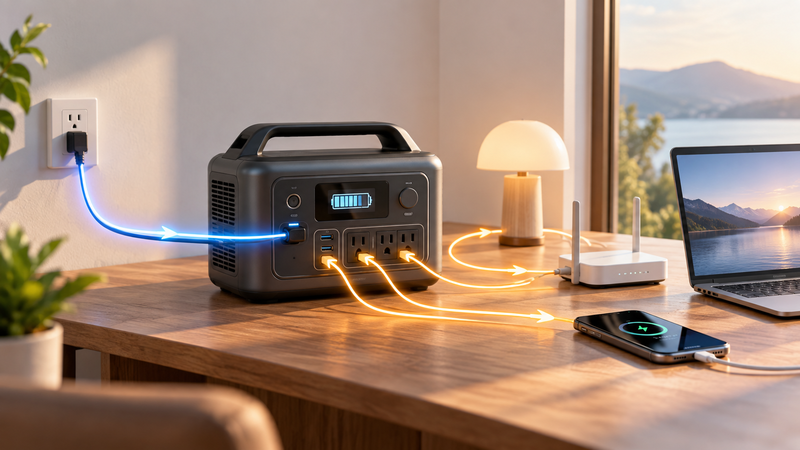
Pass-through charging is a feature that allows a battery system or portable power station to receive power while supplying power to connected devices at the same time.
In simple terms, energy comes in from a charger, solar panel or another source while the system continues powering its loads.
That sounds straightforward, but the actual energy flow can be more complex than simply “charging and discharging at the same time.”
Different products handle pass-through operation differently, and those differences can affect charging speed, efficiency, heat and battery behaviour.
What Pass-Through Charging Means
Imagine a portable power station connected to mains power.
At the same time, a laptop, router and lamp are plugged into the power station.
The unit is receiving energy from the wall while also supplying energy to those devices.
That is pass-through charging.
The same concept can apply when solar panels are supplying power while appliances are running.
The broad battery-capacity concepts behind these systems are explained here:
https://medium.com/@volodymyrzh/battery-capacity-explained-mah-wh-amp-hours-decoded-1dc676be5a38
The important point is that the incoming power does not necessarily go directly into the battery first.
The system may divide, route or prioritise energy depending on its internal design.
A Simple Energy-Flow Example
Suppose a power station receives:
500W input
At the same time, connected devices consume:
300W
In an idealised example, around 300W of the incoming power could support the loads while the remaining power is available for charging the battery.
That might leave roughly:
500W − 300W = 200W
for battery charging.
Real systems also have conversion losses, control limits and changing battery conditions, so the actual charging power may be lower.
But the example shows the basic principle.
The charging source and the load are competing for part of the same incoming energy.
Pass-Through Charging Is Not the Same as Full-Speed Charging
One common misunderstanding is that a power station will charge at its normal maximum rate even while powering large loads.
That is not always true.
Suppose a device can accept up to 600W from a charger.
If connected loads are consuming 400W, the full 600W may not be available for battery charging.
Depending on the design, some of that incoming power may first support the load.
The battery could therefore charge more slowly.
The exact behaviour depends on how the manufacturer has designed the internal power path.
Energy Can Follow Different Paths
A simplified pass-through system may behave like this:
Input power → load + battery
But another device may route energy differently.
For example:
Input → conversion stage → battery → inverter → load
or:
Input → load directly, excess → battery
These architectures are not identical.
The first may involve additional conversion steps. The second may reduce unnecessary cycling in some situations.
That is why two products with similar battery capacity and charging specifications can behave differently during pass-through use.
The Battery Management System Still Matters
A battery system does not simply accept and deliver unlimited power.
Its battery management system, or BMS, monitors conditions such as voltage, current and temperature.
A broader explanation of that role is available here:
https://digitalowl.fika.bar/what-does-a-battery-management-system-do-01M2VNAVCRSBTWHF3T6SPZMX9P
During pass-through charging, the BMS may need to manage incoming charging power while the system is also supporting outgoing power.
If temperatures rise or electrical limits are approached, charging power may be reduced.
This means pass-through operation is still constrained by the same protections that apply during normal charging and discharging.
Efficiency Losses Still Apply
Incoming energy does not move through the system without losses.
There may be losses in:
AC-to-DC conversion
DC-to-DC conversion
battery charging
battery discharge
inverter operation
internal electronics
Charging efficiency is discussed in more detail here:
https://digitalowl.fika.bar/what-is-charging-efficiency-01M3FBWVAFHWYBA8TBT7J8FCD5
This matters because a 500W input does not automatically translate into 500W of useful energy divided perfectly between the load and the battery.
Some energy becomes heat.
The more conversion stages involved, the greater the potential losses.
Pass-Through Charging Can Create More Heat
Charging generates heat.
Supplying large loads can also generate heat.
Doing both at the same time can increase thermal stress inside the system.
This does not mean pass-through charging is inherently harmful.
Products that officially support it are designed to manage the operating conditions they permit.
But the system may respond by reducing charging power, increasing fan speed or limiting output.
That is one reason why pass-through specifications should be checked rather than assumed.
Not Every Product Supports It the Same Way
“Pass-through charging” is not always a single standardised feature.
Different manufacturers may allow different combinations.
One product may support:
AC input + AC output
Another may support:
solar input + AC output
A third may allow both but impose lower power limits.
Some devices may disable specific ports during certain charging modes.
Others may limit total input or output when charging and discharging simultaneously.
So the question is not only:
Does this power station support pass-through charging?
A better question is:
Which inputs and outputs can operate simultaneously, and at what limits?
Pass-Through Charging vs UPS Operation
Pass-through charging is sometimes confused with UPS or EPS functionality.
They are related concepts, but they are not necessarily the same.
A system may allow simultaneous charging and output without providing fast automatic switching during a grid outage.
UPS-style operation usually refers to the ability to switch from grid power to battery power quickly enough to keep connected equipment running.
Pass-through charging simply describes simultaneous energy input and output.
A product can support one without necessarily offering the same performance in the other.
Solar Pass-Through Charging
Pass-through operation becomes especially useful in solar-powered systems.
Imagine a portable power station connected to solar panels during the day.
The panels produce 400W.
Connected devices consume 150W.
Part of the available solar energy can support those devices while the remaining energy charges the battery.
If the load rises above solar production, the battery may begin supplying the difference.
For example:
Solar input: 400W
Load: 550W
The system must find approximately:
550W − 400W = 150W
from stored energy, assuming the design allows that operating mode.
This is why solar pass-through systems can move continuously between charging, neutral balance and discharge depending on sunlight and load.
Pass-Through Can Reduce Unnecessary Battery Cycling
In some architectures, incoming power can support the load directly before excess energy is stored.
That can reduce the amount of energy that needs to enter and immediately leave the battery.
For example, imagine a steady 200W load while 500W of solar power is available.
A well-designed system may direct much of the solar power toward the load and use the remainder for charging.
This can be more efficient than repeatedly routing all energy through the battery.
However, the exact behaviour is model-specific.
Manufacturers do not always publish detailed internal power-flow information.
It Does Not Create Extra Power
Pass-through charging changes how available energy is routed.
It does not increase the total amount of energy available.
If the charger supplies 300W and the connected load requires 500W, there is still a 200W deficit.
The battery must provide that difference.
Similarly, if the charger provides 500W and the load consumes 450W, only a relatively small amount remains available for battery charging.
The basic energy balance still applies.
Large Loads Can Slow Charging Dramatically
Consider a system with:
800W charging input
and a connected appliance using:
650W
Ignoring losses, only around 150W remains available for charging the battery.
A battery that would normally recharge quickly at 800W may therefore charge very slowly while that appliance is operating.
This is especially important when estimating recharge times for backup systems or portable power stations used continuously.
A quoted “full recharge in two hours” figure may assume minimal or no simultaneous load.
Check the Specification Before Relying on It
Before planning around pass-through charging, check the manufacturer's documentation.
Useful specifications include:
supported simultaneous input and output modes
maximum charging input
maximum AC output
maximum DC output
restrictions during solar charging
restrictions during AC charging
UPS or EPS switching behaviour
thermal limits
whether charging speed changes under load
Do not assume that a feature supported by one model works identically on another.
The Key Idea
Pass-through charging allows a battery system to receive energy and power connected devices at the same time.
But it is better understood as an energy-routing feature than as two completely independent processes.
Incoming power may support the load first, charge the battery with the remainder or pass through several conversion stages depending on the product.
That means simultaneous use can affect:
charging speed
efficiency
heat generation
battery behaviour
The feature is useful, especially in solar and backup applications, but the practical limits depend on how the specific system is designed.
Comments
No comments yet. Be the first to comment!