Power Bank Capacity Explained: mAh, Wh and Real Usable Energy
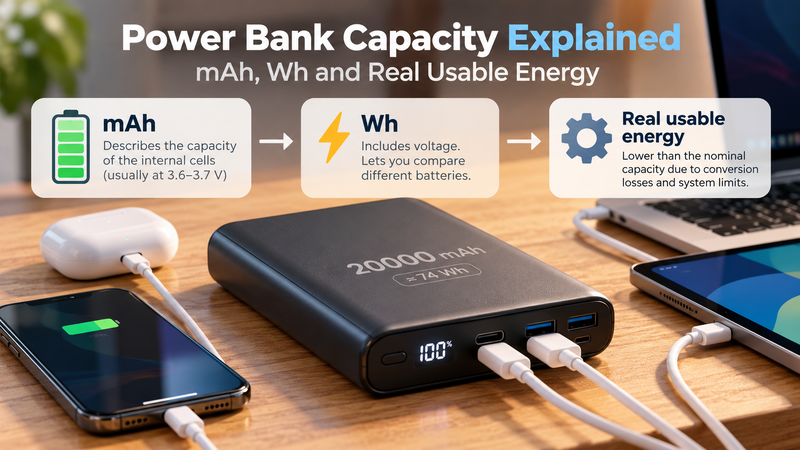
A power bank may be labelled 10,000 mAh, 20,000 mAh or even 30,000 mAh, but that number does not tell you exactly how much energy will reach your phone, tablet or other device.
The reason is simple: the advertised mAh rating usually refers to the internal battery cells, while the USB output operates at a different voltage and introduces conversion losses.
Understanding power bank capacity therefore requires three separate ideas: mAh, watt-hours and usable output energy.
For the broader battery-capacity framework, including mAh, Ah and Wh, see:
https://medium.com/@volodymyrzh/battery-capacity-explained-mah-wh-amp-hours-decoded-1dc676be5a38
What Does the mAh Number on a Power Bank Mean?
Most consumer power banks are marketed using milliamp-hours.
A 20,000 mAh power bank sounds as if it should charge a 5,000 mAh phone four times. In practice, it normally cannot.
That does not necessarily mean the manufacturer is exaggerating the specification. The two mAh figures are usually measured at different voltages.
Inside many power banks, lithium cells operate at a nominal voltage of roughly 3.6–3.7 V. The power bank then converts that voltage to the voltage required by its USB output.
This is why mAh alone is useful mainly when comparing batteries operating at similar voltages.
A more detailed explanation of milliamp-hours is available here:
https://digitalowl.fika.bar/what-is-mah-milliamp-hours-explained-simply-01M2GD3RKJD95V79BPHEW37S32
Convert Power Bank Capacity to Watt-Hours
Watt-hours provide a better way to compare batteries because they include voltage.
A simplified conversion is:
Wh = Ah × V
Since 1,000 mAh = 1 Ah, a 20,000 mAh power bank contains:
20,000 mAh = 20 Ah
If its internal cells have a nominal voltage of 3.7 V:
20 Ah × 3.7 V = 74 Wh
That 74 Wh figure describes the approximate stored energy before conversion losses and internal operating limits.
This is why watt-hours are usually more useful than mAh when comparing batteries with different voltages.
For the underlying unit:
https://digitalowl.fika.bar/what-is-a-watt-hour-wh-explained-simply-01M2GM471S7BVV7BQ4R37DEEAP
Why 20,000 mAh Does Not Mean 20,000 mAh at USB Output
The internal cells and the USB output are not operating under identical conditions.
Suppose the power bank stores approximately 74 Wh internally. If it were theoretically converted to a 5 V output with no losses:
74 Wh ÷ 5 V = 14.8 Ah
That is equivalent to about 14,800 mAh at 5 V, not 20,000 mAh.
Real conversion is not perfectly efficient, so the usable figure will be lower again.
This difference is one of the main reasons users sometimes believe a power bank delivers far less capacity than advertised.
The mAh label describes the internal cell capacity at its specified voltage. It is not a promise that the same mAh figure will appear at every output voltage.
Where the Energy Goes
A power bank uses electronics to regulate and convert voltage between its internal cells and connected devices.
Some stored energy is consumed or lost through:
voltage conversion;
heat;
internal control electronics;
cable resistance;
charging circuitry inside the receiving device;
battery-management limits;
standby consumption.
The amount varies with the power bank, device, output voltage, charging protocol and load.
For that reason, there is no single efficiency percentage that accurately describes every power bank.
Rated Capacity vs Usable Capacity
This creates an important distinction between rated capacity and usable capacity.
Rated capacity describes the nominal energy stored by the battery cells under specified conditions.
Usable capacity is the amount of that energy that can actually be delivered through the output after system limits and losses are considered.
A 74 Wh power bank will therefore not normally deliver the full 74 Wh to a connected device.
The same principle appears in larger batteries and portable power stations.
More on the distinction:
https://digitalowl.fika.bar/rated-capacity-vs-usable-capacity-what-s-the-difference-01M2GQ5Y5KA68T9JHJQKWPD6TE
How Many Times Can a Power Bank Charge a Phone?
A rough estimate should compare energy rather than simply dividing one mAh number by another.
Suppose:
power bank: 20,000 mAh at 3.7 V;
stored energy: about 74 Wh;
phone battery: 5,000 mAh at about 3.85 V.
The phone stores roughly:
5 Ah × 3.85 V = 19.25 Wh
If there were no losses:
74 Wh ÷ 19.25 Wh ≈ 3.84 full charges
Real charging involves losses in both the power bank and the phone, so actual results will be lower.
The practical number also changes if the phone is being used while charging.
Why Direct mAh Comparisons Can Mislead
Consider two devices:
Battery A: 10,000 mAh at 3.7 V
Battery B: 10,000 mAh at 7.4 V
They have the same mAh rating but not the same stored energy.
Battery A:
10 Ah × 3.7 V = 37 Wh
Battery B:
10 Ah × 7.4 V = 74 Wh
Battery B stores roughly twice as much energy even though both are labelled 10,000 mAh.
That is why mAh works best as a comparison metric when voltage is the same or very similar.
For comparisons across different battery types, Wh is usually safer.
Fast Charging Does Not Increase Battery Capacity
Another common misunderstanding is that a 20 W, 45 W or 100 W USB-C output somehow increases the capacity of the power bank.
It does not.
Watts describe power, or how quickly energy can be transferred at a particular moment.
Watt-hours describe energy capacity.
A 74 Wh power bank is still approximately a 74 Wh power bank whether its maximum USB-C output is 20 W or 100 W.
Higher output power may charge compatible devices faster, but it does not create additional stored energy.
Output Power Still Matters
Capacity and output power solve different problems.
Capacity answers:
How much energy is stored?
Output power answers:
Can the power bank deliver energy quickly enough for this device?
A small phone may need relatively little power. A laptop may require USB-C Power Delivery at 45 W, 65 W, 100 W or more depending on the model.
A power bank can therefore have enough total Wh to provide useful laptop runtime but still be unsuitable if its USB-C output cannot deliver the required power.
Always check both capacity and output specifications.
Why Wh Is Useful When Comparing Power Banks
mAh remains useful because it is familiar and easy to recognise.
Wh becomes more useful when you want to:
compare power banks with different internal voltages;
estimate how many device charges are realistic;
compare a power bank with a laptop battery;
compare power banks with portable power stations;
understand airline battery limits;
estimate actual stored energy.
A product specification that gives both mAh and Wh is therefore more informative than one that gives mAh alone.
A Better Way to Compare Two Power Banks
Instead of asking which model has the larger mAh number, compare several specifications together.
Start with:
stored energy in Wh;
USB-C and USB-A output power;
supported charging protocols;
usable output under realistic conditions;
number and type of ports;
recharge speed;
size and weight.
For basic capacity comparison, Wh should carry more weight than the marketing mAh figure when internal voltages differ.
Example: 10,000 mAh vs 20,000 mAh
Assume both power banks use internal cells rated at approximately 3.7 V.
A 10,000 mAh unit stores approximately:
10 Ah × 3.7 V = 37 Wh
A 20,000 mAh unit stores approximately:
20 Ah × 3.7 V = 74 Wh
Under similar conditions, the larger model contains roughly twice the stored energy.
But that does not guarantee exactly twice as many phone charges because conversion efficiency, output behaviour and device use can differ.
The energy relationship is predictable. Real-world delivery is less exact.
The Practical Rule
When evaluating power bank capacity:
Use mAh to understand the familiar cell-capacity rating.
Use Wh to compare stored energy.
Use output watts to check whether the power bank can actually power your device.
Expect usable energy to be lower than the nominal stored capacity.
A large mAh number is useful, but it is only one part of the specification.
Once voltage, watt-hours and conversion losses are considered, power bank capacity becomes much easier to compare realistically.
Comments
No comments yet. Be the first to comment!