What Is Charging Efficiency?
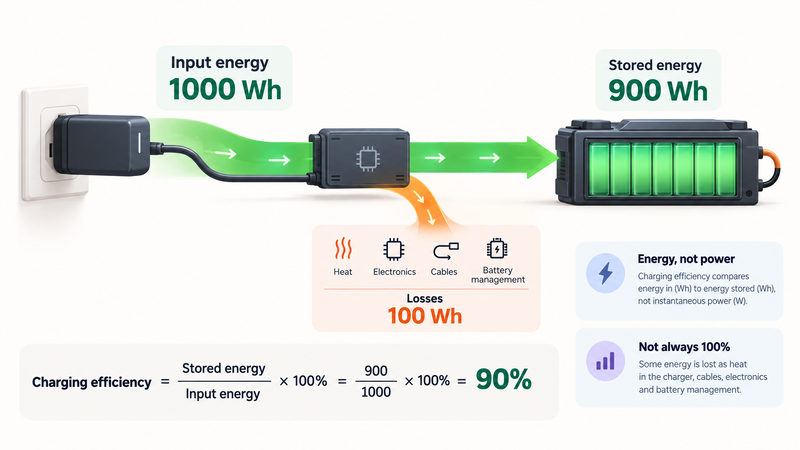
Charging efficiency describes how much of the energy supplied to a battery system actually becomes stored battery energy.
If a charger draws 1,000 Wh from a power source but the battery gains only 900 Wh, the missing energy has not disappeared. Part of it has been consumed or converted into heat by the charger, battery, cables, electronics and other components.
The basic relationship is:
Charging efficiency = Energy stored ÷ Energy supplied × 100%
Charging efficiency therefore answers a different question from battery capacity or charging power.
It asks:
How much of the input energy successfully becomes stored energy?
Charging Efficiency Is About Energy, Not Power
Charging efficiency should normally be calculated using energy, such as watt-hours.
For example:
Energy supplied: 1,000 Wh
Energy stored: 900 Wh
Then:
900 Wh ÷ 1,000 Wh × 100% = 90%
In this simplified example, 90% of the input energy becomes stored battery energy.
The remaining 10% is associated with losses elsewhere in the charging process.
Charging power is different. It describes the rate of energy transfer in watts.
The distinction between battery capacity and charging power is explained here:
https://digitalowl.fika.bar/charging-power-vs-battery-capacity-01M3F78YY9ZSWJQV8EX0ZGEMP1
Why Charging Is Not 100% Efficient
Real electrical systems have losses.
During charging, energy can be used by or lost through:
AC-to-DC conversion;
DC voltage conversion;
charger electronics;
cables and connectors;
battery internal resistance;
battery-management electronics;
cooling fans;
heating systems;
control electronics;
cell-balancing processes.
Some of the energy becomes heat.
Some may operate electronics that are necessary for the charging process.
The exact distribution depends on the battery system and charging method.
This is why the energy drawn from the source can be higher than the energy finally stored in the battery.
Input Energy and Stored Energy Are Different Measurements
Suppose a battery gains 1,800 Wh during a charging session.
If the wall outlet supplied 2,000 Wh, the charging efficiency would be:
1,800 ÷ 2,000 × 100% = 90%
But if the battery gained the same 1,800 Wh while the source supplied 2,100 Wh:
1,800 ÷ 2,100 × 100% ≈ 85.7%
The battery has gained the same amount of stored energy in both examples.
What has changed is how much energy was required from the source.
This matters when estimating:
electricity consumption;
solar energy requirements;
generator runtime;
charging cost;
total system efficiency.
Charging Efficiency Affects Charge-Time Estimates
The theoretical battery charge-time formula is:
Charge time = Energy required ÷ Charging power
That formula is explained here:
https://digitalowl.fika.bar/battery-charge-time-formula-01M3F98QE99JV0CY8AEYC2PWAV
However, the simple formula assumes an ideal relationship between source power and stored energy.
If some input energy is lost, the source may need to deliver more energy than the battery actually stores.
Suppose a battery needs to gain 1,800 Wh.
At perfect efficiency, the source would need to supply exactly:
1,800 Wh
If the overall charging process were 90% efficient in that particular situation, the required source energy would instead be approximately:
1,800 Wh ÷ 0.90 = 2,000 Wh
This does not automatically mean charge time increases by exactly the same percentage because charging power may also vary over time.
But efficiency is one reason real charging can take longer than the simplest Wh ÷ W calculation suggests.
Do Not Assume One Universal Efficiency Percentage
Charging efficiency is not one fixed number for every battery.
It can vary with:
battery chemistry;
charger design;
charging power;
state of charge;
battery temperature;
input voltage;
battery voltage;
conversion architecture;
auxiliary power consumption;
battery condition.
Even the same battery system may not achieve exactly the same efficiency under every charging condition.
For that reason, a statement such as:
“Battery charging is always 90% efficient”
is too broad.
A percentage should be treated as a measured result, manufacturer specification or explicit assumption for a particular system and operating condition.
Efficiency Can Change During the Charging Session
Charging conditions are not necessarily constant from 0% to 100% state of charge.
A battery may accept high charging power during one part of the session and lower power later.
Electronics may also consume approximately similar background power while the amount of energy flowing into the cells changes.
This means the effective efficiency measured over a complete charging session can differ from the efficiency at one particular moment.
For practical energy planning, whole-session energy measurements are often more useful than comparing two instantaneous watt readings.
Charging Efficiency vs Inverter Efficiency
Charging efficiency should not be confused with inverter efficiency.
Charging efficiency describes:
source energy → stored battery energy
Inverter efficiency describes a different direction:
stored DC battery energy → AC energy delivered to a load
The two processes can both create losses, but they occur at different stages of the energy flow.
A dedicated explanation of inverter efficiency is available here:
https://app.fika.bar/blog/post/what-is-inverter-efficiency-01M2K65Q757EW3H13TCFP3JFJ7
For example, a backup-power system may experience losses while charging the battery and then additional conversion losses later when delivering AC power.
This means round-trip performance can be lower than either individual conversion stage considered by itself.
Wall-to-Battery Efficiency
One useful measurement boundary is wall-to-battery efficiency.
This compares:
energy drawn from the AC outlet
with:
energy added to the battery
For example:
Wall energy: 2,200 Wh
Battery energy gained: 2,000 Wh
Charging efficiency:
2,000 ÷ 2,200 × 100% ≈ 90.9%
This type of measurement includes losses in the charging system between the wall outlet and battery.
But even here, the result depends on how battery energy gained is estimated or measured.
The measurement boundary should always be clear.
Solar-to-Battery Efficiency Uses a Different Boundary
Solar charging creates another possible efficiency measurement.
You could compare:
energy produced by the solar panels
with:
energy stored in the battery
Losses can occur through:
panel wiring;
charge controllers;
DC conversion;
battery charging;
system electronics.
That value should not automatically be compared with wall-to-battery efficiency unless both measurements use compatible boundaries.
This is a recurring principle in energy calculations:
efficiency percentages only make sense when you know what goes in and what comes out.
Low-Power Charging Can Make Fixed Losses More Visible
Imagine a system that consumes some power simply to keep charging electronics active.
At a high charging rate, that fixed overhead may represent a small part of total input energy.
At a very low charging rate, the same background consumption can become a larger percentage of the energy being transferred.
This helps explain why system efficiency may vary with charging power.
It also shows why a single efficiency percentage should not automatically be applied to every charging mode.
Temperature Can Affect the Charging Process
Battery temperature can influence charging limits and battery behaviour.
The battery-management system may restrict charging under certain thermal conditions, and some systems may use energy for heating or cooling.
If auxiliary thermal management operates during charging, source energy can increase without producing an equivalent increase in stored battery energy.
The next article in this series will examine charging lithium batteries in cold weather in more detail.
How to Measure Charging Efficiency Conceptually
A simple workflow is:
Measure or estimate the battery's increase in stored energy.
Measure the total energy supplied by the charging source over the same period.
Keep the measurement boundaries consistent.
Divide stored energy by supplied energy.
Multiply by 100.
The formula is:
Efficiency (%) = Stored energy (Wh) ÷ Input energy (Wh) × 100
Example:
Stored energy = 1,500 Wh
Input energy = 1,700 Wh
1,500 ÷ 1,700 × 100 ≈ 88.2%
This percentage describes that charging event under those measurement assumptions.
It should not automatically be treated as a permanent specification for every operating condition.
Why Charging Efficiency Matters for Battery Sizing
Charging efficiency does not change the battery's rated capacity.
A 2,000 Wh battery remains a 2,000 Wh battery.
But efficiency changes how much energy must be available from the source to replenish that capacity.
If you are sizing:
a solar array;
a generator;
grid-energy consumption;
a charging window;
an off-grid energy budget;
you need to distinguish between:
energy you want stored
and:
energy the source must provide
That difference becomes increasingly important as battery capacity grows.
Some usufull videos about electrisity and batteries
The Key Idea
Charging efficiency measures the relationship between input energy and stored battery energy.
The essential formula is:
Charging efficiency = Stored Wh ÷ Input Wh × 100%
But the percentage depends on the system and conditions.
The practical sequence is:
source energy → conversion losses → battery-management overhead → cell charging → stored energy
That is why a battery may need more energy from the wall, generator or solar system than its nominal increase in stored Wh suggests.
For the broader battery-capacity framework:
https://medium.com/@volodymyrzh/battery-capacity-explained-mah-wh-amp-hours-decoded-1dc676be5a38
Charging efficiency is therefore not a replacement for battery capacity or charging power. It is the missing link that explains why energy supplied and energy stored are not always the same number.
Comments
No comments yet. Be the first to comment!