How Much Battery Capacity Does a Sump Pump Need?
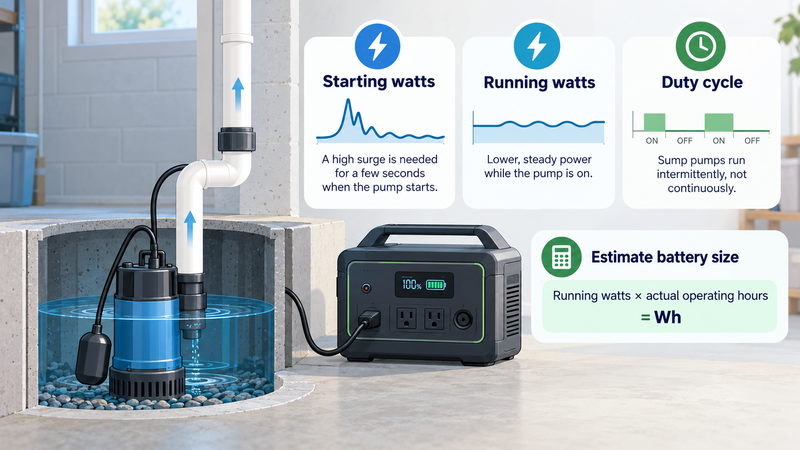
A sump pump is very different from a light, router or laptop when it comes to battery backup.
It may remain idle for long periods, switch on only when water reaches a certain level, and then draw a relatively high amount of power for a short time. Its motor can also require a much larger burst of power at startup than during normal operation.
That means sump-pump backup sizing depends on three separate factors:
starting watts → running watts → how often the pump actually runs
Battery capacity determines how much energy is available over time. Inverter output determines whether the pump can start and continue operating when required.
For the broader battery-capacity framework:
https://medium.com/@volodymyrzh/battery-capacity-explained-mah-wh-amp-hours-decoded-1dc676be5a38
Start With the Pump's Actual Specifications
There is no universal wattage for a sump pump.
Different pumps vary by motor size, pumping capacity, head height, design and efficiency.
A smaller pump might have relatively modest running consumption, while a larger unit may require significantly more power.
The most useful starting points are:
the pump nameplate
manufacturer documentation
or:
measured operating power
Generic wattage tables can be useful for understanding the method, but they should not replace the specifications of the actual pump.
Running Watts Describe Normal Operation
Suppose an example sump pump draws:
700 W while running
If it operated continuously for one hour, it would consume:
700 W × 1 h = 700 Wh
But sump pumps normally do not run continuously.
They operate only when enough water enters the sump basin to trigger the float switch or control system.
That makes runtime behaviour extremely important.
A pump that runs for only a few minutes each hour may use far less energy than its running wattage initially suggests.
Starting Watts Can Be Much Higher
When an electric motor starts, it may briefly draw substantially more power than during normal operation.
Suppose our example pump runs at:
700 W
but requires:
1,800 W briefly at startup
The 1,800 W surge does not mean the pump consumes 1,800 Wh.
It is a short power demand.
This distinction is explained in more detail here:
https://digitalowl.fika.bar/starting-watts-vs-running-watts-01M2K3FNMK1HM1FQDAYVFRT1PM
The backup system must therefore satisfy two different requirements:
enough inverter output to start the pump
and:
enough stored battery energy to keep supporting repeated pump cycles
A large battery cannot compensate for an inverter that cannot handle the startup surge.
Duty Cycle Determines the Real Energy Requirement
For battery capacity, the important question is how long the pump actually runs.
Imagine a 700 W pump operates for:
5 minutes every hour
Five minutes is:
5 ÷ 60 = 0.083 hours
Energy used during one cycle:
700 W × 0.083 h ≈ 58 Wh
If that happened once per hour for 12 hours:
58 Wh × 12 ≈ 696 Wh
So the pump might consume roughly:
700 Wh over 12 hours
under that illustrative operating pattern.
If it ran for 15 minutes every hour instead, energy consumption would triple.
The pump itself has not changed. The water conditions have.
Water Inflow Is the Biggest Unknown
Unlike many household loads, sump-pump runtime depends heavily on external conditions.
During dry weather, the pump may barely run.
During heavy rain, snowmelt or high groundwater conditions, it may cycle much more frequently.
That means historical energy consumption measured on a normal day may underestimate the amount of energy needed during the exact conditions when backup power matters most.
For planning, it can be useful to consider at least two scenarios:
normal cycling
and:
heavy-inflow cycling
The battery should be evaluated against the more demanding scenario if flood prevention is the priority.
A Simple Moderate-Use Example
Consider an illustrative pump with:
Running power: 700 W
Assume it runs:
10 minutes per hour
Ten minutes equals:
0.167 h
Energy per hour:
700 × 0.167 ≈ 117 Wh
Over eight hours:
117 × 8 ≈ 936 Wh
So the pump could require approximately:
0.94 kWh
during that eight-hour period before system losses and reserve.
A battery labelled 1 kWh would therefore offer very little margin in this example.
A larger capacity would be needed to account for conversion losses and uncertainty.
A High-Demand Scenario Can Change Everything
Now imagine heavy rain increases pump runtime to:
20 minutes per hour
That is:
0.333 h
Energy used each hour:
700 × 0.333 ≈ 233 Wh
Across eight hours:
233 × 8 ≈ 1,864 Wh
The same pump now requires almost:
1.9 kWh
before losses and reserve.
This demonstrates why battery sizing based only on pump wattage can be misleading.
Runtime frequency matters just as much.
Battery Capacity Is Not the Same as Inverter Capability
Suppose a battery system contains:
2 kWh of usable energy
but its inverter can deliver only:
1,000 W surge
If the pump needs a short 1,800 W startup surge, the system may fail to start it despite having plenty of stored energy.
The opposite problem is also possible.
A powerful inverter might easily start the pump, but a small battery could be depleted after repeated cycles.
A useful sump-pump backup system therefore needs to pass both tests:
Power test: Can it start and run the motor?
Energy test: Can it support enough pump cycles for the required backup period?
Add Conversion Losses and Reserve
If calculations suggest the pump will consume:
1,200 Wh
during the expected outage, the battery should not automatically be sized at exactly 1,200 Wh.
Some energy is lost through:
inverter conversion;
internal electronics;
standby power;
battery-management systems;
cabling and other conversion stages.
The real target also needs some reserve because pump cycling can increase unexpectedly.
A practical relationship is:
expected pump energy + conversion losses + reserve = target battery capacity
The exact reserve depends on the system and the consequences of running out of power.
Backup Duration Matters
Suppose the pump's average energy consumption under wet conditions is estimated at:
200 Wh per hour
Then:
4 hours ≈ 800 Wh
8 hours ≈ 1,600 Wh
12 hours ≈ 2,400 Wh
24 hours ≈ 4,800 Wh
before losses and reserve.
This shows why a battery that appears large for normal household electronics can become relatively small when supporting a motor load during prolonged wet conditions.
Recharging Can Extend Pump Backup
If the battery can recharge during the outage, total required storage may be reduced.
Possible sources include solar, generator charging or intermittent grid restoration.
For example, if the pump consumes:
2 kWh during the day
and solar restores:
1 kWh
the net depletion may be closer to:
1 kWh
under those specific conditions.
But because sump-pump demand often increases during storms, solar availability may also be poor at the same time.
Recharging should therefore be treated as part of the resilience strategy rather than assumed to be guaranteed.
The broader whole-home sizing framework is here:
Sump Pumps Show Why Real Loads Matter
Simple battery calculations often assume steady loads.
A sump pump behaves differently.
It has:
high startup power
moderate or high running power
intermittent operation
highly variable duty cycle
The real-world effect of these load patterns on battery sizing is discussed here:
This is exactly why average energy and peak power should be treated separately.
A Better Sump-Pump Sizing Workflow
Use this process:
1. Find the actual running wattage.
Use the pump specifications or measured data.
2. Check startup or surge requirements.
The inverter must be able to start the motor.
3. Estimate pump runtime per hour.
Base this on realistic water conditions rather than assuming continuous operation.
4. Calculate energy use.
Use:
running watts × actual operating hours = Wh
5. Multiply across the required backup period.
Estimate how many cycles may occur during the outage.
6. Add conversion losses and reserve.
Do not size the battery exactly to the calculated consumption.
7. Consider a heavy-inflow scenario.
The pump may run much more often during storms or groundwater events.
8. Add other loads if the battery is shared.
A whole-home backup battery may also need to support refrigeration, communications and lighting.
The Critical Difference Is Power vs Energy
Sump-pump backup becomes easier to understand when two questions are kept separate:
Can the backup system start the pump?
That depends mainly on inverter surge capability.
How long can the system keep supporting pump cycles?
That depends mainly on usable battery energy and the pump's duty cycle.
A realistic battery estimate therefore cannot come from running watts alone.
Measure or verify the pump's actual specifications, estimate how often it is likely to operate during the conditions you are preparing for, calculate the resulting Wh, and then include losses and reserve.
That approach gives a much more useful answer than simply choosing a battery from a generic sump-pump wattage chart.
Comments
No comments yet. Be the first to comment!