Batteries in Series vs Parallel
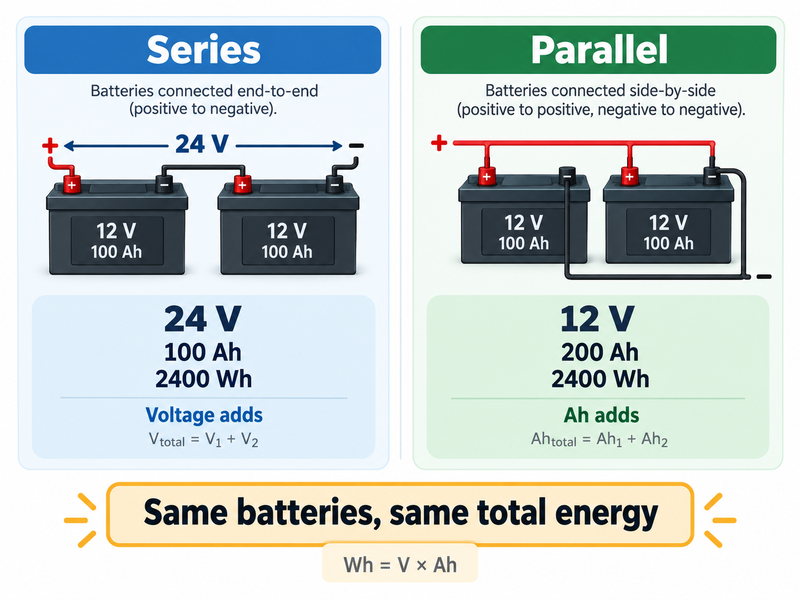
Connecting batteries in series or parallel changes how the battery bank behaves electrically.
The simplest distinction is:
Series increases voltage while amp-hours stay the same.
Parallel increases amp-hours while voltage stays the same.
But there is an important third number: watt-hours.
When identical batteries are combined, both series and parallel arrangements can produce the same total stored energy. The difference is how that energy is distributed between voltage and amp-hour capacity.
Start With Voltage, Amp-Hours and Watt-Hours
Before comparing series and parallel batteries, it helps to separate three measurements.
Voltage (V) describes electrical potential.
Amp-hours (Ah) describe charge capacity.
Watt-hours (Wh) describe stored energy.
The basic relationship is:
Wh = V × Ah
For example, a nominal 12 V, 100 Ah battery represents approximately:
12 V × 100 Ah = 1,200 Wh
A broader explanation of battery capacity and the relationship between Ah and Wh is available here:
https://medium.com/@volodymyrzh/battery-capacity-explained-mah-wh-amp-hours-decoded-1dc676be5a38
For a dedicated explanation of amp-hours:
https://digitalowl.fika.bar/what-is-ah-amp-hours-explained-simply-01M2GGB34443JC68WVPZBGPX3K
What Happens When Batteries Are in Series?
In a series arrangement, the voltages add together.
If two identical 12 V, 100 Ah batteries are considered as one series bank:
Voltage: 12 V + 12 V = 24 V
Capacity: 100 Ah
Energy: 24 V × 100 Ah = 2,400 Wh
The amp-hour rating does not double.
Instead, the higher total voltage produces the larger total energy value.
With four identical 12 V, 100 Ah batteries in series, the conceptual result would be:
48 V
100 Ah
4,800 Wh
This is why looking at Ah alone can make a series battery bank appear as if its capacity has not increased.
Its charge capacity in amp-hours remains the same, but its total stored energy increases because the bank voltage is higher.
For more context on what battery voltage represents:
What Happens When Batteries Are in Parallel?
Parallel behaves differently.
When identical batteries are combined in parallel, the voltage stays the same while the amp-hour capacities add.
Using the same two 12 V, 100 Ah batteries:
Voltage: 12 V
Capacity: 100 Ah + 100 Ah = 200 Ah
Energy: 12 V × 200 Ah = 2,400 Wh
With four identical 12 V, 100 Ah batteries considered in parallel:
12 V
400 Ah
4,800 Wh
The voltage has not increased, but the amount of charge represented by the Ah rating has.
Same Batteries, Same Total Energy
This is the most important part of the comparison.
Take two identical batteries:
12 V × 100 Ah = 1,200 Wh each
Together they represent approximately:
2 × 1,200 Wh = 2,400 Wh
Now compare the two arrangements.
Series:
24 V
100 Ah
2,400 Wh
Parallel:
12 V
200 Ah
2,400 Wh
The total nominal energy is the same.
What changes is the electrical architecture.
Series places more of the combined capacity into voltage.
Parallel places more of it into amp-hours.
Why Comparing Ah Alone Can Be Misleading
Suppose someone compares these two battery banks:
Bank A: 24 V, 100 Ah
Bank B: 12 V, 200 Ah
At first glance, Bank B appears to have twice as many amp-hours.
But converting both to watt-hours gives:
24 V × 100 Ah = 2,400 Wh
12 V × 200 Ah = 2,400 Wh
They have the same nominal stored energy.
This is why battery capacity should not be compared by Ah without also checking voltage.
The same principle applies when reading battery specifications across products that use different nominal voltages.
Series and Parallel Change More Than the Label
Voltage and Ah affect how the wider system is designed.
At the same power level, a higher-voltage system can operate with lower current than a lower-voltage system.
For example, ignoring conversion losses:
1,200 W ÷ 12 V = 100 A
while:
1,200 W ÷ 24 V = 50 A
This is one reason battery systems exist at different nominal voltages.
However, voltage choice also affects compatible inverters, chargers, controllers and other equipment. A higher-voltage battery bank is therefore not automatically better; it belongs to a different system architecture.
A later comparison of 12 V vs 24 V vs 48 V battery banks will examine that trade-off in more detail.
Series-Parallel Battery Banks
Larger systems can also combine both concepts.
Some batteries may be grouped to increase voltage, while multiple equivalent groups increase total Ah capacity.
Conceptually, this allows a system to increase both:
bank voltage, and
amp-hour capacity.
The total energy still follows the same relationship:
Wh = V × Ah
So the architecture may become more complex, but the underlying capacity math does not change.
Battery Matching Still Matters
The simple examples above assume batteries or cells with equivalent specifications and operating characteristics.
Real battery packs also depend on factors such as:
chemistry;
cell condition;
state of charge;
voltage limits;
internal resistance;
battery-management controls.
For that reason, the series-versus-parallel concept should not be treated as a universal instruction for physically combining arbitrary batteries.
It is first an electrical architecture concept for understanding how battery-bank specifications are created.
Series vs Parallel: The Key Difference
The comparison can be reduced to three lines:
Series: voltage adds, Ah stays the same.
Parallel: Ah adds, voltage stays the same.
Both: total Wh increases when additional identical batteries are added.
That last point is often overlooked.
Series and parallel do not create different amounts of energy from the same set of batteries. They organise that energy differently.
For practical battery comparisons, the better sequence is:
Check voltage → check Ah → calculate Wh → then compare the battery bank.
Battery capacity is ultimately about stored energy, while series and parallel connections determine how voltage and amp-hour capacity combine to produce it.
For the broader distinction between stored capacity and the runtime a load actually receives:
Comments
No comments yet. Be the first to comment!