How Much Battery Capacity Do You Need for Home Backup?
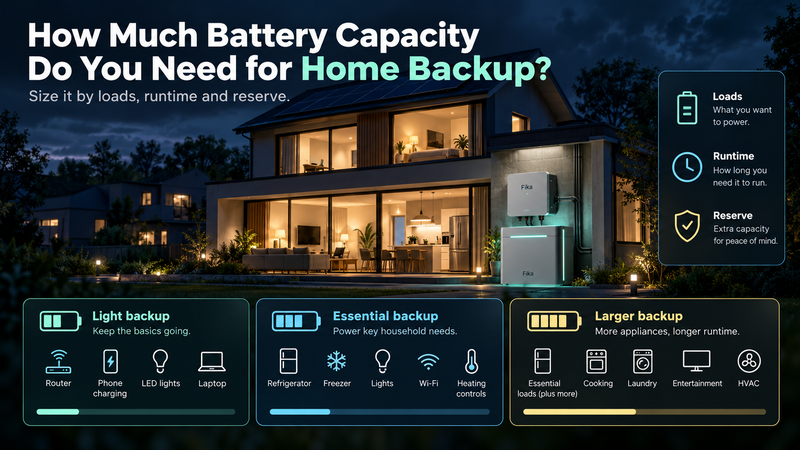
Home backup battery sizing sounds simple until you start listing everything you might want to keep running during an outage.
A few lights and a router need very little energy. A refrigerator, freezer and laptop need more. Add a well pump, heating controls, medical equipment or several hours of higher-power appliances, and the required battery capacity can increase quickly.
The useful question is not:
“How big should a home battery be?”
It is:
“Which loads must run, how long must they run, and how much reserve do I want?”
That turns home backup from a product-size question into an energy-budget problem.
For the broader battery-capacity framework:
https://medium.com/@volodymyrzh/battery-capacity-explained-mah-wh-amp-hours-decoded-1dc676be5a38
Start With the Loads You Actually Need
During a blackout, not every household device needs to stay powered.
The first step is to divide loads into categories.
Essential loads might include:
refrigerator;
freezer;
Wi-Fi router;
phone charging;
several LED lights;
laptop;
heating or boiler controls.
Optional loads may include:
television;
microwave;
coffee machine;
additional computers;
small kitchen appliances.
High-demand loads can include:
electric water heating;
electric cooking;
space heating;
air conditioning;
large pumps;
EV charging.
The difference between powering only essentials and attempting to run the entire home can be several times the battery capacity.
Calculate Energy, Not Just Appliance Watts
Appliance power is usually listed in watts.
Battery capacity is usually easier to compare in watt-hours or kilowatt-hours.
The basic relationship is:
Power (W) × time (h) = energy (Wh)
Suppose a refrigerator averages 100 W over the period being considered.
If it effectively consumes that average power for 10 hours:
100 W × 10 h = 1,000 Wh
or:
1 kWh
The same method can be applied to every load.
A more detailed single-device sizing method is here:
https://digitalowl.fika.bar/how-much-battery-capacity-does-a-device-need-01M2JVYX8GC5RDZQS859RWT5XB
The key is to estimate actual operating time rather than assume every appliance runs continuously at its maximum label wattage.
Light Backup: Communications, Lighting and Small Electronics
A light-backup system may be enough when the priority is simply to remain connected and functional during a short outage.
A simplified example could include:
Router: 15 W × 8 h = 120 Wh
Four LED lights: 40 W × 5 h = 200 Wh
Laptop: 60 W × 4 h = 240 Wh
Phone and small-device charging: 100 Wh
Total:
≈660 Wh
After allowing for conversion losses and some reserve, a system around 1 kWh of nominal battery capacity may be a reasonable planning starting point for this kind of limited backup scenario.
That is not a guarantee of eight hours of runtime. Real consumption and system efficiency can vary.
The purpose of the number is to establish an order of magnitude.
Essential Home Backup: Add Refrigeration
The next level is maintaining the household functions that become inconvenient or costly to lose during a longer outage.
Consider this planning example:
Refrigerator: 1,000 Wh
Freezer: 800 Wh
Router: 180 Wh
Lights: 300 Wh
Laptop and phones: 400 Wh
Heating controls / small circulation equipment: 400 Wh
Total:
≈3,080 Wh
Now add losses and reserve.
A nominal battery in roughly the 4–5 kWh range might be considered as a planning example for this type of essential-load backup.
The real requirement could be lower or much higher depending on appliance efficiency, climate, compressor cycling and outage duration.
This is why a household inventory is more useful than a generic statement such as “a 5 kWh battery is enough for a home.”
Larger Backup: More Loads and Longer Runtime
A larger system may be intended to support most essential household loads plus additional comfort appliances.
Suppose the daily energy budget includes:
Refrigeration: 2 kWh
Lighting and communications: 0.7 kWh
Computers and entertainment: 1 kWh
Heating controls or pumps: 1.5 kWh
Kitchen and miscellaneous loads: 1.5 kWh
Total:
≈6.7 kWh
With reserve and conversion losses, the required nominal storage might move toward 8–10 kWh or more.
Again, this is a planning range rather than a universal recommendation.
If the home relies heavily on electric heating, air conditioning, electric water heating or large pumps, the energy requirement can be substantially higher.
Outage Duration Changes Everything
A battery that comfortably supports a home for four hours may be far too small for a 24-hour outage.
If an essential load set consumes an average of:
300 W
then:
300 W × 4 h = 1.2 kWh
but:
300 W × 24 h = 7.2 kWh
The appliances have not changed.
Only the required duration has changed.
This is why runtime is one of the strongest drivers of battery size.
A useful way to think about the problem is:
Essential loads × expected outage duration = baseline energy requirement
Then add system losses and reserve.
Do Not Forget Usable Capacity
A battery may be advertised with a certain nominal capacity, but not every watt-hour necessarily becomes usable AC energy.
There can be:
inverter losses;
battery-management overhead;
standby consumption;
reserved battery capacity;
temperature-related effects;
other conversion losses.
So if your calculated load requirement is 4 kWh, choosing a battery labelled exactly 4 kWh leaves very little margin.
The required nominal capacity should usually be higher than the calculated energy demand.
How much higher depends on the system and its operating conditions.
Capacity Is Only Half the Sizing Problem
A home battery can contain enough energy for the planned outage and still fail to run a particular appliance if the inverter cannot provide enough power.
That is why you must also check:
continuous output power
and:
surge output power
For example, a 5 kWh battery might have plenty of stored energy, but if its inverter can supply only 1,200 W continuously, it may not support several high-power appliances operating together.
Portable power stations illustrate the same distinction clearly:
https://digitalowl.fika.bar/portable-power-station-capacity-explained-01M418WTCRZQBSBGP2JVK082W9
The three numbers answer separate questions:
Wh or kWh → how much energy is stored?
Continuous W → how much load can run normally?
Surge W → can the system handle short startup peaks?
Motors and Compressors Need Special Attention
Refrigerators, freezers, pumps and some HVAC equipment can briefly draw much more power during startup than during normal operation.
Suppose a pump normally consumes 700 W but requires a short 1,800 W startup surge.
A battery system with enough energy capacity but only 1,000 W of surge capability may not start it successfully.
This is why a home-backup plan should include both:
daily or outage energy requirement
and:
maximum simultaneous / startup power requirement
Ignoring either one can result in a system that looks large enough on paper but cannot support the intended loads.
Reserve Capacity Makes the System More Practical
Planning to use 100% of the expected battery energy leaves no room for uncertainty.
Real outages do not always end when expected.
Loads can change.
A refrigerator may cycle more frequently.
Someone may use an appliance that was not included in the original calculation.
For that reason, adding a reserve is often sensible.
A simple planning model might be:
Calculated load energy + system losses + reserve = target battery capacity
The reserve does not need to be the same in every situation.
A short urban outage with reliable grid restoration may justify a different reserve philosophy than a remote home where outages can last much longer.
Recharging Can Reduce the Required Stored Reserve
Battery size becomes easier to manage if the system can be replenished during an outage.
Possible charging sources include:
solar panels;
generator charging;
grid power during intermittent restoration;
another external charging source.
If the battery can reliably recover some energy during the outage, it does not necessarily need to store the entire multi-day energy requirement at once.
This is one of the key differences between a static battery-capacity calculation and a full energy-system calculation.
The broader relationship between storage sizing and renewable-energy systems is covered here:
The practical idea is simple:
storage capacity and recharge capability work together.
A larger battery increases the stored reserve.
Faster or more reliable recharging reduces how much reserve must be carried from the start.
Three Useful Planning Tiers
A simple way to begin planning is to think in three tiers.
Light backup
Typical focus:
router + phones + lights + laptop
Possible planning scale:
around 1 kWh
Essential backup
Typical focus:
light backup + refrigerator + freezer + critical controls
Possible planning scale:
roughly 4–5 kWh
Larger home backup
Typical focus:
most essential loads + additional appliances + longer runtime
Possible planning scale:
roughly 8–10+ kWh
These numbers are not product recommendations or guaranteed runtime figures.
They are examples that show how quickly storage requirements increase as more loads and longer durations are added.
The correct number comes from your own load list.
Build the Battery Size From the Home Backwards
The most reliable way to size home backup is to start with what the house needs rather than with a battery model.
Use this sequence:
1. List essential loads.
2. Estimate watts for each load.
3. Estimate how many hours each load must operate.
4. Convert each load into Wh or kWh.
5. Add the energy requirements together.
6. Account for conversion losses.
7. Add a reserve.
8. Check continuous and surge output requirements.
9. Consider whether solar or generator recharging will be available.
This creates a battery target based on the outage scenario rather than on marketing categories.
A small household protecting communications and refrigeration may need only a modest energy reserve.
A home trying to maintain heating, cooling, pumps and kitchen loads may need many times more.
That is why there is no single battery capacity that is “enough for a house.”
The right capacity depends on what must stay on, how long it must stay on, and how the battery can be recharged before the stored energy runs out.
Comments
No comments yet. Be the first to comment!