Phone vs Laptop Battery Capacity: Why mAh Alone Is Not Enough
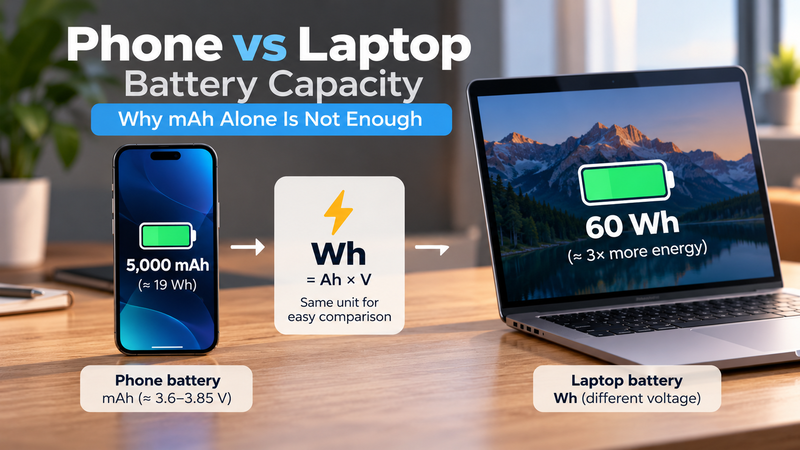
A phone may have a 5,000 mAh battery while a laptop is labelled 60 Wh. At first glance, those numbers are difficult to compare because they use different units.
The important point is that mAh measures electric charge, while Wh measures stored energy. To compare a phone battery with a laptop battery properly, voltage must be included.
For the broader battery-capacity framework:
https://medium.com/@volodymyrzh/battery-capacity-explained-mah-wh-amp-hours-decoded-1dc676be5a38
Why Phones Usually Use mAh
Smartphone batteries are commonly advertised in milliamp-hours because most phone cells operate within a relatively narrow voltage range.
A 5,000 mAh number is therefore useful when comparing two phones with similar battery chemistry and nominal voltage.
But mAh by itself does not describe energy.
A battery rated at 5,000 mAh stores different amounts of energy depending on its voltage.
For a deeper explanation of the unit:
https://digitalowl.fika.bar/what-is-mah-milliamp-hours-explained-simply-01M2GD3RKJD95V79BPHEW37S32
Why Laptops Usually Use Watt-Hours
Laptop batteries are more often described in watt-hours because laptops use battery packs with different voltages and cell configurations.
Wh includes both capacity in amp-hours and voltage:
Wh = Ah × V
This makes Wh much better for comparing batteries across different devices.
A 50 Wh laptop battery and a 70 Wh laptop battery can be compared directly in terms of stored energy even if their pack voltages are different.
For the unit itself:
https://digitalowl.fika.bar/what-is-a-watt-hour-wh-explained-simply-01M2GM471S7BVV7BQ4R37DEEAP
Voltage Is the Missing Part of the Comparison
Suppose a phone battery is rated at:
5,000 mAh
That equals:
5 Ah
If the battery operates at a nominal voltage of about 3.85 V:
5 Ah × 3.85 V = 19.25 Wh
So a 5,000 mAh phone battery contains roughly 19 Wh of energy.
Now compare that with a laptop battery rated at 60 Wh.
The laptop battery stores:
60 Wh ÷ 19.25 Wh ≈ 3.1
So the laptop contains a little more than three times the stored energy of the phone battery in this simplified example.
The voltage concept is explained in more detail here:
https://digitalowl.fika.bar/what-is-voltage-battery-voltage-explained-simply-01M2GH66XEB0MHMG3Z2Y7SNBEE
Why Comparing mAh Directly Can Be Misleading
Imagine a phone battery rated at 5,000 mAh and a hypothetical laptop battery rated at 5,000 mAh.
The numbers look identical.
But if the phone operates around 3.85 V and the laptop pack operates around 11.4 V:
Phone:
5 Ah × 3.85 V = 19.25 Wh
Laptop:
5 Ah × 11.4 V = 57 Wh
Both batteries have the same Ah rating, but the laptop stores almost three times as much energy.
This is why mAh is not a universal energy-comparison metric.
Convert Everything to Wh
When comparing batteries across device categories, the simplest approach is to convert both to watt-hours.
For mAh:
Wh = (mAh ÷ 1,000) × V
Example:
5,000 mAh at 3.85 V:
(5,000 ÷ 1,000) × 3.85 = 19.25 Wh
Once everything is expressed in Wh, phone, tablet, laptop and power-bank batteries can be compared on the same energy scale.
A Laptop Battery Has More Energy, But That Does Not Mean More Runtime
This is one of the most important distinctions.
Suppose:
phone battery: 19 Wh;
laptop battery: 60 Wh.
The laptop stores more than three times as much energy.
That does not mean the laptop will run three times longer.
Runtime depends on how quickly the device consumes energy.
A phone may average only a few watts during light use. A laptop may consume 10 W, 20 W, 40 W or much more depending on workload, brightness, processor activity, graphics load and connected hardware.
A bigger battery can therefore still produce shorter runtime if the device consumes energy much faster.
Capacity and Power Consumption Must Be Kept Separate
Battery capacity answers:
How much energy can the battery store?
Device power consumption answers:
How quickly is that energy being used?
A simplified runtime relationship is:
Runtime ≈ Battery energy ÷ Average power
If a 60 Wh laptop averages 10 W:
60 Wh ÷ 10 W ≈ 6 hours
If the same laptop averages 30 W:
60 Wh ÷ 30 W ≈ 2 hours
The battery has not changed. The load has.
This is why battery capacity alone cannot predict actual runtime.
Why Phone Runtime Can Look Better Despite a Smaller Battery
Phones are designed around aggressive energy management.
Processors change power states constantly. Screens dim or turn off. Background processes are limited. Radios, sensors and applications consume different amounts of power depending on use.
A phone might contain only around 15–20 Wh yet still operate for most of a day.
A laptop with 50–70 Wh may last a similar amount of time or less because its screen, processor, cooling system and other components can consume far more power.
Comparing runtime therefore requires both battery energy and realistic device consumption.
Example: 4,500 mAh Phone vs 50 Wh Laptop
Assume the phone battery is 4,500 mAh at 3.85 V.
Convert mAh to Ah:
4,500 mAh = 4.5 Ah
Then:
4.5 Ah × 3.85 V ≈ 17.3 Wh
The laptop battery stores 50 Wh.
Energy comparison:
50 ÷ 17.3 ≈ 2.9
The laptop stores almost three times as much energy.
But if the phone averages 2 W during a period of use:
17.3 Wh ÷ 2 W ≈ 8.7 hours
If the laptop averages 15 W:
50 Wh ÷ 15 W ≈ 3.3 hours
These are simplified calculations, but they demonstrate why more Wh does not automatically mean longer runtime.
Battery Labels May Use Different Voltages
Another complication is that devices may list battery specifications differently.
A smartphone may show mAh and nominal cell voltage.
A laptop may show Wh directly.
Some laptop batteries also list voltage and Ah.
If Wh is already stated, use it for cross-device comparisons.
If only mAh or Ah is available, you need the appropriate nominal voltage to calculate energy.
Do not assume the voltage of one battery simply because another device uses a similar chemistry.
What About Power Banks?
Power banks create the same comparison problem.
A 20,000 mAh power bank may contain around 74 Wh internally if its cells are rated near 3.7 V.
That makes it much larger than a typical phone battery but potentially similar in stored energy to some laptop batteries.
However, not all of that energy reaches the connected device because voltage conversion and charging introduce losses.
This is another reason Wh provides a better starting point than mAh when moving between different device categories.
The Practical Comparison Rule
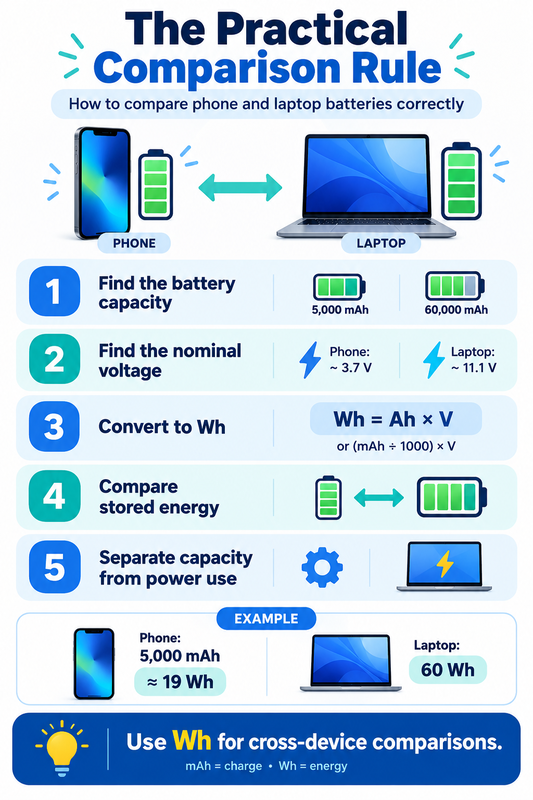
If you are comparing two phones with similar battery voltages, mAh can be useful.
If you are comparing a phone with a laptop, tablet, power bank or another battery system, use Wh.
The workflow is simple:
Find the battery capacity.
Find its nominal voltage if capacity is given in mAh or Ah.
Convert to Wh.
Compare stored energy.
Keep device power consumption separate from battery capacity.
The main mistake is treating mAh as if it were a direct measure of energy across every device.
It is not.
mAh tells you charge. Voltage tells you the electrical potential associated with that charge. Wh combines both into an energy value.
That is why watt-hours are the most useful common unit when comparing phone and laptop battery capacity.
Comments
No comments yet. Be the first to comment!