Battery Capacity for Camping and RV Use
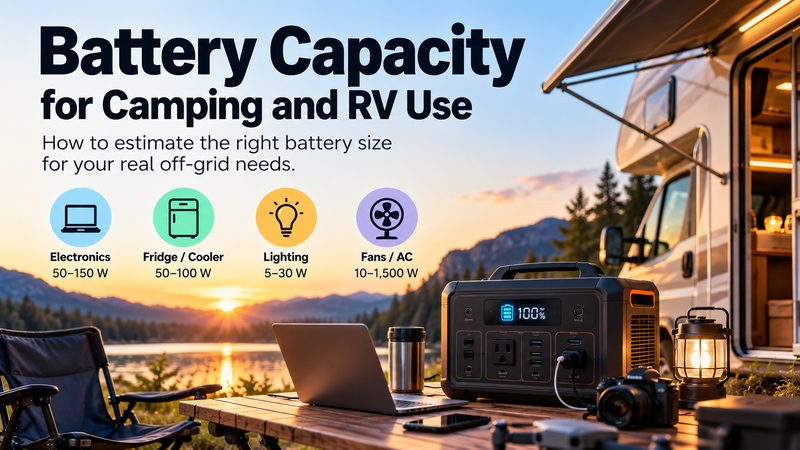
Battery sizing for camping or RV use is not really about choosing between a 1 kWh, 2 kWh or 4 kWh power station. The useful starting point is simpler:
How much energy will you use during one day away from the grid?
A weekend setup with LED lights, phones and a small fridge may need relatively little stored energy. Add laptops, cooking appliances, water pumps or air conditioning, and the requirement can grow quickly.
The practical approach is:
daily loads → daily Wh → days of autonomy → losses and reserve → battery capacity
For the broader battery-capacity framework:
https://medium.com/@volodymyrzh/battery-capacity-explained-mah-wh-amp-hours-decoded-1dc676be5a38
Start With a Daily Energy Budget
Camping and RV loads become easier to understand when every device is converted into watt-hours.
Power (W) × operating time (h) = energy (Wh)
Example:
LED lighting: 20 W × 4 h = 80 Wh
Laptop: 60 W × 3 h = 180 Wh
Phones and small electronics: 100 Wh
Portable fridge: 500 Wh/day
Fans: 30 W × 5 h = 150 Wh
Daily total:
80 + 180 + 100 + 500 + 150 = 1,010 Wh
That is roughly 1 kWh per day before inverter losses, standby consumption and reserve.
Refrigeration Often Runs All Day
A camping fridge or RV refrigerator may operate throughout the day, but its compressor does not necessarily run continuously.
Consumption depends on outside temperature, temperature setting, insulation, how often the fridge is opened, food temperature, ventilation and efficiency.
That makes measured daily Wh especially useful.
If a refrigerator uses:
500 Wh/day
then three days without recharging require roughly:
1,500 Wh
for refrigeration alone.
Electronics Are Usually Easier to Control
Phones, cameras, laptops, tablets and drones can often be scheduled rather than powered continuously.
Example:
Laptop: 180 Wh/day
Two phones: 40 Wh/day
Camera batteries: 50 Wh/day
Drone batteries: 120 Wh/day
Total:
390 Wh/day
These loads are also easier to reduce when battery reserve becomes low. You can delay drone charging, use the laptop less or charge devices while solar production is strongest.
Lighting Usually Has a Small Energy Cost
Modern LED lighting is relatively efficient.
For example:
15 W × 5 h = 75 Wh
Even:
30 W × 5 h = 150 Wh
Compared with refrigeration or air conditioning, lighting is usually a minor part of the daily energy budget.
Air Conditioning Changes the Scale
Air conditioning can completely change the calculation.
Consider an AC drawing:
800 W
For two effective hours:
800 W × 2 h = 1,600 Wh
For four hours:
800 W × 4 h = 3,200 Wh
That one appliance can use more energy than the entire basic camping setup.
This is why an RV without air conditioning may work with a modest battery, while AC backup can require several times more capacity.
Portable Power Station Capacity Is Only Part of the Decision
Camping setups often use portable power stations because they combine battery storage, inverter, charging electronics, AC outlets, DC outputs and USB ports.
But headline battery capacity is only one specification.
You also need to check continuous output and surge capability, especially for appliances such as coffee makers, pumps, cooking equipment or air conditioners.
More detail:
https://digitalowl.fika.bar/portable-power-station-capacity-explained-01M418WTCRZQBSBGP2JVK082W9
A large battery cannot run an appliance if the inverter cannot provide enough power. A high-output power station with limited Wh may run it successfully but only briefly.
Days of Autonomy Multiply the Requirement
Suppose your campsite uses:
1.2 kWh per day
One day without recharging:
≈1.2 kWh
Two days:
≈2.4 kWh
Three days:
≈3.6 kWh
before losses and reserve.
Trip duration therefore matters almost as much as the device list.
Solar Can Reduce the Stored Energy You Need
Suppose the setup consumes:
1.2 kWh/day
and solar delivers:
800 Wh/day
The daily battery deficit becomes:
1,200 Wh − 800 Wh = 400 Wh
The battery is now losing roughly 400 Wh per day rather than the full 1.2 kWh.
This can dramatically extend the time between full recharges.
More on solar replenishment and battery sizing:
https://digitalowl.fika.bar/how-solar-recharging-changes-battery-capacity-needs-01M3PGEW71ED2G597CTNXN0BG3
But solar should be treated as variable energy rather than guaranteed daily production.
Weather Changes the Solar Contribution
Suppose daily consumption is:
1,200 Wh
Good-day solar production:
900 Wh
Battery deficit:
300 Wh/day
Cloudy-day solar production:
300 Wh
Battery deficit:
900 Wh/day
The same battery can therefore last much longer under one weather pattern than another. Reserve capacity protects against this uncertainty.
A Simple Weekend Camping Example
Consider a two-day trip:
Fridge: 500 Wh/day
Lighting: 80 Wh/day
Laptop and phones: 250 Wh/day
Fans and miscellaneous loads: 170 Wh/day
Daily total:
1,000 Wh
For two days without recharging:
2,000 Wh
After allowing for losses and reserve, a battery around 2.4–2.8 kWh could be a comfortable planning range for this example.
If reliable solar contributes several hundred Wh each day, the required initial storage could potentially be lower.
A More Demanding RV Example
Now add higher-demand appliances:
Fridge: 600 Wh/day
Lighting and electronics: 500 Wh/day
Water pump and miscellaneous loads: 200 Wh/day
AC: 2,400 Wh/day
Total:
3,700 Wh/day
or:
3.7 kWh/day
For two days without meaningful recharging:
7.4 kWh
Most of the increase comes from one load: air conditioning.
This is why identifying optional high-power appliances quickly reveals the scale of the required RV battery system.
Load Management Can Be Better Than More Battery
Increasing storage is not the only way to extend off-grid runtime.
You can also:
use fans instead of AC when practical
charge devices while solar production is strong
turn off unnecessary lighting
avoid high-power cooking from the battery
reduce fridge opening frequency
switch off inverter-powered loads when not needed
Saving just:
200 Wh/day
over five days saves:
1,000 Wh
or:
1 kWh
That can be equivalent to carrying significantly more battery capacity.
Build the Battery From the Trip Backwards
Use this sequence:
1. List every electrical load. Include both small continuous loads and large occasional ones.
2. Estimate daily operating time. Do not assume every device runs continuously.
3. Calculate daily Wh.
Watts × hours = Wh
4. Multiply by days of autonomy. Decide how long you need to operate without reliable recharging.
5. Estimate solar replenishment separately. Do not assume perfect weather.
6. Add losses and reserve. Nominal capacity is not the same as delivered usable energy.
7. Check inverter power. High-power appliances and startup surges must remain within system limits.
The Best Camping Battery Size Comes From the Daily Energy Budget
There is no single ideal battery capacity for camping or RV use.
A minimalist setup may need only a modest power station. A full RV with refrigeration, computers, pumps and air conditioning may require several kilowatt-hours.
The useful calculation is:
daily energy × required autonomy
then adjust for:
solar replenishment + losses + reserve
Start with the devices you will actually use, build a realistic daily Wh budget, and then decide how much energy must be stored versus how much can be replenished while you travel.
Comments
No comments yet. Be the first to comment!